
What if a gene program evolved that could predict the future? Would organisms use it to boost their reproductive success? Recent work from the MCB lab of Craig Hunter sheds new light on how experience—especially nutritional and environmental stress—can be inherited across generations through non-genetic mechanisms.
The Hunter lab investigates how specific experiences are transmitted to progeny. To leverage the powerful genetic tools in C. elegans, the team sought a system that would enable the measurement of inherited adaptive traits in individual animals and be ecologically and evolutionarily significant. In the wild, C. elegans live an unpredictable “boom-bust” life, determined by food availability, such as bacteria on rotting plant matter. Not only is the presence of food ephemeral and unpredictable, but different bacterial species also have different nutritive value.
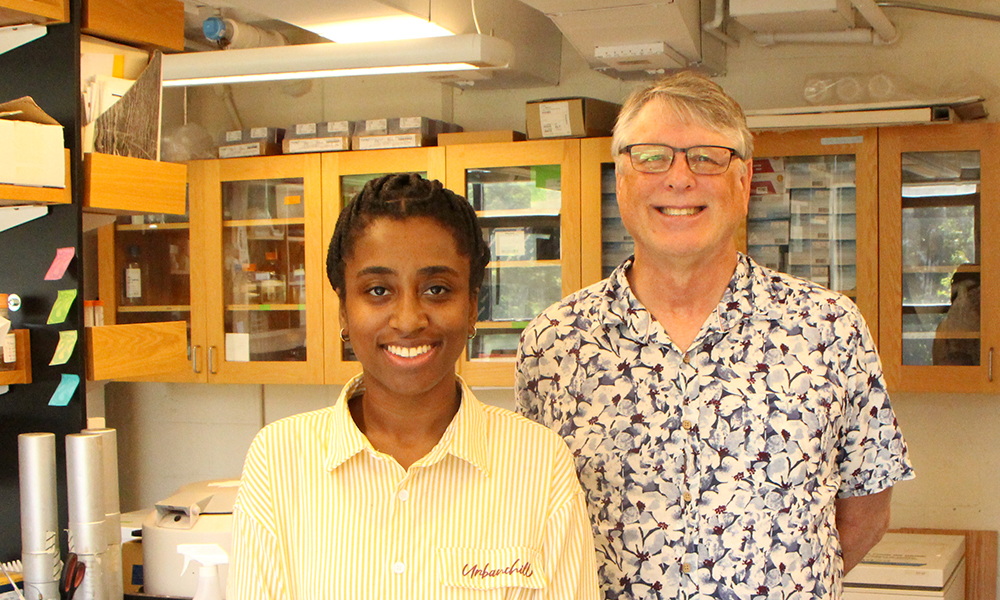
To study heritable responses to food change, Alexandria (Ali) Pete, a graduate student in Craig Hunter’s lab, developed a protocol to measure reproductive fitness on different bacterial foods. Her findings, recently published in Nature Communications, revealed surprising patterns.
C. elegans hermaphrodites produce both sperm and oocytes, so a single animal can give rise to a whole brood without males. Pete identified several different bacterial species that, when provided as a new food source, dramatically reduced brood size. Through a series of experiments, she demonstrated that certain bacteria impaired sperm function, while others impacted oocytes. Remarkably, after maintaining animals on these bacteria for 5–10 generations, their reproductive capacity recovered—they adapted to the new diet, and did so in a stepwise fashion, with brood sizes increasing generation to generation. Furthermore, the speed of adaptation increased when the exposure per generation was lengthened. Yet, adaptation came at a cost: in 9 or 12 unique combinations, animals that had adapted to the new food were found to be maladapted to their original diet.
To investigate this reciprocal adaptation-maladaptation, Pete crossed animals fully adapted to different food sources with each other. She then asked: Would the cross progeny fare better on the mother’s or the father’s diet? She found that when both parents were adapted to foods that initially impaired sperm, the offspring thrived on the father’s diet (sperm-transmitted adaptation). When that adaptation was related to oocytes, the offspring did better on the mother’s diet (oocyte-transmitted adaptation).
One hypothesis suggested by these observations is direct transmission of adapted phenotypes. That is, adapted sperm or oocytes transmit the adapted phenotype directly to their progeny. Other hypotheses that invoke established mechanisms for transmitting epigenetic information between generations, such as non-coding RNAs, histone modifications, or even prions, are also compatible with the observations and will be investigated in follow-up experiments.
Pete’s work not only provides a powerful system for dissecting non-genetic inheritance in a genetically tractable model, but also challenges conventional thinking about adaptation. In C. elegans, it’s not just the genes you inherit – it’s also the experiences your ancestors survived.