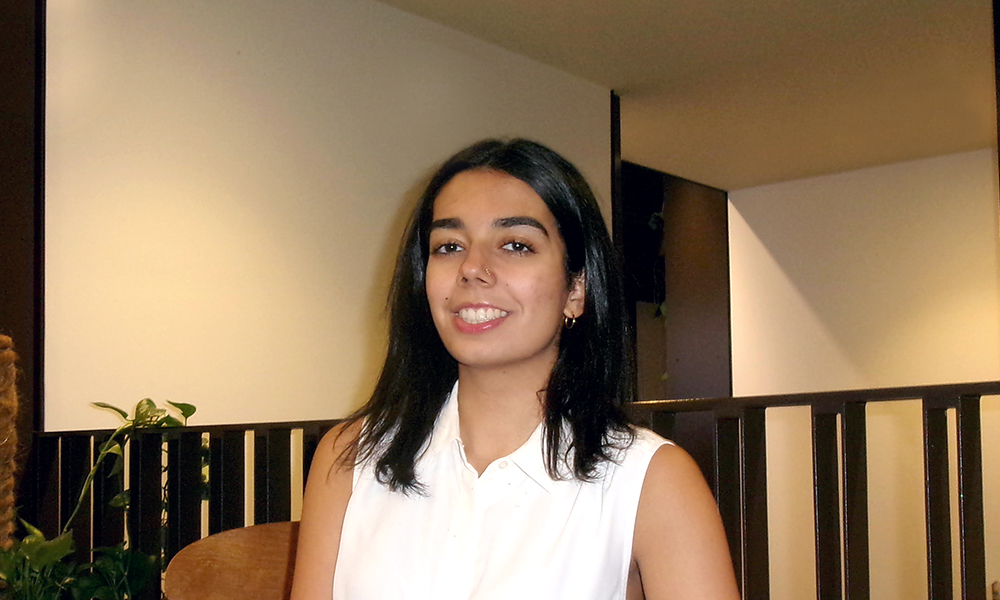

Harvard College senior Fajr Khan, a neuroscience concentrator whose work spans maternal mental health, child psychology, and the biological foundations of psychiatric illness, has been selected as a 2025 Rhodes Scholar representing Pakistan. Khan—whose academic and personal mission centers on improving mental-health care for vulnerable populations—will continue this work at the University of Oxford, where she plans to pursue graduate training in psychiatry research, experimental psychology, or clinical and therapeutic neuroscience.
Khan’s research interests have crystallized around a central question: How can biological insights into mental illness improve treatment and reduce stigma—particularly for mothers and children? This blend of scientific inquiry and human-centered care has shaped her time at Harvard and now guides her long-term goal of becoming a clinical psychologist who also leads translational research.
Khan conducts independent research in Harvard’s Postpartum Traumatic Stress Disorders Lab, led by Sharon Dekel, where she studies maternal mental health in both prenatal and postpartum contexts. Her work includes analyzing SSRI use in mothers, contributing to longitudinal mental-health data, and supporting a neuroimaging study designed to understand the neural correlates of postpartum experiences.
One of her most formative roles has been working on the Harvard-MGH BIRTH Study, an NIH-funded study aimed at identifying the course and predictors of childbirth-related PTSD and its effects on the child, and establishing the foundation for preventive and holistic care for both mother and child. Khan regularly visited the postpartum unit—often within a day of delivery—to survey new mothers and document their early mental-health experiences.
“Talking to mothers just after they’ve given birth gives you a real sense of how complex and vulnerable that time can be,” she reflected. “It’s shaped my understanding of why maternal mental health needs more research, more attention, and more structural support.”
Khan also contributes to youth mental-health projects at Harvard Medical School’s Mental Health for All Lab, where she works on efforts to expand psychological care by training frontline workers. These experiences have sharpened her desire to integrate clinical practice with rigorous research.
Khan applied for the Rhodes not simply for the prestige, but because the scholarship emphasizes mission-driven work.
“I’m driven by the idea of improving well-being, and this scholarship gives me the opportunity to keep working toward that—to study, to research, and hopefully to make a difference,” she explains.
She is currently applying to research-intensive master’s programs in psychiatry, experimental psychology, and clinical and therapeutic neuroscience at Oxford—each offering opportunities to deepen her understanding of mental illness while training in methods she intends to bring back to clinical work.
Khan’s advisor at Harvard, Kristina Penikis, PhD, Concentration Advisor and Lecturer in Neuroscience, notes that her path to clinical psychology emerged from deep exploration and introspection:
“Fajr entered the Neuro concentration with diverse interests, exploring paths from premed to a joint with Philosophy,” she says. She would have excelled in any of these fields, but the pieces fell together during her junior year. “Clinical psychology offers an ideal combination of her strengths, allowing her to pursue both academic inquiry and human-facing care. Broad exploration of courses and extracurriculars led her to this discovery, but it wouldn’t have happened without her capacity for self-reflection and a steady confidence in her core values. I’m delighted she discovered such a fitting path, one where she will make a difference in both individuals’ lives and structurally.”
After Oxford, Khan hopes to pursue a PhD in clinical psychology, conducting research that informs early interventions for both youth and perinatal populations. Her ultimate goal is to bridge scientific understanding and clinical practice—translating neuroscience into real-world psychiatric care.
“I want to use biological insight to improve treatment and reduce stigma,” she said. “Mental health is deeply human, and science can help us understand it in ways that change people’s lives.”
The MCB community congratulates Fajr Khan on this remarkable achievement and looks forward to seeing the impact of her future work.