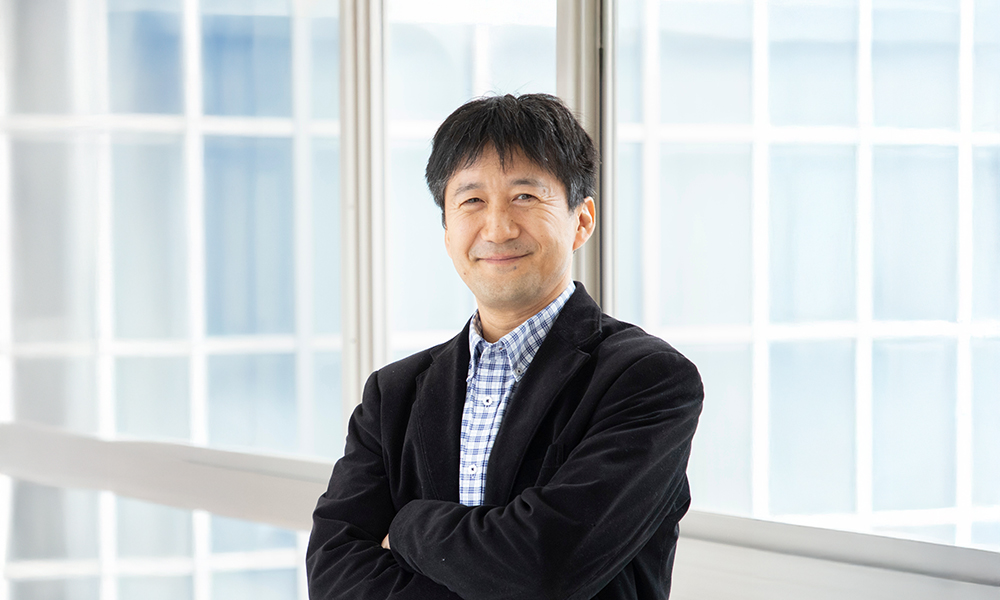

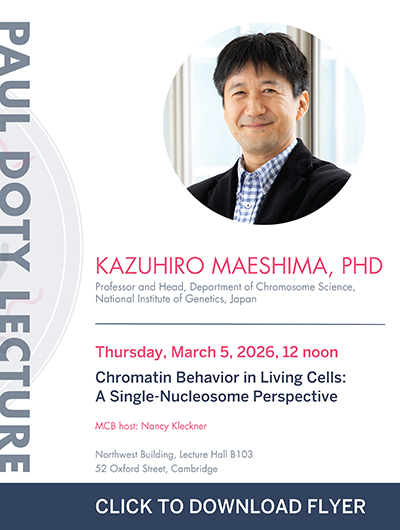
The Department of Molecular and Cellular Biology is pleased to announce this year’s Paul Doty Lecture, featuring renowned chromosome biologist Kazuhiro Maeshima of Japan’s National Institute of Genetics whose innovative work has reshaped how scientists think about chromatin organization inside living cells.
The lecture will be held on Thursday, March 5th, at 12 PM in the Northwest Building, Room B103.
Chromosomes are the repositories of our genetic material and thus fundamental to life. Yet despite decades of study, many of their most basic physical and functional properties remain poorly understood. Dr. Maeshima is one of only a handful of researchers worldwide who investigates the nature and behavior of chromatin and chromosomes directly in living cells—bringing an “outside-the-box” approach to longstanding biological puzzles.
Rethinking the Structure of Chromatin
Early in his independent career, Dr. Maeshima overturned a long-standing dogma in molecular biology: the idea that chromatin—the DNA/nucleosome fiber—forms a regular 30-nanometer filament. That model, widely accepted for years, was based largely on in vitro experiments performed under low-salt conditions.
Through careful in vivo analysis, Dr. Maeshima demonstrated that the 30-nanometer structure is in fact, an artifact of those experimental conditions. Instead, chromatin fibers in living cells are interdigitated and organized in a more irregular, droplet-like configuration. This work fundamentally changed how scientists visualize the physical organization of the genome.
His lab’s emphasis on real-time imaging of single nucleosomes has further transformed the field. By observing chromatin dynamics directly in living cells, Dr. Maeshima and his colleagues discovered that chromatin behaves in a remarkably fluid, “liquid-like” manner—an insight that has opened new ways of thinking about genome function and regulation.
New Perspectives on Old Questions
Viewing chromatin as a dynamic, fluid material rather than a rigid filament has allowed Dr. Maeshima to re-envision solutions to longstanding questions in chromosome biology, including:
- Why do different regions of the genome replicate at different times?
- How does linker histone H1 promote chromatin compaction?
- Are euchromatic and heterochromatic regions truly more and less compact, as traditionally described?
- What features of chromosomes determine their physical properties during the cell cycle, or in aberrant cellular states such as disease?
By integrating advanced imaging, biophysics, and molecular biology, Dr. Maeshima continues to probe how structural organization gives rise to functional outputs in the genome.
A Career Shaped by Radical Thinking
Dr. Maeshima first became fascinated by DNA as an undergraduate at the University of Tsukuba. He earned his PhD at Osaka University in the laboratory of Toshihiro Horii, where he studied DNA–protein interactions involving the recombination protein RAD51.
He then carried out postdoctoral work with Uli Laemmli, internationally known not only for the development of SDS-PAGE but also for influential models of mitotic chromosome organization. Dr. Maeshima has credited Laemmli with encouraging “free and radical thinking,” a mindset that would become a hallmark of his scientific career.
After returning to Japan, Dr. Maeshima worked with Naoko Imamoto at RIKEN before joining the National Institute of Genetics in Mishima, Japan, where he is now Professor and former Department Head of Chromosome Science.
Honoring Paul Doty’s Legacy
Paul Doty was the Mallinckrodt Professor of Biochemistry Emeritus and also Director, Emeritus, of the Belfer Center for Science and International Affairs, which he founded at the John F. Kennedy School of Government in 1974. As a biochemist, Doty elucidated the structure and function of large molecules, ranging from the polymers in plastics and fibers, to polypeptides and polynucleotides. He is perhaps best known for demonstrating the denaturation of the double-stranded DNA molecule and its reuniting through hybridization, a technique that helped open the era of recombinant DNA research.
As an advocate for arms control, Doty led and participated in many initiatives to bring Russian and American scientists together in pursuit of international security, making more than 40 trips to the Soviet Union. He was a member of the President’s Science Advisory Committee (PSAC) during the Kennedy Administration. After retirement, he continued his work in this area, including serving as a board member of the Soros International Science Foundation that provided critical research support to Russian scientists in the 1990s. He passed away on December 5, 2011.
Paul Mead Doty (1920-2011) Science Retrospective, PDF
by Matthew Meselson