

A new study co-led by MCB’s Kazuki Nagashima and published in Science Immunology (PDF) identifies plant-derived molecules that help quiet the immune system, preventing inflammatory reactions to the foods we eat every day.
From an evolutionary standpoint, the immune system is designed to recognize foreign proteins and respond with inflammation. Yet every meal introduces thousands of foreign molecules into the body without triggering immune attack. This long-recognized phenomenon—known as immune tolerance to food—has puzzled researchers for decades.
Scientists have known that the immune system actively suppresses responses to dietary proteins, but the specific food molecules responsible for initiating that suppressive response remained unknown.
The research, co-led by Nagashima during his postdoctoral work in the lab of Michael Fischbach at Stanford University in collaboration with the Elizabeth Sattely lab, identifies one answer: plant seed storage proteins. The study shows that proteins found in common foods such as corn and soybeans can actively dampen inflammation in the immune system.
“The project is about immune response to a food diet,” Nagashima explained. “Immune response can go in two directions. One is inflammation—for example, when you get an infection. The other direction is a suppressive immune response.”
Under normal circumstances, Nagashima said, the immune system responds to food in this second way. “In usual circumstances, when we eat food, it is a suppressive type of immune response,” he said. “That’s why we don’t show any inflammation to our normal diet.”
Searching for the molecules behind immune tolerance
Most previous research on immune responses to food has focused on allergens—substances such as peanuts or gluten that provoke inflammation in susceptible individuals.
“But people only characterized allergens,” Nagashima said. “People didn’t know what ingredient or what molecule in food induced a suppressive type of immune response.”
The new study identified seed storage proteins as key players in promoting immune tolerance. These proteins are abundant in the edible portions of plant seeds, including staple crops such as corn and soybeans.
Nagashima and his colleagues found that molecules derived from these proteins could dampen inflammatory responses in the immune system when eaten. This discovery provides a molecular explanation for why the immune system normally tolerates dietary proteins rather than responding to them as threats.
A discovery rooted in mouse diet research
The researchers initially identified these suppressive molecules while studying the composition of mouse chow—the standardized diet commonly used in laboratory studies.
Unlike human diets, mouse chow is highly simplified and consists of only a handful of ingredients, such as soybean, corn, wheat, oats. Because of this simplicity, the diet provided an ideal starting point for identifying immune-modulating components.
By systematically examining the ingredients, the team was able to pinpoint molecules derived from plant seeds that actively suppressed inflammatory immune responses.
Expanding the search to human diets
Nagashima is now extending these findings to more complex diets that resemble what people actually eat. In his current work, researchers in his lab prepare meals containing common foods and feed them to mice while monitoring immune responses. “We are trying to find the suppressive molecule from our diet,” he explains.
To do this, the team assembled a set of the most commonly consumed food ingredients and systematically tests them to identify which components help regulate immune activity.
“These are about 20 of the most commonly consumed ingredients in a human diet,” Nagashima said. “We give these to mice and try to find which ingredient—and exactly which proteins—are suppressing allergic responses.”
Although the experiments are conducted in mice, the goal is to uncover dietary molecules that may influence immune regulation in humans as well.
A new direction for the lab
The project represents an important new research direction for Nagashima’s lab. Leading the effort is Lisa Tilokani, who is spearheading the work.
By identifying natural dietary compounds that promote immune tolerance, the research could eventually help scientists better understand—and potentially treat—conditions such as food allergies and inflammatory diseases.
We got the cover!
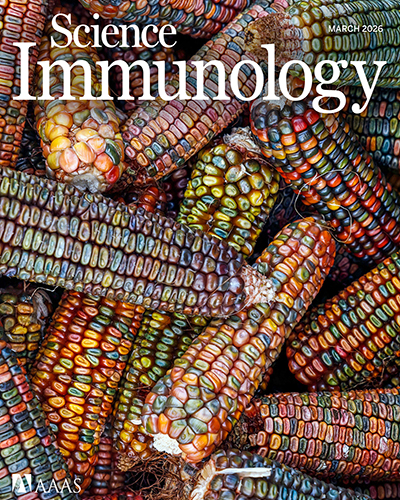
Immunity Gets a “Grain Check.” Immune tolerance to dietary antigens is essential to prevent food allergies and other digestive disorders, but the food-derived antigens that contribute to tolerance are poorly described. Blum et al. mapped the dietary epitopes recognized by food-responsive T cell receptors expressed on murine intestinal regulatory T (Treg) cells. Seed storage proteins from corn, wheat, and soy, including the maize protein αZein, were targets of Treg cells that could suppress antigen-specific T cell responses. This month’s cover features an image of flint corn, a frequently colorful variant of maize (Zea mays), that contains an immunodominant food epitope recognized by Treg cells.
Credit: Andreas Häuslbetz/Alamy.
 (PDF)
(PDF)