
Department News

Konrad Bloch Lecture to Feature Ruth Lehmann on Engineering RNA-Specific Translation

Konrad Bloch Lecture to Feature Ruth Lehmann on Engineering RNA-Specific Translation

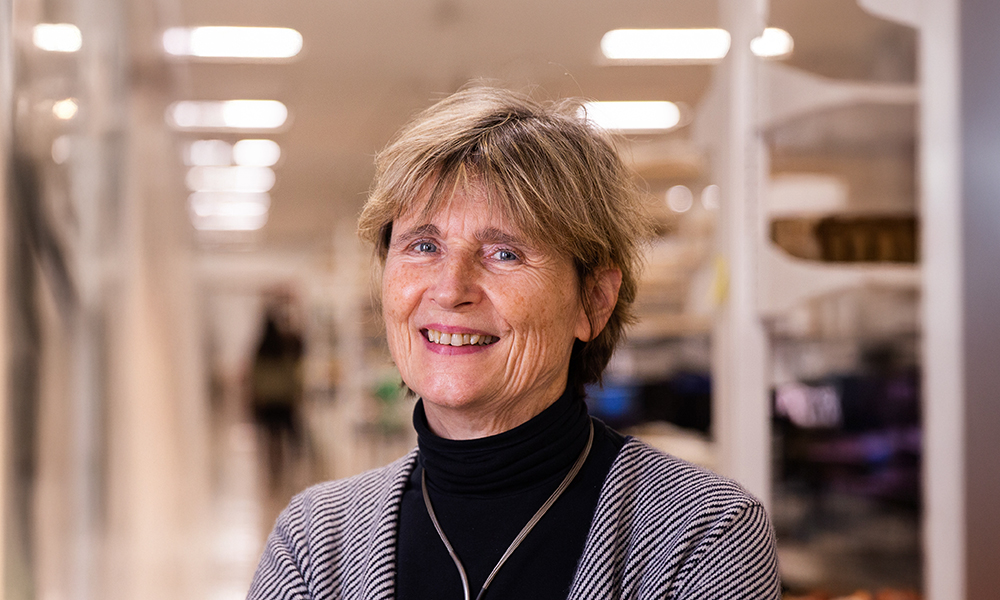
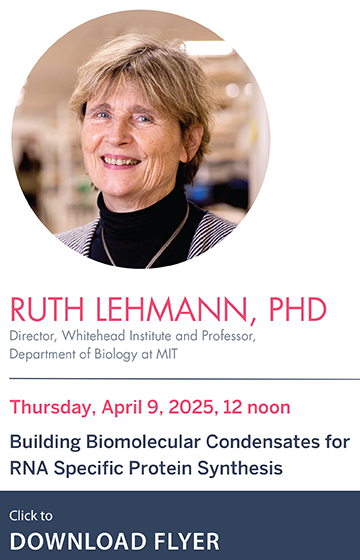
The Department of Molecular and Cellular Biology (MCB) is pleased to announce the upcoming Konrad Bloch Lecture, featuring Ruth Lehmann, Director of the Whitehead Institute and Professor in the Department of Biology at MIT, on April 9 at 12:00 PM.

The lecture, titled “Building Biomolecular Condensates for RNA Specific Protein Synthesis,” will be hosted by Catherine Dulac, Xander University Professor, and held in Lecture Hall B103, Northwest Building (52 Oxford Street, Cambridge).
Lehmann, a leader in the study of germ cell biology and RNA regulation, will present new insights into how cells use biomolecular condensates—membraneless compartments that organize molecules in space and time—to control gene expression. These dynamic structures play a critical role in regulating cellular processes by concentrating specific components to modulate biochemical reactions and responses.

“Throughout her career, Professor Ruth Lehman has conducted pioneering research in cellular and developmental biology,” said Dulac. “Using drosophila as a model system, her lab has addressed the fundamental question of how germ cells, which differ from all the other cells in the organism by their ability to stay totipotent and transmit to the next generation, acquire and maintain their identity among somatic tissues. Professor Lehman’s research uncovered myriads of novel and unexpected molecular and cellular processes underlying germ cell development and these findings have been truly transformative in the field. In addition, she also held significant leadership roles as the head of the Skirball Institute and Chair of the Department of Cellular Biology at NYU and currently as the Director of the Whitehead Institute at MIT. It is a very special treat for MCB to host her as this year Bloch Lecture speaker.”

The Konrad Bloch Lecture series honors the legacy of Nobel laureate Konrad Bloch and brings leading scientists to Harvard to share pioneering research with the MCB community.

All are welcome to attend.


About the Konrad Bloch Lecture

The Bloch lecture, sponsored by Pfizer, honors Harvard faculty member and Nobel-prize recipient Konrad Bloch (1912-2000), a pioneer in the field of cholesterol and lipid metabolism. 
Konrad E. Bloch was an outstanding scientist who helped shape the discipline of biochemistry in its formative years.  One of the founders of biochemical studies at Harvard, he was part of the pioneer generation that included George Wald, Paul Doty, John Edsall and Frank Westheimer. Best known for his studies of cholesterol, he was awarded the Nobel Prize in Medicine or Physiology in 1964 (shared with Feodor Lynen) for investigations in the mechanism and regulation of cholesterol and fatty acid metabolism. Especially noteworthy were the studies on the biological synthesis of the molecule and, according to the Nobel Prize website, “on various aspects of terpene and sterol biogenesis…enzymatic formation of unsaturated fatty acids and…in various aspects of biochemical evolution.”
Arriving at Harvard from the University of Chicago in 1954, he was appointed Higgins Professor of Biochemistry, a position he held until his retirement in 1982. He was part of the core group at Harvard that founded the Committee on Higher Degrees in Biochemistry. With the somewhat later arrival of James Watson, Matthew Meselson, Walter Gilbert, Mark Ptashne and Guido Guidotti, Harvard had achieved a remarkably dynamic and productive core group in biochemistry and molecular biology, of which Dr. Bloch was a signal part. The late Dean Jeremy Knowles described him as “a marvelously perceptive biochemist and a wise, generous and cultivated man who forged the connections between chemistry and biochemistry. He was one of that distinguished line of European biochemists whose deep understanding of metabolism laid the chemical foundations of today’s biology.” [quoted in Harvard Gazette, Oct. 19, 2000]
Dr. Bloch was born in Neisse, then part of Germany, in 1912; he was racially excluded from his studies at Munich in 1934 upon the Nazi advent to power. His subsequent odyssey began in Switzerland, and he was spared a likely fatal return to Germany by the intervention of John Anderson, a Yale biochemist, who helped him with a visa to the US. In America, his studies resumed at Columbia; after a brief stay in Chicago, he came to Harvard.
His work was widely recognized; in addition to the Nobel, he received the US National Medal of Science, and many other awards and honorary degrees. In addition to his scientific output, he wrote intriguing popularizing works such as “Blondes in Venetian Paintings, the Nine-banded Armadillo, and Other Essays in Biochemistry”. He died in 2000, at the age of 88. In 1986, the annual Konrad Bloch lecture was inaugurated in his honor.

The author wishes to express his gratitude to Prof. Guido Guidotti for reviewing the text for accuracy.

by Jim Henle


X Share on X Bluesky Share on BlueSky
Ruth Lehmann

Ruth Lehmann