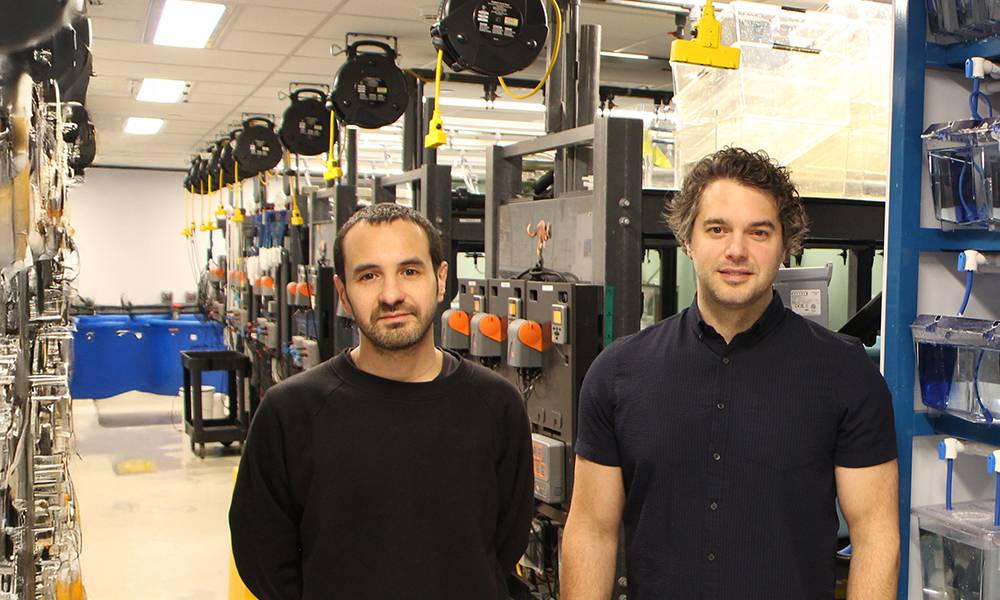

A new study (PDF) from the MCB lab of Nicholas Bellono reveals an unexpected sensory mechanism underlying octopus reproduction—showing that a specialized arm used for mating is also a finely tuned chemical sensing organ that enables animals to identify and engage appropriate mates, even in complete darkness.
Led by postdoctoral fellow Pablo Villar del Rio, the work began with a deceptively simple question: what role do chemosensory receptors play in octopus arms? These receptors, previously identified by the Bellono lab, are known as “chemo-tactile receptors” because they require physical contact to detect chemical signals. While studying their distribution, Villar del Rio noticed that these receptors were highly expressed in the male octopus’s hectocotylus—the specialized arm used to transfer sperm.
“That was surprising,” Villar del Rio said. “Why would they have that receptor there if this is the arm they use for transferring sperm cells?”
To investigate, the team designed a laboratory setup to observe octopus mating behavior under controlled conditions. Because octopuses can be aggressive, the researchers initially separated males and females with a perforated divider, allowing the animals to interact safely by reaching through small openings. Crucially, the divider was opaque, preventing any visual cues.
What happened next was unexpected.
“They mated through the divider just by touching—just using chemical information,” Villar del Rio said. The animals successfully engaged in mating behavior without ever seeing one another, relying entirely on chemical signals detected through contact. The finding provided direct experimental evidence that chemosensation alone can guide critical aspects of octopus reproduction.
“I think the surprise to us was that they were able to mate through the openings in the wall with no visual information,” he added. “It was very clear that this is chemosensory—they’re using chemical cues.”
Building on this observation, the study goes on to characterize the full sensory system: from the receptors expressed in the mating arm, to the chemical signals likely released by females, to the neural and behavioral responses that guide mating. The work suggests that the hectocotylus is not simply a reproductive appendage, but a dual-function organ that integrates sensation and action.
Beyond identifying the mechanism, the study offers a broader conceptual advance. By linking behavior, physiology, and molecular biology, it provides a framework for understanding how animals recognize appropriate mates—and how those processes may shape species boundaries.
“This is an exceptional study from Pablo,” said Bellono. “It started with his curious observation that octopuses can mate in the dark, to discovering that the specialized male arm for mating is actually a sensory organ, to finding the molecules it detects from the ovaries to mediate mating, to uncovering the receptors, to describing the evolutionary history.”
Bellono emphasized the interdisciplinary scope of the work, which spans behavioral experiments, receptor biology, and comparative analyses across species.
“It spans behavior, physiology, single nuclei sequencing, continents for comparative biology, structural biology—it’s super impressive,” he said. “But I think the most impactful aspect is that it provides a conceptual framework from which we can rigorously explore how mate detection contributes to reproductive isolation, cross-species mating, and the origins of new species—among the most important questions in biology.”
Indeed, the findings suggest that chemical sensing during mating may play a critical role in ensuring species specificity. While octopuses are known to use visual displays to locate potential mates in the wild, this study shows that final mate recognition—and the decision to proceed with reproduction—can depend entirely on chemical cues.
“We described the whole system,” Villar del Rio said, noting that the receptors in the arm detect the sensory information needed “to guide the behavior and find the right mate.”
The discovery raises new questions about the evolution of sensory systems and reproductive strategies. Rather than evolving entirely new structures, octopuses appear to have adapted existing appendages by embedding them with specialized molecular machinery, allowing them to perform multiple functions.
For the Bellono lab, which has been at the forefront of uncovering novel sensory modalities in cephalopods, the study represents a significant step forward in understanding how animals interact with their environment—and each other—through touch and chemistry.
As Villar del Rio’s work shows, even in the absence of light, complex behaviors like mating can be orchestrated with remarkable precision, guided by signals that are invisible but deeply informative.
 (PDF)
(PDF)
We got the cover!
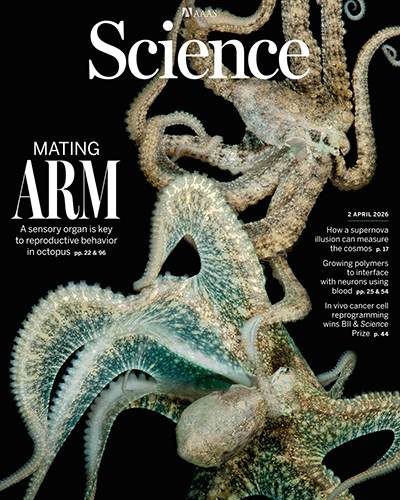
Animals rely on sensory cues to choose mates before reproduction. Male octopuses use a specialized arm that acts as both a sensory and reproductive organ to navigate the female’s mantle, locate oviducts, and transfer sperm. These findings reveal how sensory systems shape reproductive behavior and drive speciation. This image shows courtship during mating. Credit: Roy Caldwell/TONMO.com