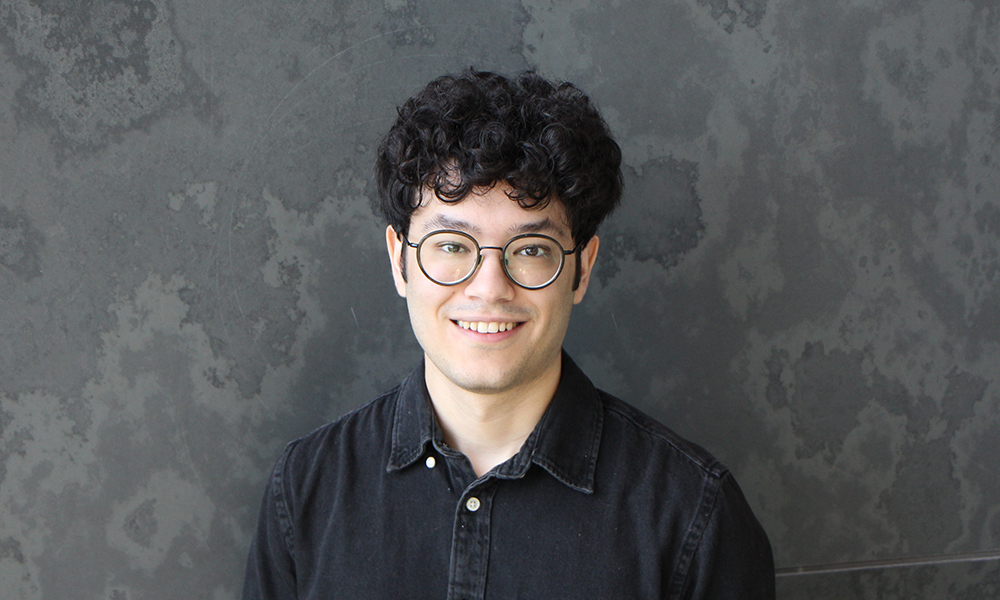

Arshia Mostoufi, an MCO PhD candidate in the lab of Ya-Chieh Hsu in Harvard’s Department of Stem Cell and Regenerative Biology, has received a prestigious doctoral fellowship from the Canadian Institutes of Health Research (CIHR).
The competitive fellowship supports Canadian doctoral students conducting outstanding research in Canada and abroad. Similar in purpose to the National Science Foundation Graduate Research Fellowship or the NIH F31 fellowship in the United States, the award provides funding to help support doctoral research and training.
“It is offered to Canadian doctoral students, who are either studying in Canada or abroad,” said Mostoufi, a Canadian citizen. “I’m grateful that Canada and CIHR are willing to invest in my research and my career.” The fellowship will provide approximately 40,000 Canadian dollars annually toward Mostoufi’s graduate stipend.
Mostoufi, now in his third year of graduate school, will use the fellowship to continue investigating how neuronal signals in the stomach affect gastric homeostasis and disease.
“The stomach is a remarkable organ,” he explained. “It’s constantly exposed to the outside world, like everything we eat and drink, so on top of digesting food, it has to defend the body against harmful substances and microbes. To do that, it has to be able to sense its environment and respond appropriately.”
“That ability to sense and respond may depend, at least in part, on the nervous system. Interestingly, the stomach is a densely innervated organ,” he said. “I’m interested in how the nervous system communicates with the stomach, helping it maintain homeostasis and protect us against disease.”
Mostoufi is driven by a desire to understand how the body’s own physiology shapes health and disease. “The connection between the nervous system and our internal organs is something we’re only beginning to appreciate,” he said. “I hope this work will reveal new insights into how our tissues sense and respond to the world around us to stay healthy.”
That curiosity about how the outside world shapes our biology is also what drew Mostoufi to the Hsu lab. Although the Hsu lab is best known for its work in stem cell biology and tissue regeneration, its broader research interests in how environmental factors influence health strongly attracted him. “I was really interested in joining this lab because it really tries to understand how the environment impacts us,” he said. “If you think about most diseases, they actually come from our lifestyles and our interface with the environment.”
Rather than focusing solely on genetics, the Hsu lab investigates how external influences—including stress, sleep, diet, and infection—shape tissue function and disease risk. Those questions align closely with Mostoufi’s own scientific interests.
Ultimately, he hopes his work will help illuminate the complex interactions between biology and the environment that determine whether disease develops. “The key thing that motivated me to join this lab is really trying to understand how our day-to-day life, our lifestyle, and our environment influence our biology,” Mostoufi said. “I think there’s a lot of interesting interaction between the outside world and us that can make things better or worse. It’s difficult to study, and it’s not studied as much.”