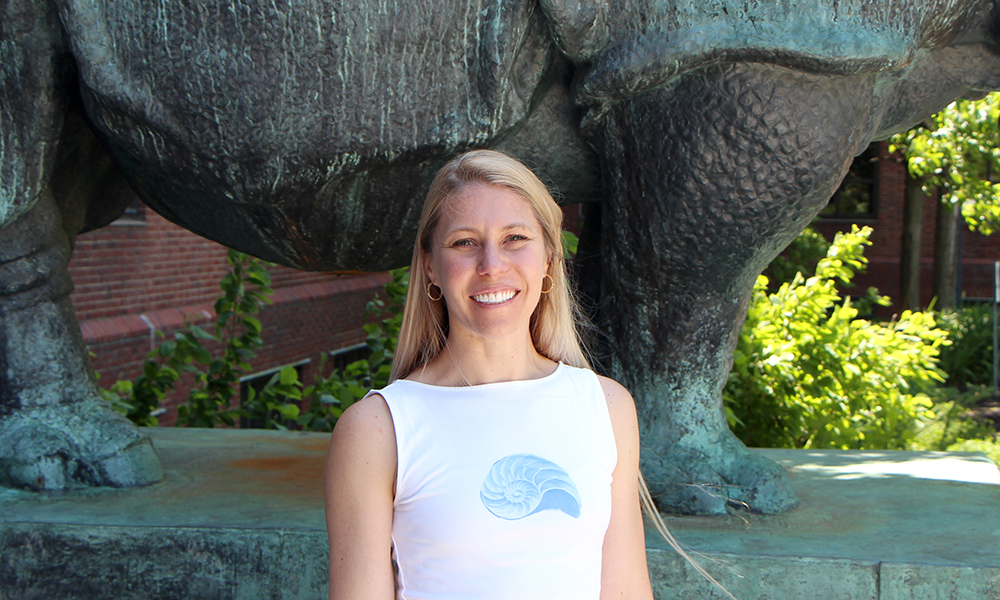

Rebecka Sepela, a postdoctoral researcher in Nicholas Bellono’s MCB lab, has received an NIH Pathway to Independence (K99/R00) Award to study how animals derive information from their external microbial environment.
“By coating nearly every surface and secreting metabolites in a growth‑ and environment‑dependent manner, microbes constitute a living interface with the physical world,” Sepela said. “The entirety of animal evolution has unfolded on this microbial stage and I seek to understand not only how microbes inform animal sensation but also how they have sculpted the evolution of animal nervous systems.”
While the fundamentals of internal host–microbe signaling are becoming clear, how animals read microbial cues in their external environment is not well understood. Sepela’s early postdoctoral training was spent searching for surface‑adhered microbial molecules that influenced octopus ‘taste-by-touch’ chemotactile sensation of their seafloor environment, discovering molecules that helped the octopus differentiate desirable prey and progeny from those that have decayed.
In this search, she and her team unexpectedly realized that octopus sensory receptors were responding not only to the secreted microbial molecules, but also to the acidity of the environment shaped by microbial growth itself. “Although the effect of microbial growth on pH is well documented, this finding highlighted that bacteria alter not just the chemistry of the environment, but its physicochemistry too,” Sepela said. This appreciation that microbes and the environment are intimately tied aligns with a growing recognition that scientific phenomena must be interrogated within the precise ecology, or in this case, microbial ecology, in which they naturally occur.
This award will advance a project aimed at doing just that. Her K99 project now asks how animals integrate chemical signals across environments of different pH. Using octopuses as a model system, she will investigate how these polymodal microbial signals work together to activate chemoreceptors—the sensory receptors animals use to detect chemical cues. The work has already shown that both octopus chemoreceptors and the animals themselves respond differently to microbial chemicals depending on environmental pH. “Increasing acidity appears to put octopus chemoreceptors on ‘high alert’, sharpening their ability to detect specific microbial chemicals that accompany acidifying bacterial growth,” Sepela said.
Although the research centers on octopuses, Sepela believes the findings could have broad implications. “Our bodies have to sense and respond to microbes,” she said. “It’s well appreciated that microbes produce chemicals, but in areas like the gut they also change the environment.” By decoding how receptors integrate microbial chemicals within specific environmental conditions, this project could reveal general principles of human–microbe interaction and offer insights into how our own receptors function in their polymodal microenvironments.
Sepela credited numerous mentors and colleagues for helping her reach this milestone, including her current mentor, Nick Bellono; John Clardy (HMS); Ryan Hibbs (UCSD); her former mentor, John Sack (UCD); and other MCB departmental faculty including Rich Losick, Ryan Nett, Carolyn Elya, Colleen Cavanaugh, and Polina Kehayova, whose advice during the project and K99 application process proved invaluable.