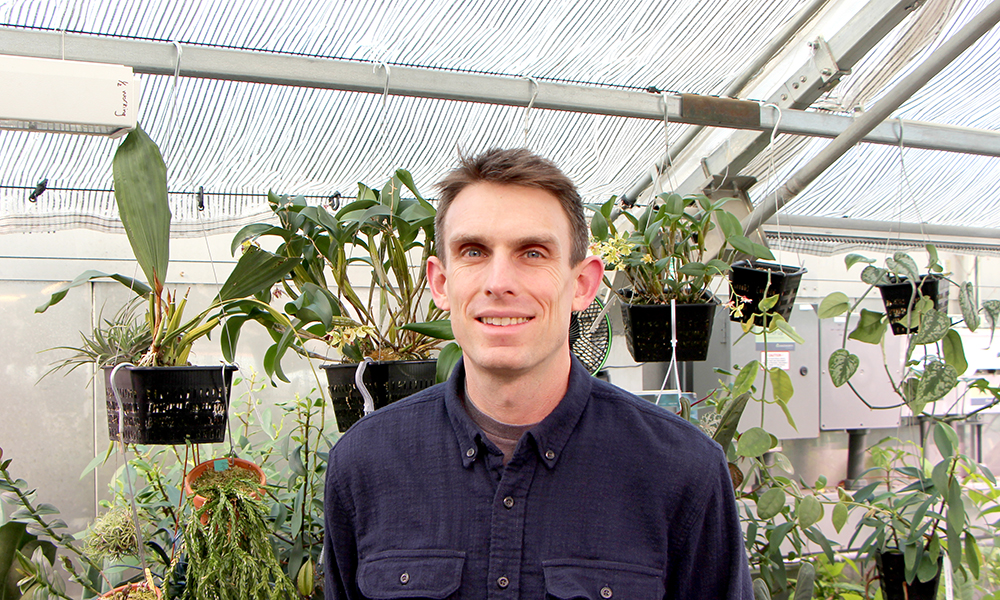

How do plants that first appeared hundreds of millions of years ago produce molecules that may one day help treat human disease?
That question is at the heart of a new five-year National Science Foundation (NSF) CAREER Award to MCB’s Assistant Professor Ryan Nett, whose lab studies the remarkable chemistry of clubmosses—small, evergreen plants that have been making the same biologically active compounds – termed “Lycopodium alkaloids” – for roughly 400 million years.
The prestigious NSF Faculty Early Career Development (CAREER) Award will support Nett’s efforts to uncover how clubmosses synthesize these complex molecules, how the pathways evolved over time, and how plant cells coordinate the production and movement of these compounds. The project also includes an ambitious education and outreach program that integrates research with teaching and community engagement.
“Ryan’s CAREER award reflects the kind of curiosity-driven science we excel at here at MCB,” said MCB Chair Naoshige Uchida. “He has turned an overlooked plant into a window onto fundamental questions of chemistry, evolution, and human health. We are very excited to see his creativity recognized by this award.”
Nett explained that he began studying clubmosses because their molecules are both chemically and biologically fascinating. “The goal of this CAREER award is really to understand the chemistry of these plants from top to bottom, including how the plants make the molecules, how the biochemical pathways evolved, and how metabolism is coordinated within plant cells,” he added
Among the molecules that first drew Nett to clubmosses is huperzine A, a natural compound that has been investigated as a treatment for the symptoms of Alzheimer’s disease because it inhibits acetylcholinesterase—the same biological target as several approved Alzheimer’s medications.
While huperzine A sparked his interest, Nett soon realized that clubmosses produce hundreds of chemically related Lycopodium alkaloids whose origins remain largely unexplored. “Huperzine A is fascinating on its own because it’s unlike almost anything else you see in plants,” he said. “Then we realized these plants have been making related alkaloids since before the dinosaurs were around. That raises some really interesting evolutionary questions—why are they making them, and how?”
The NSF-funded project seeks to answer those questions by investigating how clubmosses produce a diversity of Lycopodium alkaloids, including not just huperzine A but also hundreds of other molecules. Nett will explore how different alkaloid structures arise from a shared biosynthetic pathway, how specialized transporters move molecules between organelles and cells, and how previously unknown auxiliary proteins help boost production of these compounds. This work could provide foundational insights into these often-overlooked elements of plant metabolism. Additionally, this research may ultimately provide new strategies for engineering plants to produce valuable natural products for medicine, agriculture, and biotechnology.
Although clubmosses and their alkaloids are often overlooked, they’re surprisingly common in New England.
After joining the Harvard faculty, Nett began spotting familiar-looking plants while hiking in the woods outside of the Boston area, which turned out to be clubmosses endemic to the northeastern U.S. Those observations led his lab to begin sampling and working with multiple native Massachusetts clubmoss species, which have now become central to the project.
“My first graduate student, Eric Fields, generated nearly all of the preliminary data for this proposal and has established a local clubmoss species as a useful model system for our lab,” Nett said. “This included leading my entire lab group for a field trip to Harvard Forest to collect specimens for chemical profiling and RNA sequencing, so we’re now working mainly with the local Massachusetts varieties.”
The NSF CAREER program recognizes not only innovative research but also excellence in education. Reflecting that mission, Nett’s award supports several educational initiatives that connect plant biochemistry with students and the broader scientific community.
One component expands an undergraduate course Nett developed and has taught since 2025 that uses natural products as a gateway to understanding biochemistry, MCB 130: The Pharmacy of Life – Exploring the Function and Biochemistry of Natural Products. Drawing on examples ranging from nicotine to morphine, the course explores how molecules from nature have shaped modern biology and medicine.
“Our earliest medicines and many of the tools that helped us understand our own biology came from natural products,” Nett said. “We can use these molecules as a way to understand biology and biochemistry and to motivate student interests in these areas.”
The award will also strengthen the lab’s outreach partnership with Boston Green Academy, where Nett lab members have visited the past two years to introduce high school chemistry students to plant science and biochemical research. The CAREER Award will allow the program to expand beyond its current annual visits and develop a deeper connection between Boston Green Academy and Nett’s lab.
Finally, the grant will help grow the Boston-area Plant Biochemistry Symposium, an annual meeting that Nett has been developing with Professor Jing-Ke Weng (Northeastern University) and other collaborators to connect researchers across the region. “There’s not a ton of plant molecular biology and biochemistry research in the Boston area,” Nett said. “We’re trying to build that community, create opportunities to exchange ideas, and hopefully foster future collaborations.”
The NSF project is expected to reveal fundamental principles of how plant cells organize and regulate complex metabolic pathways while creating new opportunities to engineer valuable plant-derived molecules. At the same time, its integrated education and outreach activities aim to inspire the next generation of scientists—from high school students to undergraduate researchers—through the enduring power of plant chemistry.