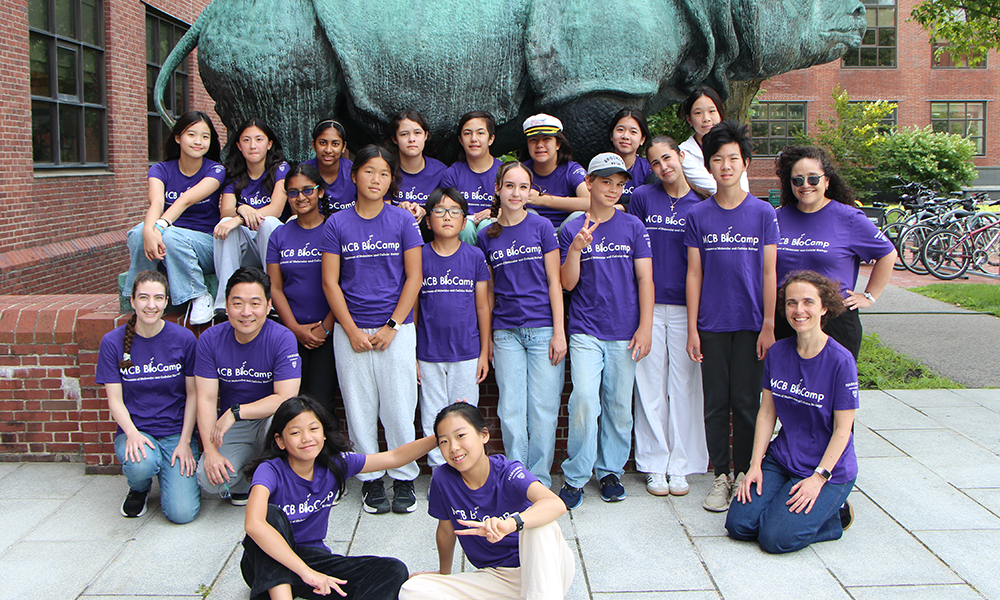

For the middle-school students who attended Harvard MCB’s inaugural BioCamp this summer, learning biology meant doing biology.
Campers grew bacteria, peered through microscopes, dissected sheep brains, tested favorite snack foods for genetically modified organisms (GMO), and even controlled a robotic arm using electrical signals from their own muscles. The goal was not to have students memorize scientific terminology, but to give them a chance to experience how scientists explore questions and make discoveries.
By that measure, BioCamp’s first summer exceeded the expectations of its founders, Polina Dimitrova Kehayova, PhD, and Dominic Mao, PhD.
“It was an experiment,” Kehayova said of their approach to teaching science to students ages 10 to 14. “It was entirely hands-on, no homework, no prior knowledge required at all. We emphasized concepts and hands-on learning.”
Yes, the same group of students had fun not only in the classroom and laboratories but also outdoors.
The inaugural program offered two weeks of microbiology and one week each of neuroscience and molecular and cellular biology, with some students enrolling in a single module and others completing all three. Each was taught by a team of Harvard scientists, including PhD researchers, graduate students, and an undergraduate researcher.
The guiding philosophy was simple: introduce sophisticated biology through experiments and experiences that young students could understand and connect to their own lives.
“We didn’t want them to memorize terms,” Kehayova said. “We wanted them to understand how scientists approach questions.”
That meant rethinking how scientific concepts were presented. If an activity required too much jargon to explain, Mao said, the team reconsidered the approach. Instead, instructors relied on analogies, demonstrations, and experiments that allowed campers to encounter the concepts firsthand.
“You should be able to explain it to middle schoolers without having to use terms like ‘ions’,” Mao said. “If you need to hang on to jargon, then we would say no.”
The results could be both scientific and creative. In microbiology, campers learned to grow bacteria and use microscopes. They also created bacterial art using E. coli strains engineered to express a variety of colors, including green fluorescent protein, or GFP—the glowing protein originally discovered in jellyfish.
After visiting the Harvard Museum of Natural History, some campers made a particularly fitting choice for their bacterial artwork: they used their GFP-expressing bacteria to draw jellyfish on agar plates.
“It was like a very nice full circle,” Mao said.
In the molecular and cellular biology module, campers investigated something equally familiar: their snacks. Using foods including Cheetos, chips, pretzels, cookies, and popcorn, they tested for the presence of GMO.
The experiment also gave students a taste of one of the most important parts of research—not knowing the answer beforehand. Even the instructors learned something when the tests showed that the commercial popcorn they examined was not genetically modified.
“We were actually doing a real experiment,” Kehayova said. “We didn’t know what the result of some of these would be.”
Neuroscience offered another set of hands-on challenges. Campers dissected sheep brains and examined neurons under microscopes. One instructor built a robotic arm that students could control by attaching electrodes to their forearms, demonstrating how electrical signals can be translated into movement and how similar technology might have applications for people who have lost a limb.
Another experiment used “miracle berries,” which contain a protein called miraculin that temporarily makes sour foods taste sweet, to explore how sensory perception works.
“The neuro module—they were inundated with a lot of concepts, but in a very fun way that they could make the connections,” Mao said.
For camper Aubree M., those opportunities made BioCamp unlike anything she had participated in before.
“My experience at MCB BioCamp was amazing!” she said. “I got to see and experience things I never would have until college. Every day at the camp would be another great learning experience.”
Her favorite part was spending each day in the lab. “I learned so much at MCB BioCamp and Dr. K(ehayova) and Dr. M(ao) were so helpful and inspiring,” Aubree said. “I honestly never wanted the camp to end.”
Camper Sharina C. attended all three modules and singled out microbiology as her favorite. She especially valued the opportunity to work in laboratories used by Harvard undergraduates and to visit research labs and meet the scientists working there.
“Being at this camp is one of my favorite activities that I have done this summer,” Sharina said, “and I can’t wait for more people to know and enjoy this camp as well!”
That enthusiasm was shared by campers who traveled from well beyond the Boston area. BioCamp welcomed students from several U.S. states as well as international campers from countries including Russia, Taiwan, South Korea, and India. Some traveled to the United States specifically to attend the program—a response that Kehayova said surprised the organizers.
For Mao, the summer demonstrated that the team had found what he called a “sweet spot”: engaging 10- to 14-year-olds in real science, holding their attention, and giving them meaningful laboratory experiences in a safe and enjoyable environment.
“We had a hypothesis going in,” Mao said. “Engaging them in real science while making it exciting for them, capturing their attention the entire time, and doing it in a safe environment—we have found that sweet spot, so we definitely have proof of concept of that hypothesis now.”
Perhaps one of the clearest measures of success came from an unlikely source: campers’ phones. BioCamp was cell-phone-free, with students turning in their devices during the day. On several occasions, Kehayova said, campers were so absorbed in the experience that they went home without remembering to retrieve them.
“We have achieved the state of student excitement in which they forgot to pick up their cell phone at the end of the day,” she said.
The campers are already looking ahead. Kehayova said students who completed all three modules repeatedly asked the organizers, “Can you please promise us that there will be BioCamp next summer?”
Kehayova and Mao plan to offer the current modules again for new campers and are considering a more integrated, research-oriented module that would bring together microbiology, neuroscience, and molecular and cellular biology for returning students. They also hope to raise funds to provide scholarships and financial aid so BioCamp is more accessible.
The program’s success, Mao and Kehayova emphasized, depended on a broad community of instructors, researchers, laboratories, staff, and partners across Harvard who contributed their time and expertise.
With Thanks
BioCamp extends its thanks to the camp instructors who helped make the inaugural summer possible:
Nurunisa Akuz, PhD; Monica Boselli, PhD; Anwen Cao, Harvard College junior; Monica Carrasco, PhD; Hanan Dahche, PhD; Isra Galicia Silva, PhD student; Tayne Kim, PhD student; Kanako Otomo, PhD; Annabel Perry, PhD student; Clemens Riegler, research scientist; Lisa Tilokani, PhD; Maya Waarts, PhD student; Gates Yin, PhD student.
Special thanks also go to members of the Bellono Lab, Dulac Lab, Elya Lab, Engert Lab, Nett Lab, and Whipple Lab whose researchers opened their labs to campers, provided demonstrations and tours, and offered a firsthand look at scientific research.
BioCamp also thanks Harvard Center for Biological Imaging (HCBI), including Doug Richardson and Alex Lovely; the Harvard Museum of Natural History; and the Northwest Teaching Labs team, with a special shoutout to Clark Magnan.
Finally, special thanks go to MCB administration and MCB Graphics, whose behind-the-scenes work helped make the inaugural BioCamp possible.