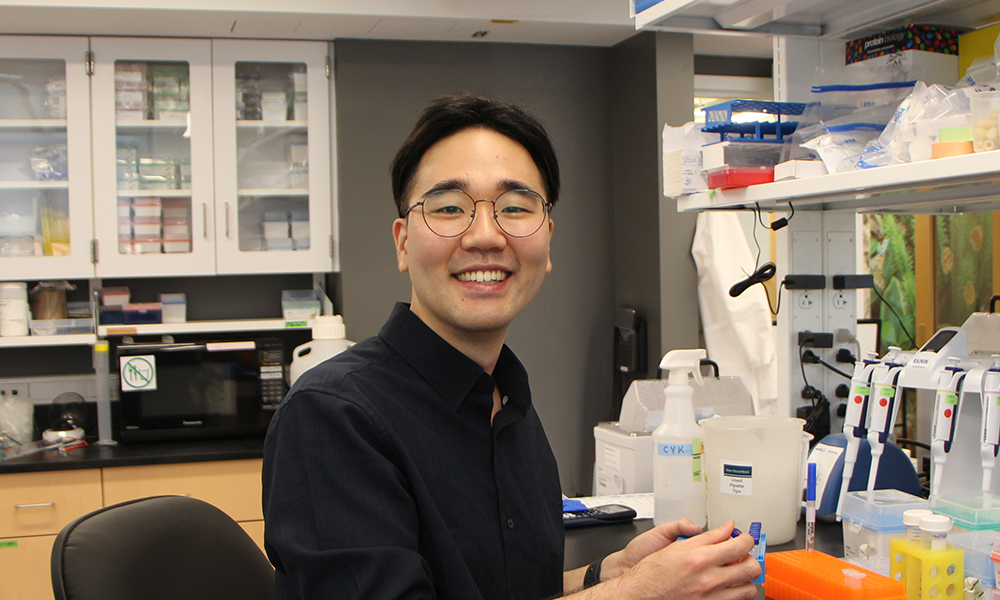

For MCB postdoctoral researcher Colin Kim, studying plants means discovering what talented chemists they can be—and learning how their molecular machinery might be harnessed to make medicines.
Kim, a postdoctoral fellow in the lab of MCB Assistant Professor Ryan Nett, has received three awards recognizing both his research accomplishments and his promise as a future leader in plant science: a Rising Stars Award from the Salk Institute for Biological Studies and an Early Career Award from the Phytochemical Society of North America (PSNA) and The Plant Journal, and most recently, a 2026 Sahyadri Outstanding Plant Postdoc Award.
In the Nett Lab, Kim studies how plants make specialized molecules with medicinal properties. His research over the past three years has focused on kanna (Mesembryanthemum Tortuosum), a succulent native to South Africa that produces neuroactive compounds with antidepressant properties.
“There are ancient historical texts describing an indigenous population in South Africa that chewed on the leaf of the plant before they went out hunting because it suppressed their hunger, allowed them to focus better, gave them this peaceful, anxiety-relieving type of effect,” Kim said.
Kim is working to uncover the chemistry behind those effects by identifying the molecular machinery the plant uses to build the compounds. His research has gone a significant step further: He and his colleagues have transferred that machinery into a model plant related to tobacco and engineered it to produce the same molecules.
“It’s a way for us to essentially make drugs,” Kim said. “We call it molecular farming, where we can engineer the machinery into a more tractable model plant species and produce these antidepressants.”
That combination of ambitious questions and experimental follow-through is one of Kim’s strengths as a scientist, Nett said. “These awards are well-deserved honors for Colin,” Nett said. “He has always impressed me with his combination of creativity and work ethic. In particular, Colin has the rare ability to come up with big, high-impact ideas and then execute the experiments quickly and rigorously.”
Nett pointed to Kim’s “discovery of a complete biochemical pathway to an antidepressant from a medicinal plant” as one of his major accomplishments. He also praised Kim’s contributions to other projects and collaborations and his ability to communicate his science to broad audiences.
“These awards highlight Colin’s excellence in research and communication, and I’m thrilled that his accomplishments are being recognized broadly in our community,” Nett said.
Kim was selected in January for the Salk Institute’s Rising Stars Program. Applicants were asked not only to describe their research but also to consider how they would lead in the spirit of Salk founder Jonas Salk’s call to be “good ancestors”—responsible stewards of the scientific community they inherit. His second honor, the PSNA Early Career Award, recognizes postdoctoral researchers and other early-career scientists preparing for faculty careers. The Sahyadri Postdoc Award is a recognition from peers in the Plant Postdocs Community, an organization led primarily by postdoctoral fellows with support from faculty and industry leaders in plant science-related fields.
“I’m really thankful for these awards because they empower the next generation of academic scientists to take bold steps in establishing their own research programs,” he said, “and also learn to be a good steward and generous mentor in science.”