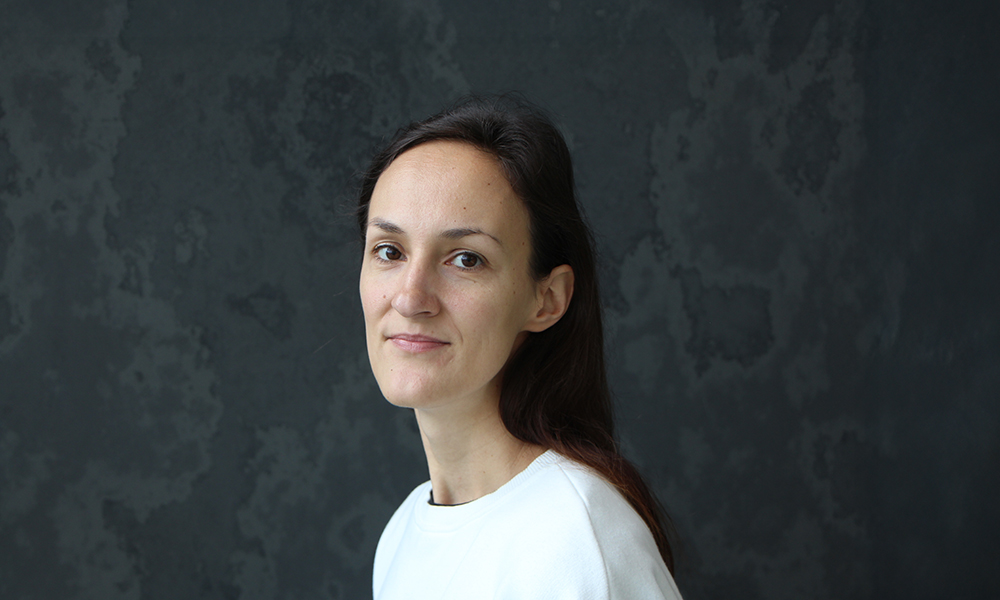

Postdoctoral fellow Anastasiia Sukalskaia has received a prestigious Swiss National Science Foundation (SNSF) Postdoc.Mobility Fellowship, which will support her research in the lab of MCB’s Nicholas Bellono on the sensory biology of starfish.
Sukalskaia joined the Bellono Lab in September after completing her PhD at the University of Zurich in the group of Raimund Dutzler, where she investigated a previously mysterious group of human membrane proteins and discovered that they transport lipids in endosomes with the help of apolipoproteins. Her PhD findings were recently published in Nature.
During her PhD, Sukalskaia became increasingly curious about how the molecular functions she studied connect to the biology of whole organisms. “I spent a lot of time during my PhD working with purified proteins, which is fascinating but was a little bit out of physiological context,” she says. “For my postdoc, I was looking for a lab where molecular understanding of membrane protein biophysics is combined with trying to understand these proteins in the context of whole organisms. Nick is one of the few people in the world who works on such interdisciplinary projects, interrogating biological systems on many levels of organization from molecules to organisms.”
Now, Sukalskaia is turning her attention to the sensory biology of starfish. Her project aims to identify the receptors starfish use to detect chemical cues from their prey, such as mussels, and to determine how those molecules drive feeding behavior. “We can screen libraries of molecules that come from prey and see which ones activate those receptors,” she explains. “Then we can go back to the animal and see whether it actually responds to those same molecules. That’s a way to validate that what we find at the molecular level is true for the organism itself.”
Bellono says Sukalskaia’s arrival has already had a major impact. “We are thrilled to have Anastasiia join us,” he says. “She is an incredible structural biologist interested in how the evolution of novel protein features facilitates adaptive organismal behaviors. In just a short time in the lab, she has fearlessly established numerous new exploratory avenues. She has also made time to contribute to several projects across our lab and floor, and has provided input to Doug Richardson [MCB senior scientist] and the Harvard Center for Biological Imaging toward establishing a new cryo-EM facility at Harvard. She is an outstanding scientist, but perhaps most importantly, she elevates those around her.”
The SNSF fellowship provides two years of postdoctoral funding and also offers recipients an optional return phase to help them establish independent labs in Switzerland. Says Sukalskaia, “It’s an amazing opportunity for postdocs like me to grow as independent researchers.”