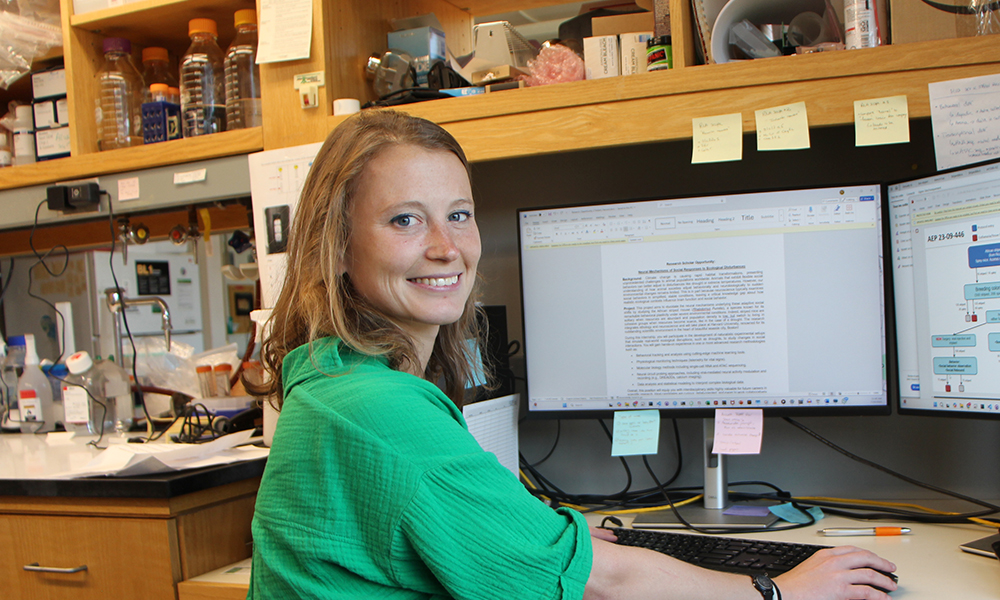

Harvard Junior Fellow Camille Testard has been awarded the highly competitive Branco Weiss Fellowship – Society in Science, a prestigious five-year award that supports exceptional early-career researchers with bold, cross-disciplinary ideas. As a Branco Weiss Fellow, Testard will launch an ambitious new research program to investigate how animal societies adapt to ecological disturbances, bridging the fields of ecology and neuroscience.
“This fellowship is life-changing,” says Testard. “It gives me the freedom to pursue an idea that’s high-risk and high-reward. It allows me to tackle one of the biggest scientific challenges we face: how the brain enables social adaptation to environmental crises.”
Understanding Social Flexibility in a Warming World
Climate change is transforming habitats at an unprecedented rate, creating new survival challenges for animals worldwide. In these rapidly shifting landscapes, social flexibility—the ability to change how individuals interact with others in their group—may be essential for survival. However, scientists still know very little about how animal brains generate such behavioral changes in realistic environmental contexts.
While neuroscience has made significant strides in understanding social behaviors, much of this work has been conducted in highly controlled and stable environments. “There’s a huge gap between how we study social behavior in the lab and how it actually unfolds in the real world,” Testard explains. “We don’t know how brains respond to chaotic or rapidly changing ecological conditions—conditions that are becoming increasingly common because of climate change.”
“Mounting evidence suggests that flexibility in social behavior is critical for animals’ survival in the context of disasters,” she says. “But we don’t yet understand how the brain makes that possible. This fellowship allows me to pursue that question head-on.”
A Natural Model for Extreme Flexibility
To tackle this challenge, Testard will work with the African striped mouse, a desert-dwelling rodent species known for its remarkable behavioral plasticity. These animals live cooperatively during resource-scarce drought periods, sharing nests and food, but switch to solitary, territorial behavior when resources become abundant. This makes them an ideal model for exploring how environmental conditions drive dramatic social shifts—and how those shifts are regulated in the brain.
In the lab, Testard will simulate ecological stressors, such as severe drought, extreme heat, and urban pollution, using large, naturalistic enclosures. She will manipulate key variables such as resource availability and temperature while tracking social behavior, physiological stress responses, and neural activity.
“What makes African striped mice unique is how quickly and dramatically they adapt their social structure to the environment,” says Testard. “That gives us an opportunity to study the brain in a setting that’s ecologically realistic but still experimentally tractable.”
Decoding the Brain’s Response to Disaster
Testard’s research will focus on the preoptic area of the hypothalamus, a brain region that integrates social and homeostatic needs. She will use behavioral tracking, physiological assessments, transcriptomic profiling, and viral manipulation of gene and neural activity to uncover how this brain region orchestrates social flexibility.
“This project is about mapping the full pathway—from environmental stress to brain function to social behavior,” she says. “And ultimately, it’s about identifying the molecular and neural tools that promote resilience in the face of climate-driven disruption. This work will identify a clear pathway from disasters to social resilience via the brain and suggest mitigation strategies to support animal and human populations vulnerable to climate change.”
The Branco Weiss Fellowship, awarded to eight researchers this year, offers unparalleled flexibility: 600,000 CHF (Swiss francs) over five years, with the ability to take the funding to any institution worldwide. Testard will remain at Harvard in the lab of MCB Professor Catherine Dulac, whose mentorship has helped shape this interdisciplinary project.
“Camille is bringing exciting new ideas and talent to the field of neuroscience and social ecology,” says Dulac. “Her cross-disciplinary project funded by the Branco Weiss Foundation will break new conceptual and experimental barriers on the difficult but increasingly menacing issue of how animal behavior is affected by human-caused ecological disasters.”
Dulac comments that Testard’s prior PhD training in behavior ecology of monkeys, combined with her current deep dive into molecular and genetic neuroscience of behavior circuits in rodents will enable her to tackle the most profound questions on how circuits of behavior control vary and help in the survival of animals confronted with distinct environmental challenges in ways that have not been done before. “Receiving this highly competitive fellowship is already a remarkable accomplishment, and I am confident that Camille will achieve something very special with her superbly innovative project,” she adds.
Testard’s academic background exemplifies the kind of breadth the Branco Weiss Fellowship was designed to support. As a PhD student, she studied a population of rhesus macaques struck by a devastating hurricane, documenting how their social behavior transformed in the aftermath. Now, in the Dulac lab, she is combining that expertise in behavioral ecology with the molecular and systems neuroscience tools needed to explore the brain’s role in behavioral adaptation.
“We’re entering an era where understanding social resilience isn’t just a scientific curiosity—it’s a necessity,” says Testard. “If we want to protect animal species, ecosystems, and even ourselves, we need to know how the brain allows us to adapt socially under extreme pressure. That’s what this work is about.”