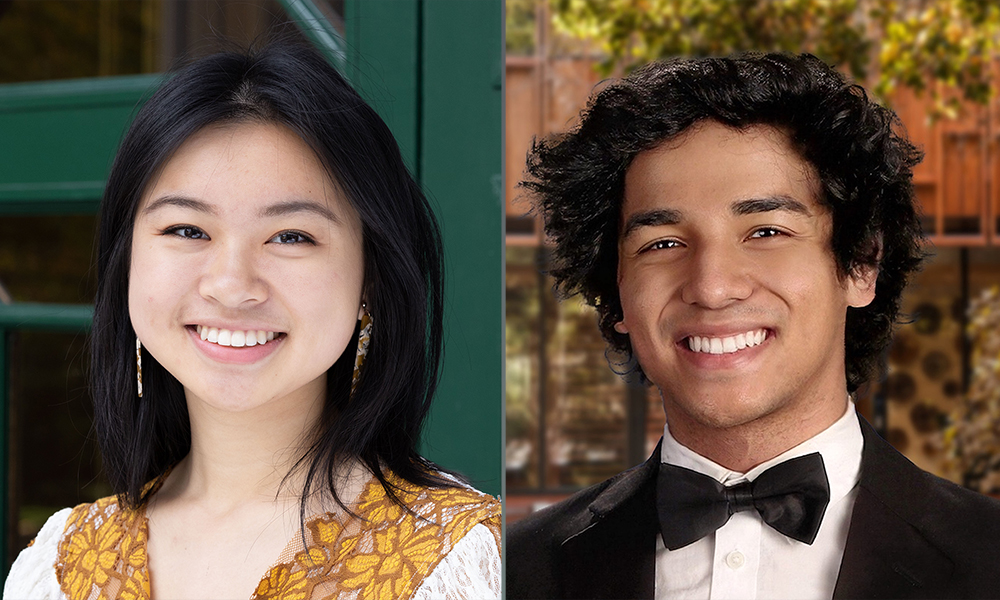

Two recent Harvard graduates with ties to the MCB department have been named recipients of the prestigious Knight-Hennessy Scholars fellowship at Stanford University, joining a global cohort of emerging leaders selected for their academic achievement, leadership, and commitment to addressing complex global challenges.
Among the honorees is Peggy Yin ’25 of Port Jefferson, New York, who graduated Phi Beta Kappa and cum laude from Harvard with a degree in computational neuroscience and a secondary field in art history. She is pursuing a PhD in psychology at Stanford’s School of Humanities and Sciences.
While at Harvard, Yin conducted research in Samuel Gershman’s lab, where she explored how network models of autobiographical memory could predict individual differences. She also worked in the MIT lab of Joshua Tenenbaum, building models of crossmodal correspondences in audiovisual perception.
One of Yin’s major projects was leading the “Future You” initiative at the MIT Media Lab, which examined how immersive technologies and artificial intelligence can help individuals better connect with their future selves and make long-term decisions. Under her leadership, the platform scaled to reach over 72,000 users worldwide.
Yin is currently working with Carol Dweck and Hazel Markus at Stanford. Her research focuses on designing and studying systems that create personally transformative experiences in order to help individuals and communities navigate disruptive change. Her recent work focuses on investigating AI-induced transformative experiences, such as “AI psychosis.”
Beyond her academic work, Yin has directed the Cognitive Security Task Force at the Stanford Institute for Human-Centered AI and contributed to socially focused technology initiatives at organizations including Teach for America and Ars Electronica. Her interdisciplinary work has been featured at venues including the Wall Street Journal Future of Everything Festival, SXSW, Carnegie Hall, the MIT Museum, and the United Nations. At Harvard, she founded the Conflux Collective for the arts and engineering sciences, directing a community of students in building new media installations exhibited around the world, and launched a local impact hackathon with the Boston Mayor’s Office.
“I’m really excited to engage with the Knight-Hennessy community, as the quest to understand, discover, and innovate better conditions for life has always been one that crosses disciplinary boundaries and cultural borders,” Yin said.
The second Harvard honoree is Craig McFarland ’25 of Jacksonville, Florida, who studied neuroscience at Harvard (with a secondary in economics) and will pursue both a PhD in neurosciences at Stanford School of Medicine and a JD at Stanford Law School.
At Harvard, McFarland conducted research at the intersection of neuroscience, law, and ethics. He worked with Christy Denckla, where his honors thesis identified brain-based biomarkers of post-traumatic stress disorder and how sex, race, and socioeconomic status may influence them. He also worked with Francis Shen on the ethical, legal, and societal implications of neuroscience and emerging neurotechnologies, frequently collaborating with judges, lawyers, and Congress members.
Across Harvard and beyond, McFarland first-authored nine publications and worked in eight different laboratories, including with Gabriel Lázaro-Muñoz on psychiatric genomics at the Neurotech Justice Accelerator at Mass General Brigham, and with Eve Valera at the Athinoula A. Martinos Center for Biomedical Imaging on multimodal neuroimaging of intimate partner violence.
McFarland is currently studying neuroscience at the University of Oxford, where he was selected as both a Harvard-UK Fellow and a Clarendon Scholar as the department’s top candidate. His current research includes working with Helen Barron using multimodal 7T neuroimaging to study first-episode psychosis, and with Rogier Mars on spatial transcriptomics approaches to compare machine-learning-derived human neuroanatomical maps of schizophrenia against genetic mouse models of the disorder.
At Stanford, McFarland aims to continue studying the neural circuits underlying psychiatric illness during his PhD research, while also exploring how brain stimulation technologies can be used to causally modulate those circuits.
“Synapsing neuroscience with the law, ethics, and other disciplines has been the most exciting experience. It was surreal to get the call that I won, and to know that others believe just as deeply in this intersection,” he said. “Neuroscience is an extraordinary field and an even more beautiful instrument. I see research as a way to advocate for those who struggle with mental illness, and to honor all the family, friends, and strangers I have lost to it.”
The Knight-Hennessy Scholars program supports graduate students from around the world who demonstrate independence of thought, purposeful leadership, and a civic mindset. Scholars receive funding for graduate study at Stanford while participating in leadership development and multidisciplinary collaboration opportunities.