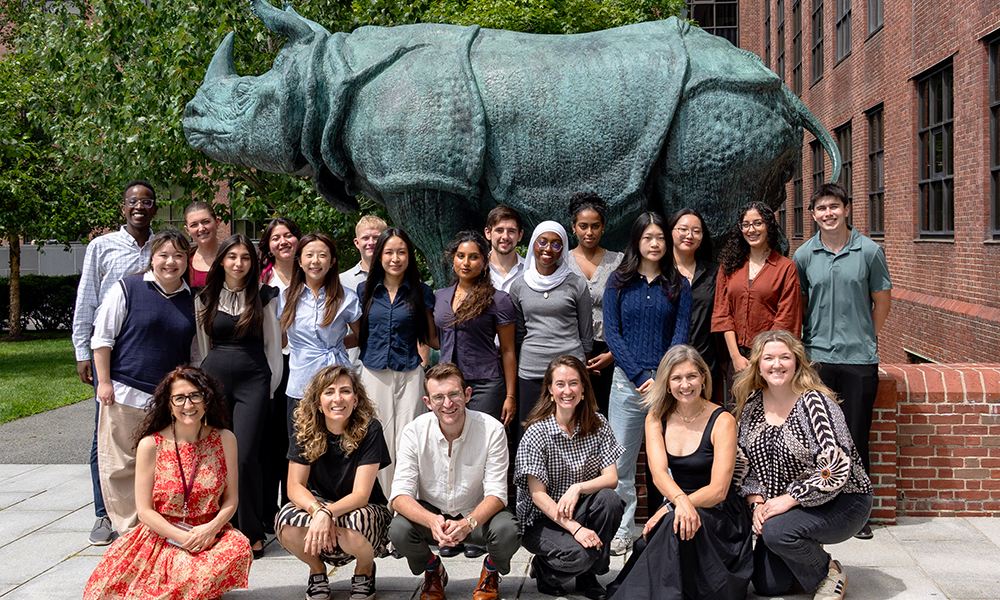

For students interested in science, getting started in a research laboratory can be daunting. Finding a lab, approaching a faculty member, designing experiments, and even knowing what questions to ask can be unfamiliar territory—particularly for first-year students.
The Foundational Undergraduate Experiences in the Laboratory (FUEL) program is designed to make that transition easier. Now in its third year, FUEL gives Harvard undergraduates hands-on research experience while helping them build the skills and confidence needed to pursue independent research across the University.
This summer, FUEL expanded in a new direction, adding a neuroscience track alongside its existing chemistry and biology experiences.
FUEL grew out of a first-year seminar that introduces students to the fundamentals of scientific research, including reading scientific literature, formulating research questions and hypotheses, and understanding experimental design. The nine-week summer program puts those ideas into practice.
“The seminar focuses on giving them the theory behind doing research—how to formulate a question, how to formulate a hypothesis, how to read scientific literature,” said MCB’s Sien Verschave, one of FUEL’s original co-developers along with Dan Kahne of the Department of Chemistry and Chemical Biology and MCB. “But then the summer program brings it further, where they get more hands-on experience in the lab.”
Students learn experimental design and data collection while developing research projects, as well as practical aspects of being a scientist, such as maintaining a laboratory notebook.
FUEL is also intended as a bridge to independent undergraduate research. Through a “lab match challenge,” students research Harvard laboratories, work on resumes and emails to faculty, contact principal investigators, and meet with at least one faculty member to discuss research opportunities. Most participants find a research position by the end of the summer or around the beginning of the following semester.
Building Confidence Early
FUEL is aimed at students who have completed their first year and have not yet declared a concentration. Participants have previously taken the first-year seminar and then applied to the summer program. This year’s cohort included 15 students.
Reaching students at this stage is deliberate. Verschave sees FUEL as a way to guide students who may not yet know how to navigate Harvard’s research environment, particularly those who do not initially “think of themselves as being capable of going into research.”
The goal, she said, is to give them the confidence, skills, and knowledge to recognize that research is an opportunity available to them.
That experience goes beyond learning laboratory techniques. “It’s not just the skills,” said MCB’s Katie Quast, who helped design this year’s neuroscience component. Students learn laboratory practices by actually using them and discover firsthand that “research takes dedication, and I have to come in at 10 a.m. when I said I would to get the experiment done.”
Neuroscience Joins FUEL
The biggest change this summer was the addition of neuroscience. Previously, students divided their research experience between chemistry and biology. Following an expansion of the first-year seminar to include a neuroscience-focused section, FUEL created a second pathway combining neuroscience and biology.
Quast, a neuroscientist, developed the new track with a particular emphasis on student-driven research. “One of my goals was really to emphasize the independent, inquiry-based research, so that the students really were deciding what they wanted to study,” she said.
Working within a framework involving behavior in a model organism, students developed projects exploring topics ranging from Parkinson’s and Alzheimer’s disease to neuromodulators and the effects of starvation on behavior.
For Quast, seeing those ideas come together in the students’ final posters was a highlight. “I was so happy and impressed with the way that they really came together with cohesive projects,” she said.
The program concluded August 5 with a poster fair where students presented the projects they had developed during the summer.
Looking Toward a Broader FUEL Program
Adding neuroscience has also provided a model for how FUEL might expand in the future. Verschave envisions other departments developing their own research modules under the FUEL umbrella, potentially extending the approach to additional scientific fields and even disciplines beyond the sciences.
For Verschave and Quast, the program fills a need that extends beyond what students can learn in a classroom. “Being a scientist, or how to be a researcher, there’s no one textbook that teaches you that,” Verschave said. “It requires some hands-on experience. It requires mentorship.” That combination of experience and mentorship, she said, is what ultimately helps students develop confidence in the lab.
The entire FUEL team wishes to thank the Department of Chemistry and Chemical Biology (CCB), Department of Molecular and Cellular Biology (MCB), Harvard Division of Science, Office of Undergraduate Research and Fellowships, Hunter lab, Center for Nano Systems, Harvard Center for Biological Imaging, Kula Bio and Axoft Inc. for their support and services during the development of this program.
Addendum (09.10.2026):
FUEL is a program of Harvard’s Department of Chemistry and Chemical Biology (CCB), which has provided funding and resources to help establish and sustain the program since its launch. CCB’s early investment helped create the foundation for FUEL and its subsequent growth, including its expansion across departments and into new areas of science. Read more about the program’s origins in CCB’s original announcement.