
A dead fly perched high on a blade of grass, wings raised, glued in place by its own mouthparts, might look like something out of a horror movie.
To researchers in the Department of Molecular and Cellular Biology, however, it represents an opportunity to answer fundamental questions about evolution, behavior, and one of nature’s most extraordinary examples of mind control.
This summer, members of the Carolyn Elya Lab are expanding Zombuddies, a citizen science initiative that asks members of the public to help collect flies infected with the “zombie fungus,” Entomophthora muscae. The project aims to build the world’s largest collection of these infected insects, enabling researchers to explore the fungus’s genetic diversity and better understand how it manipulates its hosts’ behavior.
“We’re trying to drum up more awareness of the project and get more people to send samples to us,” said Elya, who leads the laboratory. “Now is a great time to catch dead flies.”
Building a global collection
The Elya Lab studies E. muscae, a fungal pathogen that infects flies and dramatically alters their behavior before killing them. Although the fungus was first described in 1855, scientists still know surprisingly little about its diversity.
“People see it all the time,” Elya said. “But we still know very little about how many flavors of this fungus are out in the world.” For years, the lab has relied largely on a single fungal lineage that Elya discovered in her backyard as a graduate student. Expanding that collection inspired Zombuddies.
“I thought this project could be feasible solely because of iNaturalist,” Elya said. “The frequency of observations and the geographic diversity of where people are seeing zombie flies made me think that we could pull this off if we leveraged the existing iNaturalist network of citizen scientists.”
After spending the first year developing collection and processing methods, the team is ready to greatly expand participation. “We know how we want to process them, how to store them long-term, and how to automate the process to get genetic material out of these samples,” said post-baccalaureate visiting student Jessenia Yupangui Yupa.
A fungus that takes control
The fungus earns its “zombie” nickname by commandeering a fly’s behavior during its final hours. “When the fly is infected, the big three behaviors are climbing, extending the proboscis, and wing raising,” explained research assistant Maya Leonard.
Near sunset, infected flies climb to an elevated perch, glue themselves in place using their mouthparts, and raise their wings before the fungus erupts through the abdomen and releases spores. “Everything that the fly does seems to be in service of the fungus,” Elya said. “It’s getting the fungus as widely dispersed as it can be.”
Just how common zombie flies are remains an open question. Overall, Elya estimates that fewer than 1% of flies are infected, but sightings peak during the summer when fly populations are at their highest. Under the right conditions, however, local infection rates can surge during what scientists call epizootic outbreaks, when dense populations of flies rapidly spread the fungus—”a la your favorite zombie movie,” Elya said. These outbreaks may temporarily crash local fly populations. For would-be zombie hunters, she recommends searching where flies are abundant. “My advice is not to look in places where there’s only an occasional fly,” she said. “The more flies, the more likely you are to find an infected individual.”
Discovering hidden diversity
Although E. muscae has been observed nearly worldwide, the researchers suspect it is far more genetically diverse than currently recognized. “We’re trying to amass this collection of specimens so that we can have genetic material to really probe questions of co-evolution between fungus and fly,” Elya said.
Early findings already suggest that different fungal strains may specialize in infecting different fly species. “It’s our first hint that there is potentially some level of specificity for different strains of E. muscae and different hosts,” Elya said.
Science in your own backyard
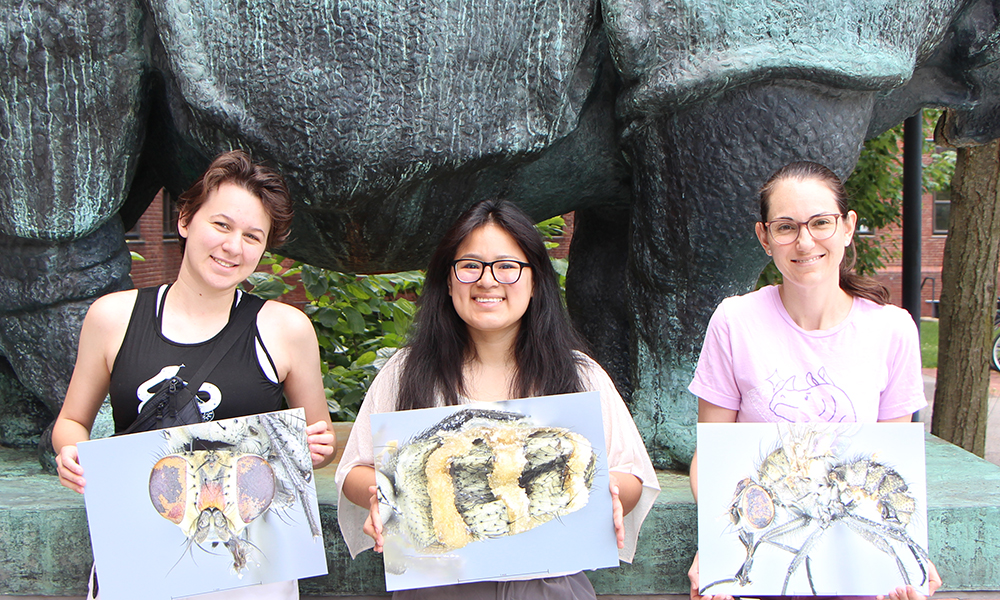
Anyone who thinks they’ve spotted a zombie fly can submit a zombie inquiry on the Elya lab website. Guidance on how to find zombie flies is provided in an infographic. Potential zombie hunters can also view video and photo examples of infected flies through the project’s media gallery. After reviewing photos, the lab provides a prepaid shipping label for confirmed specimens. Researchers then photograph each sample and extract DNA for genetic analysis.
Beyond advancing research, Elya hopes Zombuddies will show people that meaningful scientific discoveries can begin close to home. She also hopes participants discover that “you can find cool stuff in your backyard. You don’t have to go into a fancy lab with all sorts of specialized equipment.”