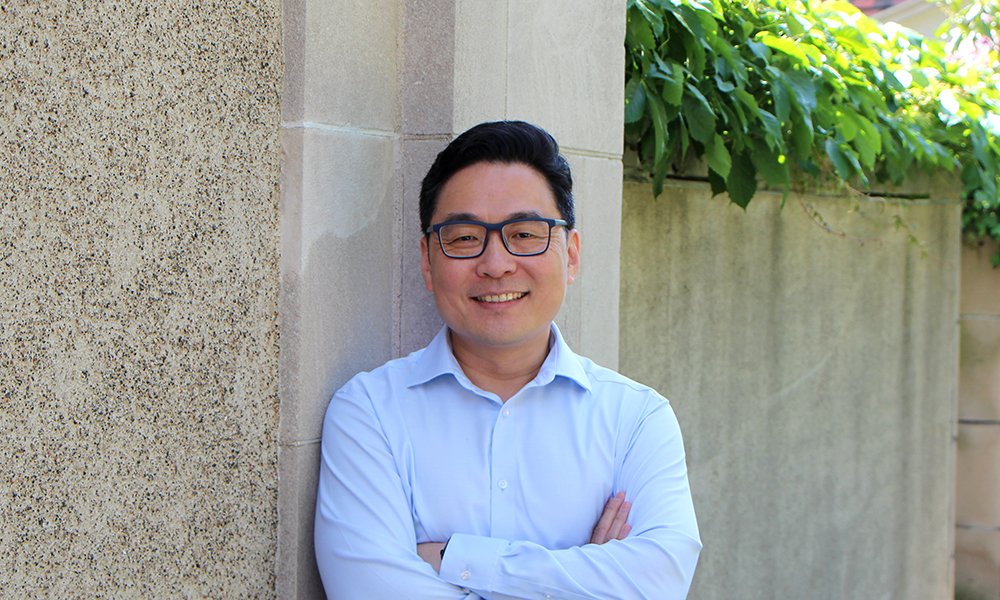

When Harvard announced its 2026 Harvard Heroes, one familiar name stood out to members of the Department of Molecular and Cellular Biology and the Committee on Chemical and Physical Biology: Dominic Mao.
Mao, Assistant Director of Undergraduate Studies for MCB and CPB and a lecturer in the Life Sciences, was recognized as a Harvard Hero for his extraordinary contributions to students, education, and the broader Harvard community. The annual Harvard Heroes program honors employees who consistently go above and beyond their formal job responsibilities to make a lasting impact across the University.
“I have mixed feelings about being called a Harvard Hero because I could not have accomplished much without the support and encouragement from my colleagues,” said Mao. “The only thing I can take credit for is that I have ideas that I like to pursue, even if they’re not part of my official appointment.”
Those ideas, however, have transformed opportunities for students both within Harvard and around the world.
As Assistant Director of Undergraduate Studies, Mao advises students, helps oversee the administration of the MCB and CPB concentrations, and teaches undergraduate courses. But many of the initiatives for which he is best known fall outside his official responsibilities.
Among them is SMART, a tool that Mao helped develop to track and manage undergraduate research experiences and thesis-advising relationships. After identifying a gap in Harvard’s ability to monitor undergraduate research participation, he secured funding to develop the platform and worked with HUIT to build it.
“When I alerted the college about the absence of a tool that would record and administer undergraduate research data, they investigated my claim and said, ‘Yes, you have identified a critical need,'” Mao said. “They awarded a grant that allowed me to recruit a consultant, and we developed the tool with HUIT.”
The platform has since expanded beyond undergraduate education and is now being adapted for use by the Graduate School of Arts and Sciences.
“The university, when approached by GSAS for funding to build a similar tool, is like, ‘Wait, there’s this guy, Dominic, he built this in 2020,'” Mao recalled. “I demoed my tool to GSAS, and they said, ‘SMART already has 80 percent of the features we need, so why don’t we join forces?'”
Logan McCarty, Associate Dean for Science—Undergraduate Education, said Mao’s impact extends far beyond the students he advises directly. “Dominic has contributed so much, not only to MCB and the Science Division, but across the FAS,” McCarty said. “He is an outstanding teacher and advisor who takes every opportunity to have a wider impact. He secured funding and created the SMART tool to support advising and communication for a wide range of undergraduate concentrations. He served on the grading committee that led the most profound change in undergraduate educational policy in decades. And he is a trusted colleague who will share his insights with candor and grace.”
MCB Chair Rachelle Gaudet said Mao combines vision with an unwavering commitment to helping others succeed. “What is so special about Dominic is that he brings creativity, efficiency, and a healthy balance of confidence and self-reflection, always thinking about how he can better serve the communities he cares about—whether it is the students, the department, or the local or even the global community,” Gaudet said. “In his teaching, mentorship, and advising roles, he similarly has a ‘high expectations with high support’ approach, always aiming to bring out the best in people. Dominic’s boundless positivity and enthusiasm help him persist through challenges and find creative solutions, including highly ambitious and successful initiatives such as the SMART tool and the Program for Scientifically-Inspired Leadership (PSIL). He is a true Harvard Hero!”
Sam Kunes, MCB concentration faculty director, said students quickly recognize Mao’s commitment to excellence. “Dominic approaches advising, teaching and all the initiatives he undertakes with an eye towards excellence,” Kunes said. “Students notice his high standards. It’s the best kind of influence.”
Mao is also the driving force behind Harvard’s international teaching and outreach programs in India. The initiative gives Harvard students opportunities to teach in under-resourced educational settings to hone their teaching skills and gain a cross-cultural, immersive learning experience.
“It gives me a great opportunity to provide service to the university and provide opportunities to our students where they can really hone their teaching skills in an under-resourced environment,” Mao said. “That’s really where you are tested as a teacher.”
The program continues to grow. This year, Mao will travel to Malaysia to evaluate potential sites for an expansion that could see the program operating simultaneously in both India and Malaysia beginning in 2027.
Mao emphasizes that his accomplishments have been possible only because of the support he has received from colleagues and departmental leadership. “I think it’s only at a place like Harvard, and especially a place like our department, where it’s very, very encouraging,” he said. “People generally say, ‘I trust you to manage your time.’ As long as your main duties are fulfilled, you can pursue whatever, and they will extend help.”
A third major initiative Mao co-developed is BioCamp, the new middle-school science summer program that he co-founded with MCB Science Director Polina Kehayova. “Dominic is the best partner in crime!” Kehayova said. “He has great ideas, but he doesn’t stop at that; he also gives all of himself to see them come to life.”
Doeke Hekstra, co-director of CPB, said Mao’s influence is often felt in ways students may never fully see. “I am often baffled by the sheer organizational complexity of education and research at Harvard,” Hekstra said. “Dominic excels at making it work for our MCB and CPB concentrators—behind the scenes, and through study breaks, concentration events, and when tutoring or advising. In addition, he has contributed enormously to the good of the department and the college through his contributions to the SMART system, a new summer camp for middle-school kids, and international outreach.”
Adam Cohen, co-director of CPB, echoed those sentiments. “Dominic brings a level of care for students, creativity, and commitment to his role that are an inspiration to all who work with him,” Cohen said.
Mao’s commitment to student education and mentorship is rooted in his own scientific journey. After earning his PhD, he completed a postdoctoral fellowship in the laboratory of legendary MCB faculty member Matt Meselson, where he developed a deeper appreciation for teaching, advising, and building educational communities.
Today, whether he is helping a student navigate research opportunities, creating tools that improve advising across Harvard, launching science camps, or expanding international educational programs, Mao remains focused on creating meaningful opportunities for others.
Looking back on the recognition, he is quick to redirect credit toward the people who have supported his work. “My India program is evidence of very strong departmental support for whatever I want to do,” Mao said. “From a department chair hooking me up with the Lakshmi Mittal South Asia Institute for logistical support (thanks, Venki!), to our finance team helping with budgets and receipts, to the graphics team making us look good…literally (thanks, Renate!), to faculty colleagues offering help (thanks, Andi and Victoria!), my venture was destined for success. Now that we are expanding to Malaysia, Asia Center has extended a collaborative hand. This is the kind of institutional culture that makes projects like this possible.”
This year’s Harvard Heroes awards ceremony, hosted by President Garber, will be held:
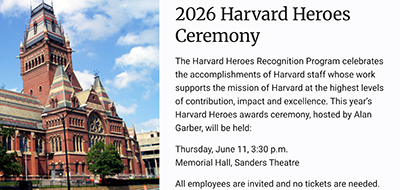
Thursday, June 11, 3:30 p.m.
Memorial Hall, Sanders Theatre