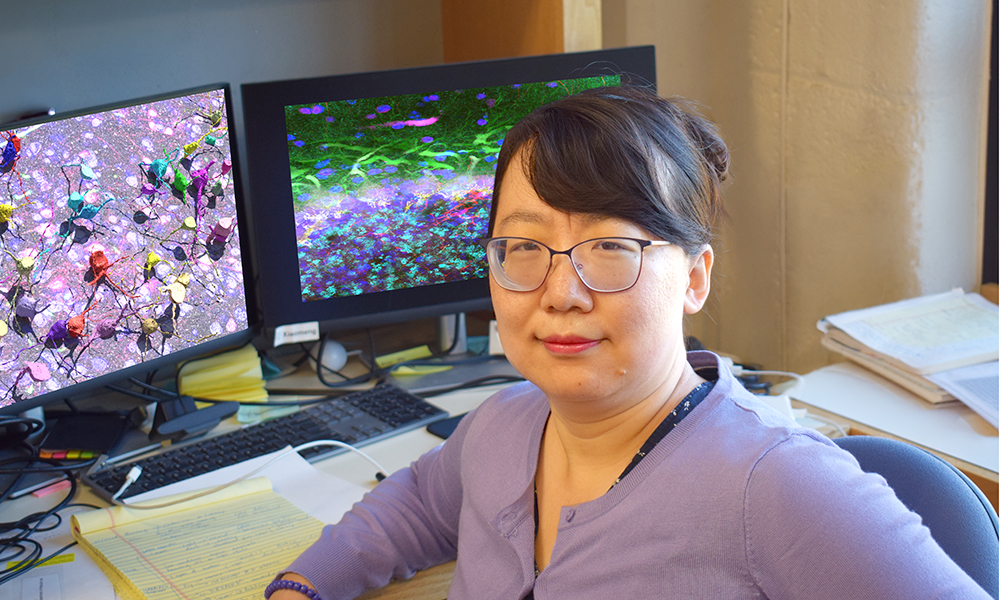

Xiaomeng Han, PhD, a postdoctoral fellow in the MCB laboratories of professors Catherine Dulac and Jeff Lichtman, studies the neural circuits that shape behavior. Outside the lab, they have also made their mark as a teacher, an artist, and an amateur folk singer, finding creative ways to communicate complex neuroscience concepts.
Their latest recognition is their selection as an associate in the Society for Neuroscience (SfN) Scholars Program, a professional development opportunity that will help them build connections with other neuroscientists and advance their academic career.
“I am delighted that Xiaomeng has been selected as an associate to the highly competitive Society for Neuroscience (SfN) Scholars Program,” said Dulac. “Xiaomeng is a highly creative and multi-talented person both in science and in many fields outside academia, such as in the arts, and this program will open doors to all sorts of interesting new encounters and professional opportunities.”
Han’s research focuses on connectomics, the study of how neurons are connected to form the circuits underlying brain function and behavior. In particular, they investigate the preoptic area of the hypothalamus.
Han joined Lichtman’s laboratory in 2019 and earned their PhD there in 2023, eventually forming an ongoing collaboration with Dulac’s group to map neural connections in the hypothalamus while maintaining their affiliation with Lichtman’s group.
“Xiaomeng is a gifted researcher who has made excellent progress in the extremely challenging area of correlated light and volumetric electron microscopy, a necessary aspect of making sense of connectomic datasets,” said Lichtman. “They deserve this acknowledgment; I know they will make the most of the opportunities this scholar’s program offers.”
The Lichtman/Dulac collaboration recently received a five-year NIH R01 grant for a project titled Connectomic Mapping of Microcircuits Underlying Infant-Directed Behavior. The research aims to provide a detailed picture of the neural circuits associated with behaviors directed toward infants, potentially revealing how brain network organization supports complex social behaviors.
For Han, an important part of research is approaching scientific questions in different ways. “I enjoy developing methods and testing hypotheses from different perspectives,” they said. “Relying on a single perspective can limit our understanding, even when the methodology is sound.”
Bringing Neuroscience into the Classroom
Beyond their research, Han has contributed to undergraduate neuroscience education at Harvard through teaching and visual communication. Currently, they are working with two students who are both doing their senior thesis in the Dulac lab.
They were among four MCB teaching fellows recognized by Harvard’s Bok Center for Teaching and Learning for excellence in teaching, reflecting their commitment to helping students understand complex scientific concepts.
A Multifaceted Artist
Han has also explored how visual storytelling can make neuroscience research more accessible. As a Media & Design Fellow at the Bok Center’s Learning Lab, they developed graphical abstracts for MCB80: The Neurobiology of Behavior, an undergraduate course examining the neural mechanisms underlying behavior.
These visual summaries translate complex neuroscience research papers into illustrations that highlight key concepts, experimental approaches, and scientific findings. By presenting information graphically, the abstracts offer students another way to engage with challenging material and understand how individual experiments contribute to broader scientific discoveries.
Their work illustrates the growing importance of visual communication in science, both as a teaching tool and as a means of making sophisticated research more understandable. Han sees art as another way to explore scientific ideas and share them with others. “I believe science and art are complementary expressions of human curiosity and creativity,” they said. “Art, when done correctly, offers a useful way to make complex concepts accessible and engaging.”
Han’s interest in visual expression extends beyond scientific illustration. From 2020 to 2022, they pursued a Master of Fine Arts degree in illustration, specializing in Comic Book Art, through an online program at an accredited institution in the San Francisco Bay Area.
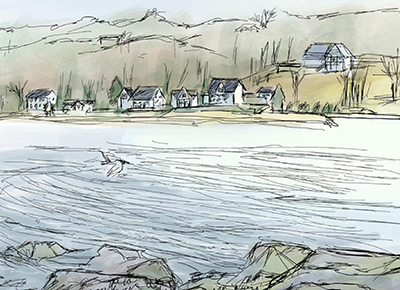
The figure shows one of Han’s assignments in this online program: a plein air digital drawing completed at Cold Spring Harbor Laboratory during the Neuronal Circuits Conference.
In 2024, their artwork was selected for exhibition at the Harvard Art Show at the Smith Campus Center, which showcases the creative talents of members of the Harvard community. The exhibition gave Han an opportunity to share another dimension of their creativity, complementing their scientific research and educational work.
Recently, Han’s interest has shifted to performing 60s folk songs with a ukulele. Their favorite folk singers are the late Phil Ochs, Pete Seeger (a Harvard College dropout in the 1930s), and Woody Guthrie. Han is also exploring how to integrate machine learning and AI into her research.
Together, Han’s research, teaching, and artistic pursuits reflect an interdisciplinary approach to neuroscience—one that brings together the detailed investigation of neural circuits with new ways of communicating scientific ideas.
“I hope to connect people with different backgrounds so that I can view science and research from different perspectives,” Han said. “I plan to be a good scientist while incorporating art, teaching, and science communication into my career.”