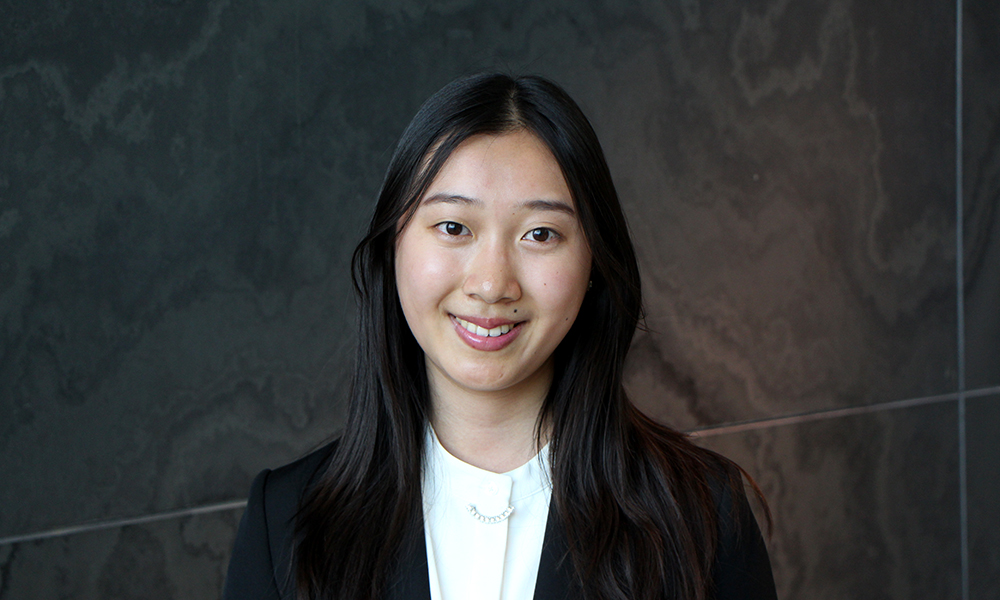

Mira Jiang, a senior concentrator in computational neuroscience with a secondary in English literature, has been selected as a Schwarzman Fellow and will begin the prestigious, fully funded postgraduate program at Tsinghua University in Beijing in late August.
The one-year Schwarzman Scholars program brings together future leaders from around the world for intensive study of global affairs, governance, and leadership, with a particular focus on China’s role in international systems. For Jiang, the fellowship represents an opportunity to step beyond the laboratory and examine how large-scale systems—especially healthcare systems—shape the practice of medicine.
“The Schwarzman is a post-grad, one-year fellowship on global affairs in China,” Jiang said. “It’s hosted at Tsinghua, and because it’s global affairs, there’s not a ton of science research that generally goes on. Scholars are expected to do a capstone, and the focus is much more on systems thinking and governance.”
Jiang plans to pursue medical school following the fellowship and views the year in China as a critical bridge between her scientific training and her long-term goals in medicine. “I’m kind of going to it to get a better understanding of how systems operate—especially healthcare systems—because I’m planning on going to medical school after,” she said.
Research at the gut–brain interface
At Harvard, Jiang has conducted undergraduate research since her freshman summer in the lab of Meenakshi Rao at Boston Children’s Hospital, where she studies the gut–brain axis. Her work explores how hormones and microbes interact to shape the function of the enteric nervous system.
“I started off studying the effects of androgens on gut motility,” Jiang said. “There’s a lot of work on disorders of gut–brain interaction showing there could be a hormonal and microbial component, and there are also a lot of sex differences in how severe the symptoms are and how often the conditions occur.”
Her research uncovered a striking connection between hormone signaling, microbes, and specific neuronal populations in the gut. “I found that androgen signaling very specifically targets an inhibitory motor neuron population, and within that, the signaling is mediated by the gut microbiome,” she said.
Building on those findings, Jiang is now investigating how microbes influence neuronal identity. “Without microbes in the GI tract—like in mice on antibiotics—there’s this shifting phenotype where inhibitory neurons start expressing excitatory markers,” she said.
Rao, who has mentored Jiang for the past three years, emphasized both Jiang’s scientific growth and her drive to explore broadly across disciplines.
“I have had the pleasure of serving as Mira’s undergraduate research mentor for the past three years,” Rao said. “Her infectious curiosity is matched only by her intellectual capability, and it has been a pleasure to watch her dive into all the opportunities at Harvard and figure out how she wants to make an impact on the world.”
When Jiang first joined the lab, Rao noted, she had no prior bench research experience. “She has since become a highly capable young scientist, now spearheading a project focused on understanding how microbes instruct neurons in the intestine on who they should be and, in turn, how this impacts gut health,” Rao said. “I am thrilled that her talents are being recognized with the Schwarzman Fellowship, and I look forward to seeing her become a leader in academic medicine.”
In addition to her work at Boston Children’s Hospital, Jiang has conducted research at the RIKEN Center for Brain Science in Japan and is a Young Guts Scholar of the American Gastroenterological Association.
Leadership, writing, and global perspective
Beyond the lab, Jiang has taken on significant leadership roles across campus. She serves as president of the Creative Writing Collective, the largest student writing organization at Harvard, co-chairs the Leverett House Committee, and was editor in chief of Prescriptions, the undergraduate medical humanities publication.
Her intellectual range and leadership were central to her Schwarzman application, according to William C. Kirby, T.M. Chang Professor of China Studies at Harvard, who taught Jiang in GenEd 1136, China: Power and Civilization, an intensive case-based course spanning more than two millennia of Chinese history.
“Mira excelled in every aspect of the course,” Kirby says. For the course’s final project, Jiang led a team investigating the collapse of China’s real estate sector, focusing on the failure of Evergrande. Kirby described the work as “a sophisticated piece of writing,” noting its historical grounding and nuanced analysis of China’s urbanization, land ownership, and political economy.
“I thought I knew this story well,” Kirby wrote, “but I learned a great deal from their study.”
Kirby also emphasized Jiang’s resilience and judgment—qualities he sees as well-suited to the demands of the Schwarzman program. “I can think of no better program for her,” he wrote. “She will be a terrific addition to the Schwarzman Scholars community.”
Looking ahead
Jiang will begin the Schwarzman Fellowship in late August and has applied to medical school this cycle, with plans to defer matriculation for the fellowship year. She hopes the experience will inform her long-term goal of shaping how artificial intelligence is integrated into medicine—both clinically and at the level of health systems and policy.