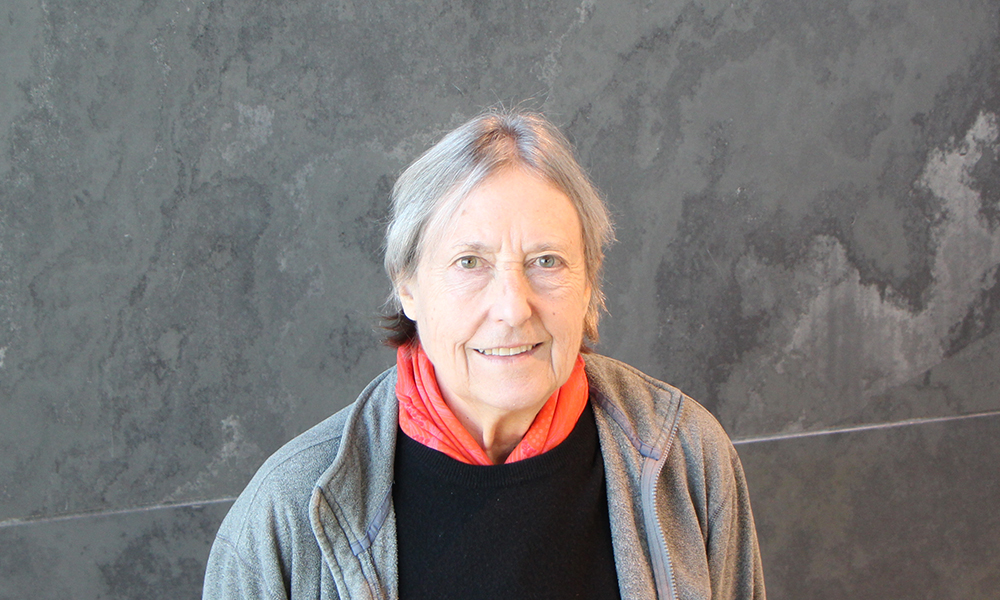

Nancy Kleckner, the Herchel Smith Professor of Molecular Biology, has been awarded the 2025 Charles E. Helmstetter Prize Lifetime Achievement Award (PDF) in recognition of her groundbreaking research on bacterial chromosome dynamics and their role in coordinating the cell cycle.
Kleckner’s work is guided by Jacques Monod’s well-known idea that “what is true for E. coli is true for the elephant.” Her lab seeks to understand how bacterial cells reliably execute one round of DNA replication, sister chromosome separation, and cell division during each cell cycle—even as growth conditions vary.
In earlier studies, the Kleckner lab discovered that the E. coli nucleoid elongates in periodic pulses rather than continuously. In her Helmstetter Prize lecture, Kleckner presented new evidence suggesting that these pulses drive the physical separation of sister chromosomes. The team’s findings point to a model in which the mechanics of chromosome segregation help coordinate both the chromosome cycle and the cell division cycle. This new insight resulted from the collective efforts of former post-doctoral fellows Mathieu Stouf, Katerina Chatzi, and Maria Mukhina; undergraduate Sam Gould; and colleague Zheng Zhang of the Shenzhen Institutes of Advanced Technology, China.
Kleckner’s research program also extends to chromosome behavior during meiosis. In collaboration with Gareth Jones (University of Birmingham) and Denise Zickler (Université Paris-Saclay/CNRS I2BC), she co-authored “Meiosis Across Three Centuries,” (PDF) a sweeping historical review of meiosis research published in Chromosoma. The article, recently named the journal’s Paper of the Year, traces the evolution of the field from the earliest cytological studies at the end of the 19th century through later cytological studies highlighted by new discoveries from electron microscopic 3D serial section reconstructions and BrdU labeling, and finally the emergence of molecular methodologies, new model organisms, and availability of fluorescence imaging.
Kleckner entered the field in this final phase, bringing expertise in chromosomal transactions at the DNA level as provided by her early independent work on transposable elements. Her laboratory is interested in two century-old phenomena: how homologous maternal and paternal chromosomes pair without generating unwanted entanglements, and the phenomenon of “crossover interference”, a one-dimensional spatial patterning process in which recombination complexes arise with even spacing along organized chromosomes.
Beyond her research, Kleckner has played a key role in preserving the legacy of longtime Harvard biochemist Guido Guidotti, who taught in the department for more than 50 years until his passing in 2021. Thanks to these efforts, the full set of Guidotti’s Spring 2000 Biochemical Sciences 11 lectures has been made publicly available. His intuitive and enthusiastic lectures were targeted to premedical students, and he drew on his training as a doctor to emphasize links between basic science and medicine.