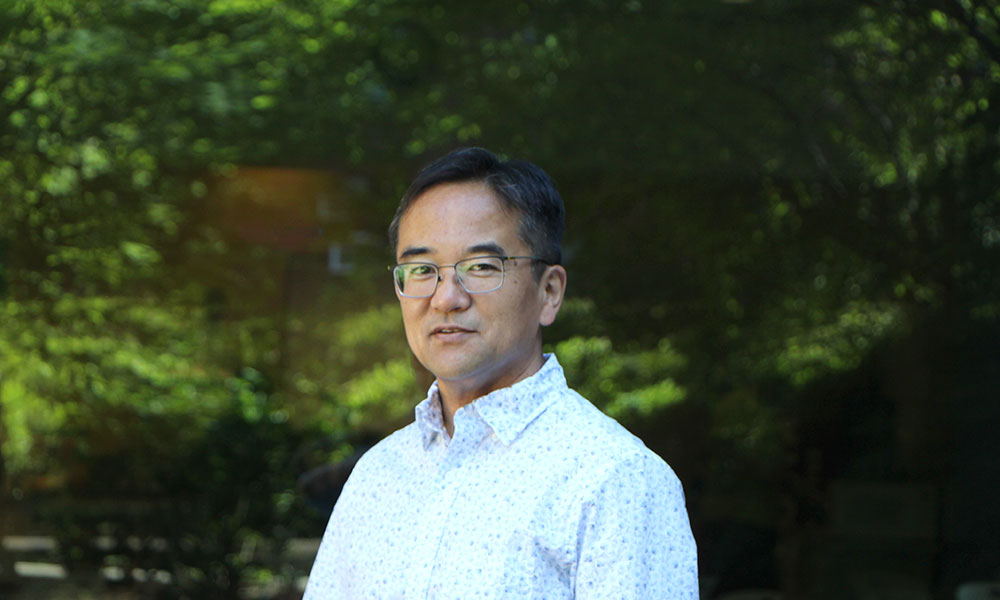

After nearly two decades at Harvard, neuroscientist Naoshige Uchida is preparing to take on a new role: chair of the Department of Molecular and Cellular Biology (MCB).
Uchida, whose research has helped illuminate how the brain learns from experience through dopamine-based neural circuits, will assume leadership of one of Harvard’s largest and most diverse life sciences departments at a time of both opportunity and challenge for academic research.
For Uchida, the decision to become chair was driven by a sense of responsibility to the department’s future—particularly its junior faculty. “I thought that this is a critical time for the department, and also a critical time, especially for junior faculty,” he said.
Over the past decade, MCB has invested heavily in recruiting promising early-career scientists across a broad range of disciplines. Ensuring their success, Uchida said, is one of his top priorities. “We spent a lot of effort over the last 10 years or so to hire new faculty, junior faculty, and we succeeded in getting great junior faculty,” he said. “It is our responsibility to create a great environment for them. Their success is really our future.”
A Career Built at Harvard
Uchida arrived at Harvard in 2006 as an assistant professor after completing postdoctoral training at Cold Spring Harbor Laboratory. He was recruited during the early years of Harvard’s Center for Brain Science, becoming its first faculty hire.
At the time, the Center for Brain Science was focused on using genetically tractable animal models to understand neural circuits and behavior. “I was just starting to study decision making in rodents, and that was really new to the field,” he said.
Although his early research focused on the sensory system and olfaction, Uchida’s laboratory soon expanded into questions of learning and decision-making. Today, his work centers on the dopamine system and its role in how animals learn from experience. “I’m still interested in sensory processing, but our focus has been learning and decision-making, particularly the neural circuits involving dopamine,” he explained
His research has helped advance understanding of the brain’s algorithms for learning from rewards and threats, and how the brain computes dopaminergic reward prediction errors —the surprise signals that drive learning in the brain—fundamental mechanisms that shape behavior across species.
An Environment That Shaped a Scientific Career
Looking back on the past 20 years, Uchida credits Harvard’s scientific community with helping him build and grow his research program. “The Center for Brain Science gathered people with an interest in neuroscience, so that was really an exciting environment to be in,” he said. “That really helped me develop my research program.”
He points to mentorship and collaboration from colleagues, including MCB faculty members Catherine Dulac and Venkatesh Murthy, as well as former Center for Brain Science faculty member Markus Meister. “All these very accomplished people helped me develop my research program here,” Uchida said. “It was quite an amazing place to be.”
Those experiences have shaped how he views leadership and mentorship today.
Protecting Curiosity-Driven Science
As chair, Uchida hopes to preserve one of MCB’s defining characteristics. “Our department really studies fundamental biology and curiosity-driven research,” he said. “These things are not necessarily strongly supported by the government sometimes, so I want to make sure that people understand that a fundamental understanding of biology is the basis of a lot of technology and also medical applications.”
He believes that maintaining the department’s strength in basic biological discovery is essential, not only for scientific advancement but also for future innovations in medicine and technology. That commitment, he noted, has deep roots within MCB.
“One of the strengths of this department is being able to study fundamental questions in a curiosity-driven manner,” Uchida said. “That has been the strength from the early days, and there is a good history of that.”
At the same time, he recognizes that modern biology has become increasingly broad and interdisciplinary. MCB now encompasses fields ranging from neurobiology and genetics to structural, cellular, and developmental biology. “Biology got quite diverse,” Uchida said. “It’s really challenging sometimes to unite the department. It’s going to be a challenge, but we have to think hard about how to address that.”
A Department Built on Community
Alongside supporting fundamental science, Uchida hopes to foster a departmental culture that is intellectually vibrant, collaborative, and enjoyable.
“I think doing science is fun,” he said. “Sometimes we forget about it.”
Creating an environment where people are excited about their work—and connected as a community—will be a central goal of his leadership.
“I think it is very important to have an exciting environment, both scientifically and as a community. It is equally important to recognize that our ability to do science really depends on the support of excellent MCB staff,” he said.
As MCB continues to grow across multiple disciplines, Uchida believes maintaining a strong sense of community will be essential to the department’s continued success.
Colleagues Endorse a Thoughtful Leader
Those who have worked closely with Uchida say his thoughtful leadership style makes him well-suited to guide the department through its next chapter.
“I’m delighted to pass the MCB chair baton to Nao,” said Rachelle Gaudet, the current MCB chair. “Nao cares deeply about our department and its research and teaching mission, and also about how it intersects with other Harvard communities. Nao’s thoughtful approach is already shining through in our work together during this transition period. I wish him clear skies, a steady helm, and all the resources he needs to implement his vision.”
Catherine Dulac, a former MCB chair, noted both the challenges and importance of departmental leadership, particularly during a period of uncertainty for academic science.
“Becoming Department Chair entails a significant time and energy commitment that is taken away from one’s own research in order to benefit the larger community,” Dulac said. “Harvard is an extraordinary place for academic excellence, so that individual faculty are trusted to lead departments for a few years is both a big challenge and a great honor.”
Dulac said Uchida’s willingness to take on the role reflects his commitment to the department and its future. “I am very grateful for Nao Uchida to step in as the new MCB chair during a complex period for the science community in general and Harvard in particular,” she said. “It is a clear testimony of his wisdom and leadership, and I am eager to help support his new responsibilities in any way I can.”
Former MCB Chair Venkatesh Murthy said Uchida’s reputation as both a scientist and colleague makes him particularly well-suited for the position. “Nao is an accomplished and highly respected neuroscientist, known for his thoughtful and deep engagement with his subject matter,” Murthy said. “I am certain that he will bring the same depth and deliberation to his role as MCB Chair. We really need such thoughtfulness in these difficult times, and I am optimistic that we will thrive under his leadership.”
Former MCB Chair Sean Eddy echoed that confidence in Uchida’s leadership. “Nao is going to be an excellent chair for MCB,” Eddy said. “He is calm and thoughtful, and as he showed at the MCB retreat last year, he also has a sly sense of humor and the deadpan delivery of a standup comedian; great skills for navigating the absurd times we are going through right now.”
As he prepares to begin his term, Uchida hopes faculty, staff, postdoctoral fellows, and students will feel comfortable sharing ideas and concerns with him. “I want people to know that I want to talk to people and I want to know what the problems are, and what they like about how things are,” he said. “Any feedback is appreciated.”
While he describes himself as “a relatively quiet person,” he wants the MCB community to know that his door is open.
For Uchida, the future of MCB will be built on the same principles that attracted him to Harvard nearly 20 years ago: scientific curiosity, collaborative discovery, and a shared commitment to advancing fundamental understanding of biology.