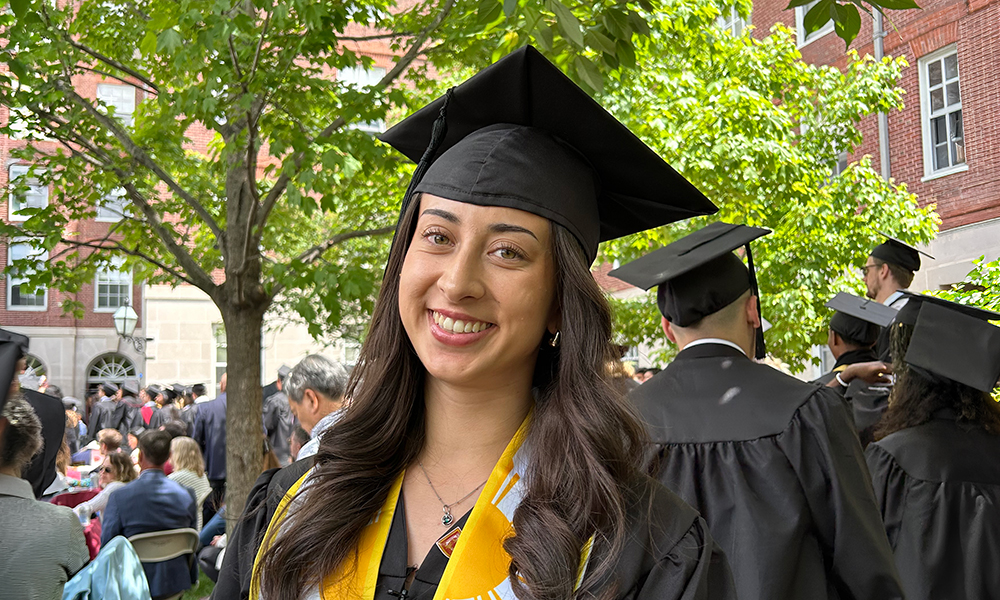

Recent Harvard graduate Vanessa Frelih has been awarded the Robert J Glushko Thesis Prize which recognizes outstanding undergraduate thesis research in cognitive science. A Neuroscience concentrator who conducted her research in the lab of Professor Naoshige Uchida, Frelih received the award for her senior thesis, Dissecting Age-Related Cognitive Flexibility Deficits: Insights from Synaptic Plasticity and Recurrent Neural Dynamics, examining how aging affects cognitive flexibility—the ability to adapt behavior when circumstances change.
“The prize itself is meant to involve any thesis that has to do with cognitive science,” Frelih said. “Any behavioral outcomes and broader cognitive processes rather than necessarily molecular-level neuroscience.”
Working in the Uchida lab since the spring of her sophomore year, Frelih investigated one of the key challenges associated with aging: why older individuals often struggle to adapt to changing environments while retaining many other cognitive abilities.
Her thesis focused on the concept of value learning—the process by which individuals learn which behaviors are likely to lead to desired outcomes. Using mouse models, she examined how aging affects this process in both stable and dynamic environments.
“We were trying to understand what drives cognitive flexibility declines with age,” Frelih said. “One of the reasons independence is kind of lost with age is difficulty adapting to new routines or being in an unexpected environment and not knowing how to respond.”
The research built on previous findings from the Uchida Lab showing that different neural mechanisms support learning in stable versus dynamic settings. In a stable environment, a particular action consistently leads to a reward. In a dynamic environment, the relationship between actions and rewards changes over time, requiring continual adaptation.
“In the stable environment, these older mice performed comparably to their younger counterparts,” she said. “But as soon as you put them in a dynamic environment, old mice struggled to flexibly adapt these learnings, manifesting as impairments in task performance.”
One of the study’s most striking findings emerged when the researchers returned the older mice to a stable environment after testing them in the dynamic setting. “When we put them back on the stable task, they immediately regained their task proficiency,” Frelih said.
The results suggest that aging may selectively impair neural processes required for adapting to changing conditions while leaving other learning mechanisms intact. “What I took away from my research and the findings was that the neural mechanisms driving value learning in dynamic environments appear to be selectively impaired by age, while the mechanisms dominating value learning in stable environments seem to be conserved,” Frelih said.
The findings contribute to a growing body of research demonstrating that aging affects specific cognitive systems differently rather than causing a uniform decline across all aspects of cognition.
Following graduation, Frelih is joining the Josselyn-Frankland Lab at the University of Toronto as an Assistant Research Technologist, working with Dr. Sheena Josselyn in the internationally recognized conjoint laboratory led by Josselyn and Dr. Paul Frankland. She plans to spend the next year gaining additional research experience before applying to graduate programs.