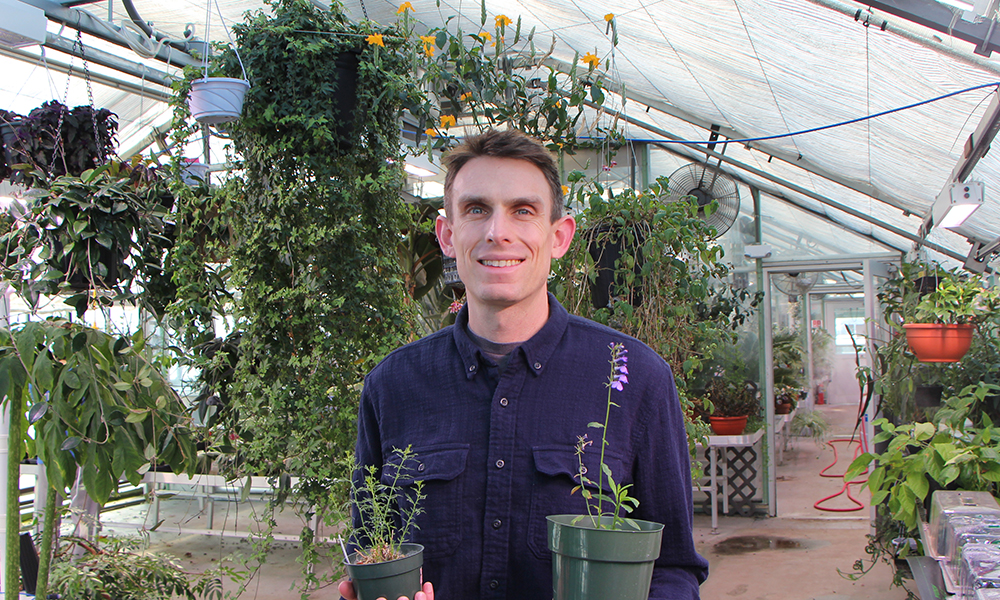

Ryan Nett, MCB assistant professor, has been named a recipient of the 2025–27 George W. Merck Fellowship. Awarded annually to outstanding tenure-track faculty, the prestigious two-year fellowship provides $600,000 in research support and recognizes investigators, nominated by Harvard faculty, whose work demonstrates exceptional innovation and promise.
The Merck Fellowship will support Nett’s lab as it investigates a fascinating and understudied question: how plants build complex neuroactive molecules that shape the behavior of animals—including humans.
“Plants make thousands of neuroactive molecules that can dramatically influence animal behavior,” Nett says. These molecules benefit the plant by acting as potent neurotoxins to defend against herbivores, or by manipulating the behavior of beneficial pollinators. “And because many neuroactive plant molecules mimic neurotransmitters, they can influence our own neurobiology.” That has led to the widespread use of plant-derived molecules as important medicines in the treatment of pain and neurological disease.
From morphine to caffeine to countless lesser-known compounds, plant natural products have profoundly shaped medicine and human culture. Yet despite their importance, scientists still understand surprisingly little about how plants synthesize many of these complex molecules—or how that chemistry is organized inside living plant tissues.
“In my lab, we are broadly interested in understanding how plants build neuroactive molecules,” Nett explains. “These molecules can be highly complex, and we understand relatively little about the underlying chemistry that plants use to synthesize most of them.”
Unlike a single chemical reaction in a test tube, plant metabolism is thought to be highly coordinated across distinct cell types, each functioning as a kind of specialized chemical factory. Different cells may synthesize, modify, transport, or store intermediates along a pathway. But how these cellular factories coordinate with each other to build complex molecules remains largely unknown.
“Plant metabolism is thought to be intricately organized among different specialized cells that act like chemical factories to build and store molecules,” Nett said. “However, we know almost nothing about how metabolic pathways are coordinated among these specialized plant cells.”
With support from the Merck Fellowship, Nett’s lab will pursue this new direction by dissecting how valuable neuroactive molecules are synthesized and how their biosynthesis is spatially organized across different plant cell types.
The work has both fundamental and translational implications. Beyond providing basic insight on how complex biochemistry occurs in a living plant, Nett expects his lab’s results will reveal novel cellular mechanisms that plants use to achieve high-level production of specific molecules. By revealing new enzymes, pathway architectures, and strategies for cellular compartmentalization, the research could inform future efforts to engineer plants—or other organisms—to sustainably produce medically important compounds.
The fellowship also represents a meaningful vote of confidence at a pivotal stage in Nett’s career.
“The study of specialized plant cells is a new direction for my lab, so I’m extremely grateful to have support from the George W. Merck Fellowship to pursue this underappreciated aspect of plant biochemistry.”
MCB Chair Rachelle Gaudet emphasized both the promise of Nett’s science and the significance of the award.
“The George W. Merck Fellowship recognizes junior faculty whose research holds exceptional promise, and Ryan Nett embodies that spirit,” Gaudet says. “Ryan’s research is transforming our understanding of how plants make medically important natural products. His lab is rapidly decoding and engineering pathways for multiple psychoactive plant compounds, revealing novel enzymes, unexpected compartmentalization strategies, and striking examples of convergent evolution across the plant kingdom. I am thrilled to see Ryan’s promise and accomplishments recognized; this prestigious award will give Ryan the freedom to pursue ambitious ideas at a critical stage in his career.”
Professor Emily Balskus, of the Department of Chemistry and Chemical Biology and one of Nett’s faculty mentors, praised Nett’s trajectory and the broader impact of his work.
“It has been exciting to follow Ryan and his group’s progress over the last few years discovering new plant biosynthetic pathways,” Balskus said. “His research has the potential to transform our understanding of how plants produce molecules with intriguing structures and important biological activity.”
Nett’s work also sits at the intersection of ecology, evolution, and neuroscience—a theme that resonates with his close collaborator and MCB colleague Nicholas Bellono.
“Ryan’s work exploits plants to discover biosynthetic machinery, evolutionary mechanisms, crosstalk with other organisms, and to learn how evolution hones medicinal molecules,” Bellono says. “It’s rooted in basic exploration of ecology and evolution and incredibly translational and impactful. It’s a privilege to share space, lab meetings, and science with the Nett group. I am even more excited since I expect this award means I will not have to buy the lab meeting bagels.”
As the Nett lab embarks on this new phase, the Merck Fellowship will provide both resources and flexibility to pursue bold questions about how plants choreograph complex chemistry within living tissues. In doing so, Nett and his team hope to illuminate not only how plants defend themselves and communicate with other organisms, but also how evolution has shaped the production of molecules that continue to influence human health.