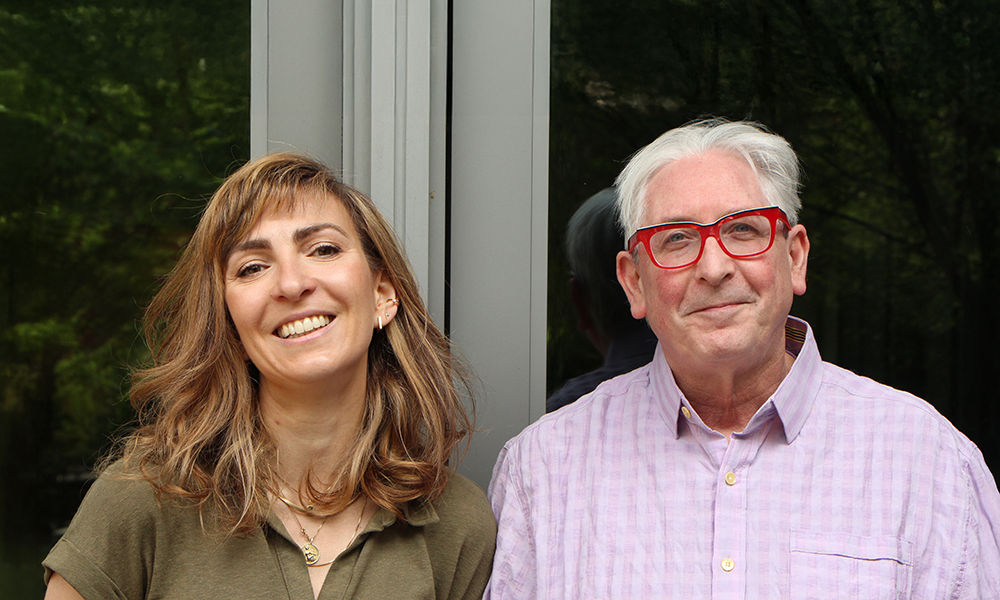

Two dedicated educators from Harvard’s Department of Molecular and Cellular Biology (MCB) have been recognized with the Anya Bernstein Bassett Award for Excellence in Teaching, a prestigious honor that celebrates outstanding non-ladder faculty who are primarily focused on teaching.
Alain Viel, MCB Senior Lecturer and Director of the Undergraduate Life Sciences Teaching Laboratories, and Sien Verschave, MCB Curriculum and Pedagogy Manager, were selected for the award, which is only in its second year and recognizes faculty members who have demonstrated exceptional commitment to undergraduate education and student mentorship.
Alain Viel: Creativity, Entrepreneurship, and Research-Based Learning
Viel, who has been with MCB since 1992, brings a unique perspective to undergraduate education through his research-based courses and innovative teaching methods. As Director of the Undergraduate Life Sciences Teaching Laboratories, Viel has spent decades developing courses that emphasize learning by doing rather than traditional lecture-based instruction.
After creating his flagship course, LS 100: Experimental Research in the Life Sciences, in 2004, Viel has been teaching it twice a year, providing students with real research experience, regardless of their year or concentration. “You could be a Comparative Literature concentrator and take the course,” he explains. “The major point is not to get published in Nature, but to develop analytical skills—to prepare life science concentrators who wish to enter a research laboratory, introduce non-science concentrators to scientific research, and further develop the analytical skills of every student enrolled.”
Viel’s teaching innovations extend beyond traditional laboratory courses. He co-created the acclaimed animation The Inner Life of the Cell with the late Rob Lue, which revolutionized how biological processes are visualized for students. The seven-minute animation has become one of the most-viewed educational videos on YouTube and is used in classrooms and museums worldwide.
More recently, Viel has developed courses in creativity and entrepreneurship in the life sciences, drawing parallels between scientific research and the development of startups. “If you think about creating a startup, of course, and doing research, it’s very similar in approach,” he noted. “You have to try to find a question that needs an answer. Then you have to know what has already been done. And then you have to think about possible solutions, test your solutions.”
Viel has also been a member of the Lemann Program for Creativity and Entrepreneurship (LPCE) for the past four years. Conceived by Lue and funded by Brazilian investor Jorge Paulo Lemann, LPCE is structured around three pillars: curriculum, coaching, and community. Viel has taught the program’s two cornerstone courses, CE10 and CE11, both of which are StudioLab on Creativity and Entrepreneurship courses, since the program’s inception. These courses empower students to address global challenges such as climate change, global health, and social justice. The first course focuses on building analytical and creative skills to generate actionable solutions, while the second supports students actively developing early-stage ventures.
“LPCE was established at the end of the COVID-19 pandemic, a time when people were focused on adapting to a new normal,” Viel explains. “But many of the social issues exacerbated by the pandemic were already present long before. One of LPCE’s missions is not to prepare us for a new normal, but for a better one.”
That vision also shapes Viel’s MCB 102, Creativity, Innovation, and Entrepreneurship in the Life Sciences course, which integrates creativity, innovation, and entrepreneurship into the life sciences curriculum. “While business leaders value the analytical and leadership skills fostered by a life sciences education, they often cite a gap in workforce readiness. That’s why I designed a course to close that gap,” Viel explains. MCB 102 provides students with opportunities to apply their scientific knowledge to real-world problems and develop ventures that create social or economic value.
In his role as the UNESCO Chair on Life Sciences and Social Innovation at Harvard University, Viel also amplifies students’ work globally and fosters connections with the broader innovation community. Students in MCB 102 are invited to participate in events organized by LPCE, the Harvard Innovation Lab, and the HealthLab Accelerator (H2A), strengthening their ties to peers across disciplines and creating an interdisciplinary network of changemakers.
Through his work with LabXchange, a platform providing free educational materials for high school STEM education, Viel extends his teaching philosophy beyond Harvard’s campus.
Sien Verschave: Empowering Students Through Research-Driven, Inclusive Teaching
Verschave, who has been with MCB since 2017 and with Chemistry and Chemical Biology (CCB) since 2024, has focused her teaching efforts on addressing what she calls a critical gap in undergraduate education: connecting students’ hunger for research experience with actual opportunities in the lab.
“There was a huge hunger that existed among these students for experiencing research. But then there tends to be a bit of a gap there where not everybody knows how to get in, or they don’t even realize that it’s accessible to them,” Verschave explained.
Verschave has transformed her approach to science education around a core philosophy: creating welcoming and supportive environments where students can realize their full potential. Her primary engagement has been with Life Sciences 1a (LS1a), a foundational course that integrates chemistry and biology to understand drug design fundamentals.
“Creating a welcoming and supportive environment is my main goal to help students realize their full potential,” Verschave explained in her teaching philosophy. She deliberately fosters spaces where students feel safe to question, explore, and embrace mistakes as learning opportunities.
In her large LS1a lectures, which have around 300 students, Verschave has implemented innovative practices to build community despite the class size. She begins each lecture by offering students an intention to keep in mind throughout class—encouraging them to “be fully present,” “exercise patience with themselves and their peers,” or “lean into challenge.”
“Initially, I hesitated to implement this, fearing it might come across as corny,” she noted, “but it quickly became a staple of the course, with students even requesting me to set an intention at the start of an exam or review session.”
Verschave’s experiences with LS1a revealed what she describes as “a huge hunger to experience scientific research” among incoming STEM students who might not know where to look for this kind of training. This insight led her to develop her signature programs: the first-year seminar “Learning to Think Like a Scientist” and the associated summer research program titled Foundational Undergraduate Experiences in the Laboratory (FUEL). While LS1a showcases the product of scientific thinking, the seminar shows students how knowledge is created.
“Having experienced what a powerful tool research can be to stimulate students taking ownership of their learning, I aim to immerse students as quickly as possible and prepare them for a successful experience at one of the Harvard labs after their first year,” she explained.”The overall idea is that when students go through this cycle, they come out more prepared to actually enter a research lab more confidently.”
The results are remarkable: fourteen of the fifteen students who took the seminar in 2024 are now working in Harvard labs, with ten finding their positions through the summer program. All students who participated in both programs last year continued doing research, and seven out of ten secured competitive summer research funding.
Verschave is now scaling her approach with MCB colleagues Katie Quast and Venkatesh Murthy to teach a neuroscience-focused version of the seminar. The expansion maintains the intimate faculty-student connections that make the program successful while reaching more students across different scientific interests.
Her teaching innovations extend beyond program structure to practical classroom techniques. Drawing on her own experiences as a student in traditional European lecture halls, she has developed staggered assessment cycles, created supporting animations for complex concepts, and revised textbook chapters based on student feedback.
“It was only when I took on research in my last year of college that I became a genuinely inspired student,” she reflected, driving her commitment to integrate research experiences much earlier in students’ academic journeys.
Both award recipients emphasized the collaborative nature of their success. Verschave expressed particular gratitude for the support she has received: “I didn’t do this all by myself; it’s really because of the support of many people helping me along the way.”
She specifically acknowledged the Department of Molecular and Cellular Biology, the Department of Chemistry and Chemical Biology, and the First-Year Seminar Program, under the leadership of Dr. Ofrit Liviatan, for their instrumental support in making her educational initiatives possible.
Viel similarly highlighted MCB’s commitment to teaching excellence: “I think that MCB has to be one of the departments that significantly contributes to education and teaching,” noting how the department’s support allows him to pursue innovative educational approaches.
About the Award
The Anya Bernstein Bassett Award for Excellence in Teaching honors the memory of a dedicated educator who, for 30 years at Harvard as a graduate student, Lecturer, and Senior Lecturer, and the long-time director of undergraduate studies for social studies, was passionate about teaching others how to teach at the college level. The award, established in 2024, specifically recognizes non-ladder faculty members who are primarily focused on teaching, acknowledging their unique contributions to undergraduate education.
The recognition comes at a time when both recipients are expanding their programs and exploring new ways to engage students in meaningful learning experiences, ensuring that their innovative approaches to education will continue to benefit Harvard students for years to come.