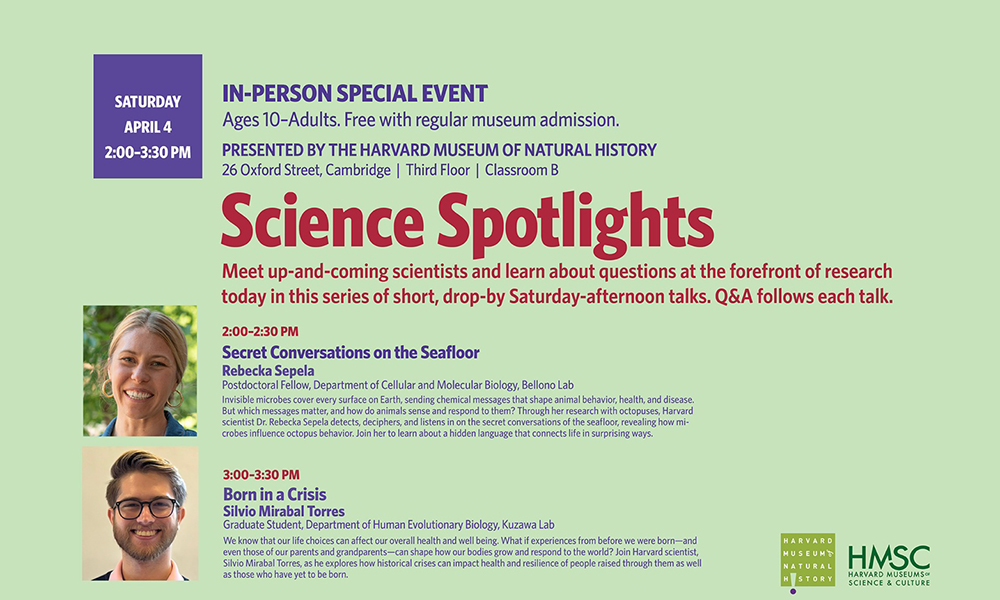

The Harvard Museum of Natural History will host a special Science Spotlights in-person event on Saturday, April 4, from 2:00–3:30 pm, featuring emerging scientists across Harvard, including MCB’s Rebecka Sepela, exploring questions at the forefront of research.
Saturday, April 4, 2:00–3:30 pm ET
Harvard Museum of Natural History
26 Oxford Street, Classroom B, 3rd Floor, Cambridge, MA
Regular museum admission rates apply; recommended for ages 10 and up.
This special event offers a unique opportunity to hear directly from early-career researchers as they delve into unique scientific discoveries—from the hidden chemical languages of the ocean floor to how early-life experiences shape human health across generations.
2:00–2:30 pm – Secret Conversations on the Seafloor
Speaker: Rebecka Sepela, Postdoctoral Fellow, Department of Molecular and Cellular Biology, Bellono Lab
“Microbes coat nearly every surface on our planet and served as Earth’s sole ‘chemical architects’ for nearly three billion years,” Sepela explains. “All of animal evolution has unfolded within this microbial world, and animals have consequently evolved to sense, interact with, and respond to microbial life.”
Focusing on octopuses, Sepela investigates how microbial molecules shape behavior, including parenting and predation. “The octopus is an especially powerful model for this work because its primary chemosensory organ evolved to maintain constant contact with a microbe-rich seafloor environment,” she says. “By identifying which microbial molecules activate the octopus sensory system, we’re beginning to uncover a chemical language shared across life.”
Her research points to broader implications for health and ecology. “Decoding this language could ultimately allow us to shape animal–microbe interactions—promoting beneficial symbioses or preventing disease-causing dysbiosis,” Sepela notes. “Ultimately, this research highlights how deeply connected we are to the microbial world and invites us to consider how our own biology and behavior may be shaped by the invisible microbes we live among.”
In this talk, Rebecka Sepela shares her research on octopuses, revealing how these remarkable animals sense and respond to microbial cues in their environment. By “listening in” on the seafloor’s hidden conversations, her work uncovers a complex chemical language that connects microbes and marine life in unexpected ways.
3:00–3:30 pm – Born in a Crisis
Speaker: Silvio Mirabal Torres, Graduate Student, Department of Human Evolutionary Biology, Kuzawa Lab
How much of our health is shaped before we are even born? And how do the experiences of previous generations influence our development?
Silvio Mirabal Torres explores how early-life stress, nutrition, and historical crises can leave lasting biological imprints that extend across generations. His research examines how these inherited influences shape growth, resilience, and long-term health—offering new insight into the biological legacy of lived experience.
No registration required; seating is first come, first served.