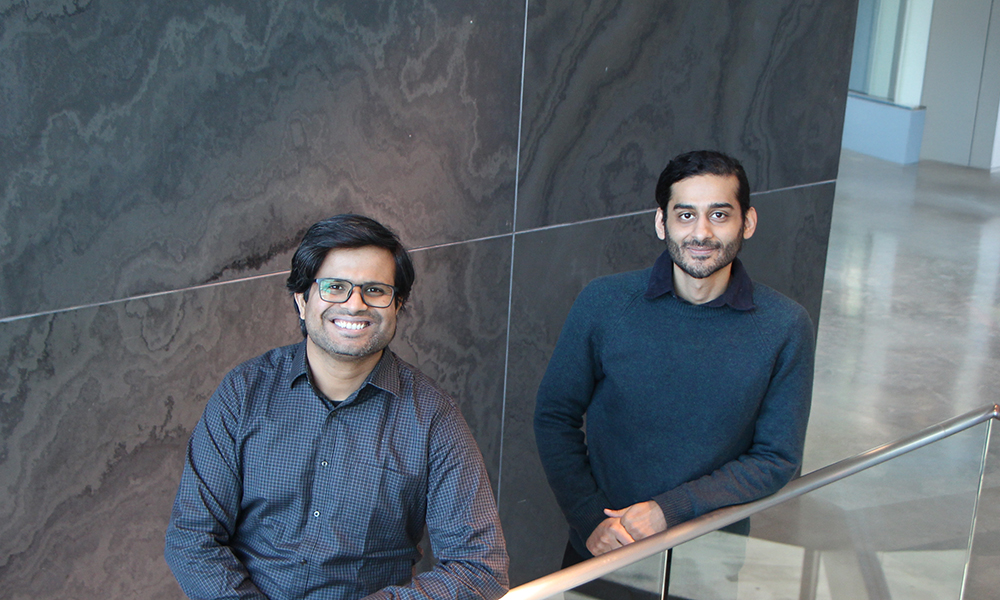

Two postdoctoral researchers affiliated with MCB have been awarded highly competitive Postdoctoral Pioneer Fellowships from the Harvard Brain Initiative (HBI), recognizing innovative projects that span disciplines, model systems, and approaches to fundamental biological questions.
Rishav Mitra and Sanket Walujkar will each use their HBI fellowships to advance research at the frontiers of molecular biology and neuroscience—one probing the deep evolutionary origins of protein synthesis fidelity, the other revealing how lipids actively shape sensory signaling in membrane proteins.
A cross-institutional effort to understand ribosomal innovation

Mitra’s fellowship supports a collaborative project that bridges in vitro biochemistry, molecular evolution, and cephalopod biology. His primary affiliation for the fellowship is with the lab of Amy S.Y. Lee at Dana-Farber Cancer Institute, with co-hosting in the MCB lab of Nick Bellono.
“For this fellowship, I’ve been working across two labs in two separate departments,” Mitra said. “It’s a collaborative project that really sits at the junction of both labs’ expertise.”
The work, “Exploiting Octopus Ribosomes to Understand the Evolution of Nervous System Function and Behavior”, centers on an unexpected and previously uncharacterized feature of the octopus ribosome—the molecular machine responsible for protein synthesis in all living cells. While ribosomes are among the most conserved structures in biology, Mitra and colleagues discovered a unique structural modification in octopus ribosomes that appears to increase the accuracy, or fidelity, of protein production.
“The ribosome is the most ancient molecular fossil we have—it dates back to the last universal common ancestor,” Mitra explained. “What’s exciting here is that we found a novel innovation in the core of the ribosome that we don’t see in other organisms.”
Early functional studies suggest that this modification allows octopus ribosomes to make proteins with fewer errors. “One of the most interesting aspects of the discovery is that this feature appears to increase fidelity during protein synthesis,” Mitra said, noting that protein misfolding and aggregation are linked to nervous system dysfunction during aging.
Beyond function, the project also explores evolutionary origins. By comparing genomes across cephalopod species, including rare deep-sea octopuses collected through collaborations with ocean exploration teams, Mitra and colleagues aim to pinpoint when this ribosomal feature emerged and how it may have co-evolved with the advanced nervous systems and behaviors seen in shallow-water octopuses.
Bellono emphasized the breadth and creativity of the work. “Rishav’s project centers on a super exciting and unexpected observation that octopuses contain unique structural modifications in their ribosome,” he said. “This broad collaborative approach allowed him to determine functional impacts on protein synthesis, underlying mechanisms, and evolutionary origins. It’s fundamental and showcases the approach of truly letting the biology guide us.”
Lipids as active players in sensory signaling

Walujkar, a postdoctoral fellow in the lab of MCB Chair Rachelle Gaudet, will use his HBI fellowship, “Investigating the Role of Pore-Lining Lipid Molecules in Insect Gustatory Receptor Function”, to pursue a computationally intensive investigation of how lipid molecules influence the function of insect gustatory receptors—membrane proteins that allow insects to sense small molecules such as sugars.
Now in his fourth year in the Gaudet Lab, Walujkar has been involved in a project that recently produced one of the first high-resolution structures of an insect gustatory receptor, the silk moth fructose receptor BmGr9. “One of the really surprising things we saw in the structure was lipid molecules lining the ion conduction pore,” Walujkar said. “That’s not something you typically see in ion channels.”
Those observations prompted new questions that are difficult to answer experimentally. “We don’t know exactly which lipids are there, or how changing their chemical identity affects ion conduction,” he said. “Lipid molecules are dynamic in nature, and you can’t genetically encode them the way you can with proteins.”
To overcome these challenges, Walujkar is turning to molecular dynamics simulations—large-scale, atomistic models that allow researchers to watch proteins and lipids move over time. His fellowship is supplemented by highly competitive access to Anton 3, a specialized supercomputer at the Pittsburgh Supercomputing Center designed exclusively for molecular dynamics.
“Anton 3 is orders of magnitude faster than general-purpose clusters,” Walujkar said. “That allows us to run simulations long enough to capture slow lipid dynamics and really understand how these pore-lining lipids affect ion conduction.”
Gaudet highlighted how the work expands the lab’s scientific toolkit. “Sanket’s current research ventures well beyond our lab’s traditional strengths,” she said. “He is establishing a new computational framework for probing gustatory receptor dynamics and lipid–protein interactions, with the potential to reshape how we think about sensory receptor function.”
More broadly, she adds that this work has the potential to reshape how we think about sensory receptor function by highlighting lipids as active, functional components rather than passive elements of the cell membrane. “Gustatory receptors play central roles in feeding behavior, host selection, and ecological adaptation in insects, including many species of agricultural and public health importance,” Gaudet explains. “By uncovering general principles governing lipid modulation of these receptors, Sanket’s research may ultimately inform new strategies for controlling insect behavior, while also contributing to a deeper, cross-disciplinary understanding of how membrane proteins function in complex cellular environments.”
Advancing interdisciplinary brain science
Together, the two fellowships underscore HBI’s mission to support bold, cross-disciplinary research into the molecular and cellular foundations of brain function. Mitra’s work links protein synthesis fidelity to the evolution of complex nervous systems, while Walujkar’s research reframes lipids as active participants in sensory signaling rather than passive membrane components.
For both postdoctoral fellows, the award provides time, resources, and intellectual freedom to pursue ambitious questions. “This fellowship is going to support the entire arc of the project, allowing us to really dig deep into something fundamentally new.”
Walujkar echoed that sentiment. “The computational resources make it possible to ask questions we simply couldn’t ask otherwise,” he said. “That’s incredibly empowering as a postdoc.”