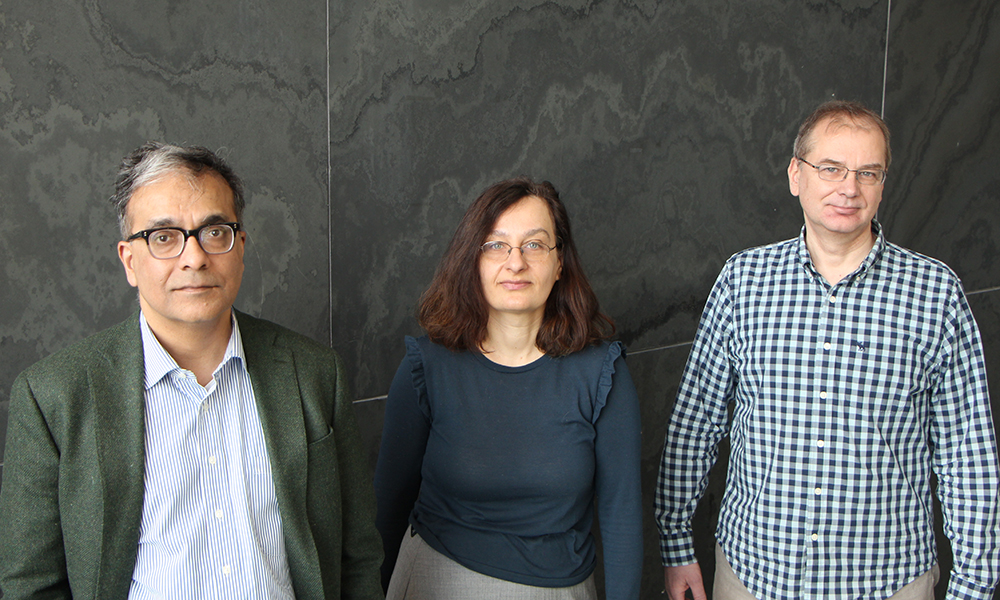

Two new papers published in PNAS from the lab of Aravinthan Samuel shine fresh light on one of biology’s most iconic molecular machines: the bacterial flagellar motor.
Although the two studies examine different facets of this rotary nanomachine—one exploring how the motor dynamically responds to signals, the other uncovering how torque is generated—they share a common goal: advancing understanding of how bacteria convert molecular-scale signals into motion.
For more than five decades, Harvard has been a global center for bacterial chemotaxis research, largely due to the work of Howard Berg. Berg, a longtime Harvard professor whose laboratory was closely connected to the Department of Molecular and Cellular Biology, transformed the field by bringing quantitative physics into microbiology. He built the first 3D tracking microscope to follow individual swimming bacteria and discovered the now-canonical “biased random walk” that underlies chemotaxis. Over the course of his career—much of it based at Harvard and the Rowland Institute—Berg pioneered experimental approaches that revealed how the flagellar motor functions as a molecular machine.
The two new PNAS papers began in Berg’s lab and were completed in Samuel’s lab after Berg’s death in 2021. Alina Mihaela Vrabioiu and Basarab Gabriel Hosu, who were among the final postdoctoral fellows mentored by Berg, moved to the Samuel lab to finish experiments inspired by his questions. Their studies now extend Berg’s legacy while pushing the field in new directions.
Zooming in on the Motor’s Dynamic Response

Alina Mihaela Vrabioiu
The first paper (PDF), led by Vrabioiu, tackles a longstanding question in chemotaxis: how does the flagellar motor respond dynamically to changing chemical signals?
“When bacteria swim, they rarely reach a steady state,” Vrabioiu explained. “They’re constantly encountering changes in attractants or repellents. We wanted to understand how the motor itself responds in real time.”
Much previous work characterized steady-state behavior—what the motor does once conditions stabilize. But in natural environments, bacteria are continually sampling fluctuating signals. To capture this reality, Vrabioiu developed an approach that allowed rapid perturbation of signaling inputs and direct measurement of motor responses on short timescales.
One of the study’s most striking findings concerns how many signaling molecules must bind to trigger a switch in rotation. Rather than requiring large numbers of molecules, the motor appears exquisitely sensitive.
“We were able to estimate the number of molecules that need to bind to the motor to trigger a change, and it’s on the order of one to three,” she said. “That was surprising.”
The results suggest that the motor operates near a threshold. Many binding sites are already occupied under baseline conditions, and only a few additional molecules are needed to tip the balance. At the same time, those final binding events are rate-limiting, preventing inappropriate switching due to random fluctuations.
“In a sense, the motor is primed to respond,” Vrabioiu said. “But it doesn’t respond by accident. There has to be a real increase in signal to push it over the barrier.”
The work reveals a delicate balance between sensitivity and specificity—hallmarks of biological signaling systems—and deepens understanding of how chemotaxis operates under realistic environmental conditions.
“Even though people have studied this motor for decades, it still has surprises,” she said. “We’re trying to understand how such a large molecular machine can respond so precisely to such tiny changes.
A Motor Within the Motor

Basarab Gabriel Hosu
The second paper (PDF), led by Hosu, addresses a different fundamental question: how does the flagellar motor generate torque?
It has been known since the 1970s that bacterial flagella rotate, and subsequent work established that a large structure called the C ring acts as the motor’s rotor. But how the membrane-embedded stator units convert ion flow into mechanical force remained incompletely understood.
Recent cryo-electron microscopy studies revealed an unexpected five-fold symmetry in the stator complex, raising the possibility that it might itself rotate. Structural images alone, however, could not demonstrate motion.
Hosu had helped develop a powerful technique in Berg’s lab—polarized fluorescence microscopy—that can detect rotation of specific protein components inside living cells. Applying this method to E. coli, he and colleagues directly observed rotation of the stator complex.
“We knew how to test the idea,” Hosu said. “Because we had already demonstrated rotation of other motor components in vivo.”
The findings show that the stator is not simply a stationary torque generator but is itself a rotary motor.
“These tiny stator units are functional rotary motors,” Hosu said. “They may be among the smallest rotary motors in nature.”
Rather than a single engine driving the filament, the flagellar motor appears to consist of multiple miniature motors arranged around a central rotor—analogous to gearwheels turning a larger gear.
“You have lots of tiny rotary motors propelling a bigger rotary motor,” he explained. “It’s like a set of gears. That changes how we think about torque generation.”
Beyond E. coli, similar stator-like structures are found in diverse bacterial species and participate in processes ranging from motility to protein secretion and defense against viruses. The discovery suggests that this compact rotary module may be a broadly reused biological solution
Together, the two PNAS studies illustrate how persistent mechanistic investigation—coupled with new experimental tools—can continue to reveal unexpected complexity in even the most intensively studied biological machines.
They also stand as a testament to continuity in scientific mentorship. Questions first posed in Berg’s lab have now yielded new answers in Samuel’s lab, ensuring that Harvard’s long tradition in bacterial chemotaxis continues to evolve—one molecular motor at a time.