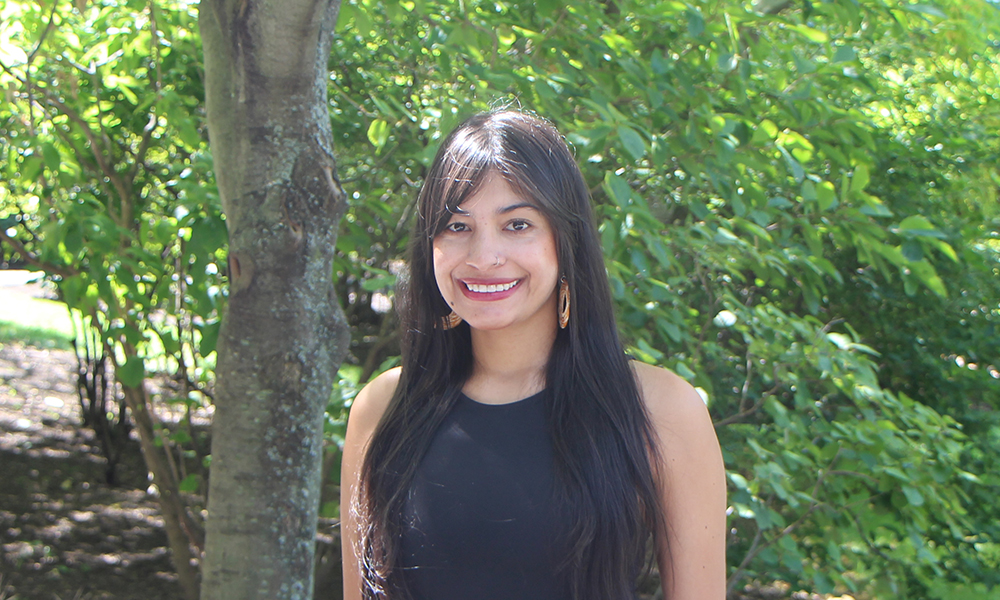

By the time Wendy Valencia Montoya arrived at Harvard, she had already lived in tents deep in the Amazon, crisscrossed Europe to study evolutionary biology, and uncovered genetic clues to pesticide resistance with global agricultural implications. Today, she is a newly appointed Junior Fellow in the Harvard Society of Fellows—bringing her naturalist’s eye, computational insight, and cross-disciplinary curiosity to questions at the intersection of ecology, evolution, and molecular biology.
“Wendy’s a free spirit, both in lab and in life,” says Naomi Pierce, one of her PhD advisors and a professor in Harvard’s Department of Organismic and Evolutionary Biology. “She has never lost that sense of curiosity and awe that led her into a career in biology in the first place.”
Growing up in Colombia, Valencia Montoya was captivated by the natural world from an early age. Encouraged by an inspiring science teacher and a student club at the Medellín Zoo, she knew she wanted to become a scientist before she even finished school.
“I think the strength of my research is that I was trained as a natural historian—and I love being in the forest,” she said. “In Colombia, it’s still very common to know your local biodiversity, to go into the field and observe firsthand the fabric of interactions— like which insects visit which plants. That kind of deep ecological knowledge gives rise to different, big-picture questions, and it’s so important now that biology is becoming increasingly mechanistic.”
She went on to earn her undergraduate degree at Universidad CES with support from a national scholarship awarded to top scorers on Colombia’s college entrance exam and as a finalist in the Math and Language Olympics. Her senior thesis focused on the highly specialized “push-pull” pollination system between cycads and their beetle pollinators—blending careful field experiments with natural history.
She later deepened that work during a two-year stint as a biologist in Colombia’s Parque Nacional Las Orquídeas, where she partnered with the World Wildlife Fund (WWF) on conservation projects in mining-impacted regions. “We slept in cabins in the park and worked with local communities. That experience made me think about how people and biodiversity interact—and how plants and insects communicate in very complex environments,” she said. “There, I saw firsthand how communities and ecosystems engage, how people depend on resources, and how hard it is to balance conservation with livelihoods.”
Crossing Borders and Disciplines
Valencia Montoya won a coveted European Union scholarship to pursue a master’s degree through the Erasmus Mundus Masters Program in Evolutionary Biology (MEME). She studied in the Netherlands, France, and the UK. Her research projects all focused on rapid evolution, particularly in plants and insects.
“I worked on rapid change adaptation, pesticide resistance, and even resurrecting plant populations from seed banks,” she said. “My real passion in science has always been evolutionary biology, and what I loved about these projects was seeing evolution happening in real time, within just a few generations.”
Pierce recalls that one of Wendy’s projects involved analyzing two of the most significant agricultural pest moths worldwide. “A recent introduction of Helicoverpa armigera into Brazil resulted in hybridization with the native Helicoverpa zea,” she explains. “Wendy used her considerable bioinformatic and quantitative skills to identify genes transferred between species, showing that a single genetic locus conferring insecticide resistance has already selectively swept into native populations—a finding that Brazilian researchers are now trying to address.”
Her academic success during this time was recognized with the Graduate Student Excellence Award from the Society for Molecular Biology and Evolution and the Exceptional Young Woman in Science Award. She was also supported by several competitive fellowships, including the Holland Fellowship, a Fulbright Fellowship, and an Ashford Fellowship in the Natural Sciences. These fellowships enabled her to pursue graduate study in the United States.
She also began integrating more genomics into her work, a shift that would carry forward into her PhD research at Harvard. Drawn to evolution in action and sensory communication, Valencia Montoya joined Harvard’s PhD program in 2019, where she pursued a singularly ambitious interdisciplinary project: decoding how cycads, evolutionarily ancient cone-bearing plants that predate flowering plants, attract beetle pollinators using heat.
“To me, Wendy is a biologist’s biologist,” said MCB’s Nick Bellono, who became her co-advisor midway through her PhD. “She studied cycads throughout her training to understand how they heat their reproductive organs as a novel signal for pollination. This signal is old—perhaps even predating the evolution of flower color.”
Once she’d confirmed the behavior, she turned to molecular biology to ask how beetles detect heat. The answer surprised her: they use the same gene families as snakes and mosquitoes, known for their infrared-sensing abilities.
Even more intriguingly, she and her collaborators used AI to analyze thousands of flower images across plant families and discovered a trade-off: plants tend to produce heat or color, but not both.
“Infrared is likely a very ancient pollination signal,” she explained. “We think colorful flowers evolved later, once bees and butterflies—which see color well—became more diverse. But beetles, which don’t rely as much on color, were there much earlier, responding to heat.”
Working across field biology, neurophysiology, informatics, and molecular evolution, Valencia Montoya also helped discover and characterize a new family of chemotactile receptors (CRs) that evolved from nicotinic acetylcholine receptors in octopuses and squid, work that was published in Nature. “She used comparative phylogenetic methods and cryo-EM structures to show how adaptive ‘taste-by-touch’ behavior in octopus evolved from neurotransmitter receptors,” said Pierce. “That project started as a side interest in Nick’s lab but became a significant contribution.”
A Vision for Neurodegenerative Disease
As a Harvard Junior Fellow, Valencia Montoya is now turning her attention to an even more ambitious question: how do some insects safely consume plants that can be lethal to humans?
“Neurotoxins can kill rapidly, but those behind many neurodegenerative diseases act more slowly,” she explained. “A striking example is ALS-PDC, a disease with symptoms similar to Alzheimer’s and Parkinson’s but linked to neurotoxins found in plants. These toxins cause ALS-PDC in people who consume cycads, but the mechanisms behind their neurotoxic effects remain unknown.”
Yet beetle pollinators feed on these cones regularly—without harm.
“In this project, I will study beetles that have evolved resistance to neurotoxins despite consuming doses that can be lethal to humans,” she said. By integrating natural history, plant biochemistry, and structural biology, she aims to elucidate the molecular mechanisms that enable these beetles to detoxify plant compounds and protect their neurons.
“Understanding how nature has solved the challenge of neurotoxin resistance offers a powerful new lens for tackling these disorders,” she said. “This work will illuminate fundamental principles of molecular co-evolution and may inspire innovative strategies for debilitating neurodegenerative disorders.”
As a Junior Fellow, Valencia Montoya will continue her collaboration on physiology with Bellono while establishing new partnerships with MCB’s Ryan Nett and Josefina del Mármol’s lab at Harvard Medical School on chemical sensing.
In addition to her field and lab work, Valencia Montoya brings a deep intellectual curiosity to her science. As an undergraduate, she also studied philosophy and history, and she continues to draw inspiration from those disciplines.
“I like science, but I also like ideas,” she said. “History, the philosophy of science—these are part of how I think about my work.”
She’s also an avid dancer. “I love salsa. That’s part of who I am, too,” she added with a laugh.
This August, she’ll begin her first field season as a Junior Fellow, studying beetle-plant interactions in Florida. Her goal: to uncover the molecular strategies beetles use to detect and resist toxic plants—and, in doing so, to illuminate some of the oldest and most fascinating coevolutionary partnerships in nature.