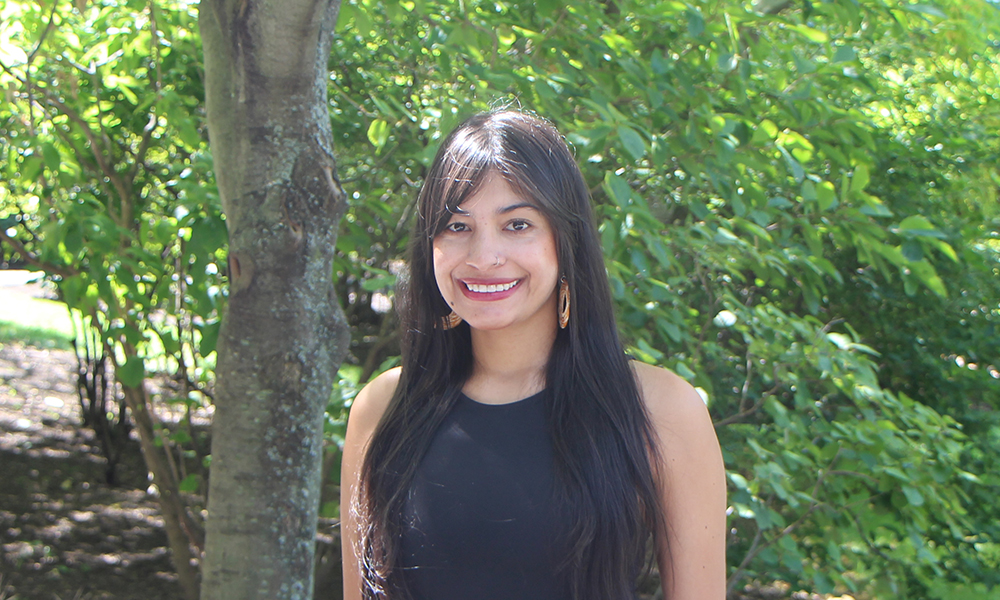

Wendy Valencia Montoya has been named a recipient of the prestigious 2026 Harold M. Weintraub Award in recognition of her doctoral thesis, an ambitious and interdisciplinary body of work that explores how animals perceive and communicate with the world around them. The award honors exceptional PhD research, and for Valencia-Montoya, it celebrates a journey that spans beetle pollinators, octopus arms, butterfly pheromones, and the evolutionary history of sensory receptors across the animal kingdom.
When we spoke in the depths of winter in Cambridge, Valencia-Montoya appeared onscreen in a sun-filled room surrounded by lush tropical plants. The environment, she explained with a smile, helps her recreate a sense of the biodiversity, both plant and animal, she grew up with in Colombia. That connection to the natural world is more than aesthetic—it reflects a guiding principle of her scientific life: understanding and protecting biodiversity by uncovering the fundamental biology that underlies it.
“For me, what ties everything together is the idea of sensory worlds—how organisms detect signals in their environment, and how those signals connect organisms to one another.”
Valencia-Montoya completed her PhD in the Department of Organismic and Evolutionary Biology (OEB), working at the interface of ecology, evolution, molecular biology, and physiology under the guidance of Naomi Pierce, including close collaborations within MCB and the lab of Nick Bellono. Her dissertation examines the interplay between signals and sensory systems through an evolutionary lens, revealing how conserved molecular mechanisms and lineage-specific innovations give rise to novel adaptations and behaviors.
At its core, her thesis asks a deceptively simple question: How do organisms sense their world—and how has that capacity evolved?
In one chapter, Valencia-Montoya surveyed sensory receptors across major animal lineages, identifying emerging evolutionary patterns in how organisms detect light, chemicals, heat, and touch. “I wanted to step back and look broadly at how sensory receptors evolved across animals,” she said. “When you do that, you start to see both deep conservation and surprising innovation.”
She then turned to vivid case studies that bring those principles to life.
One project uncovered that infrared radiation is an ancient pollination signal used by cycads to attract their beetle pollinators. Valencia-Montoya and her collaborators demonstrated not only how the plants generate heat, but also how the beetles detect it at a molecular level. In another chapter, she traced the evolutionary trajectory of cephalopod chemotactile receptors—showing how molecules that once functioned as neurotransmitter receptors were repurposed as sensory receptors expressed in octopus and squid arms, enabling their remarkable tactile-chemical perception.
Her work also extended to butterflies, where she investigated pheromone-producing organs across a radiation of species. There, she identified an evolutionary tradeoff in male signaling: increasing attractiveness comes at a cost.
“These projects span from molecular mechanisms all the way up to behavior,” Valencia-Montoya said. “I’ve been lucky to work with very different systems—octopuses, beetles, butterflies, plants—but they all address related questions about signals, senses, and evolution.”
That breadth is part of what makes her work so distinctive—and emblematic of a scientist motivated by the diversity of life itself.
“Wendy has a rare gift: she asks questions that many other scientists wouldn’t think to ask, and then has the tenacity and ingenuity to actually answer them,” said Naomi Pierce. “She seamlessly brought together labs from two different departments (OEB and MCB) to tackle problems that live at their interface. By understanding the complex molecular and sensory mechanisms governing interactions between thermogenic plants and their pollinators, she showed how much evolutionary insight can be unlocked when you refuse to stop at disciplinary boundaries. Watching her solve challenge after challenge has been one of the genuine pleasures of my career. The Weintraub Award couldn’t have found a more deserving recipient.”
Nick Bellono echoed that sentiment, emphasizing Valencia-Montoya’s intellectual range.
“Wendy is an incredible scientist with the ability to span fieldwork from the Amazon to structural biology in the lab—whatever it takes to answer her questions,” he said. “The most unique thing about her is how her creativity enhances the people and science around her. I’m very happy to see her recognized by this award, and I expect her exceptional ability to blur the lines between traditional molecular and biomedical science and ecology and evolutionary biology will add diversity and inspiration to this group in a time when we need more recognition and support than ever for true curiosity-driven science.”
For Valencia-Montoya, the recognition is especially meaningful because of the kind of science it celebrates.
“It’s unusual that work on these ‘wild’ systems is recognized,” she said. “This is very basic science. We’re studying animals that are relatively weird, and we’re learning fundamental biology about them. That’s important—especially now, when funding can be difficult for curiosity-driven research.”
A unifying theme of her thesis is biodiversity—an idea rooted in her upbringing and visible even in her Cambridge apartment. “One of the things I want to celebrate is biodiversity,” she said. “For me, it has been a journey of joy to be able to work with so many different animals and plants.” She added that continuing to understand and protect biodiversity remains an essential goal of her scientific career.
Her dissertation reveals the “coding logic” of animals’ sensory worlds—how molecular receptors translate environmental signals into perception, and how those systems evolve over time. By integrating comparative genomics, molecular biology, physiology, behavioral studies, and evolutionary analysis, Valencia-Montoya has shown how studying diverse organisms can illuminate fundamental principles that extend across life.
The Weintraub Award recognizes not only the depth of her scholarship but also its adventurous spirit: a willingness to cross disciplinary boundaries, follow unconventional questions, and embrace the complexity of life’s sensory tapestry.
As Valencia-Montoya put it, “There’s a theme of sensory perception throughout the thesis, but it’s expressed in many different systems. I didn’t want to focus on just one model organism. I wanted to explore related questions across different groups. That diversity is the point.”