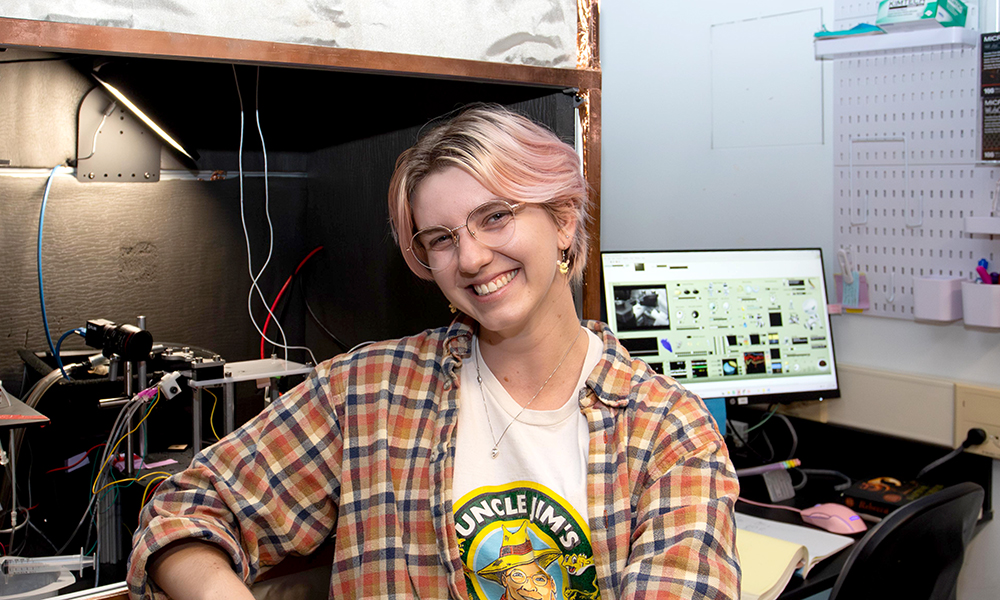

Fourth-year MCO PhD student Hannah McCalmon of the Venkatesh Murthy Lab in MCB has been awarded an NIH F31 Predoctoral Fellowship to support her research on how the brain recognizes familiar smells over time—even as the neurons that represent those smells continually change.
Her project, titled “Stability vs. Flexibility in Odor Representation,” explores how the brain balances consistency and adaptability in sensory perception. “Our brains are remarkably good at maintaining stability,” McCalmon says. “They let us recognize the scent of coffee or the sound of a friend’s voice across months or years. But the neural ‘maps’ that represent those things aren’t fixed—they drift and reorganize with time. I want to understand how we still recognize the same smell day after day when the underlying representation keeps changing.”
This phenomenon, known as representational drift, has been observed in memory and navigation centers such as the hippocampus, as well as in sensory areas like the piriform cortex. McCalmon’s research focuses on another structure in the olfactory system—the olfactory tubercle (OT)—which may help preserve meaningful odor representations even as others shift.
“The OT sits at a crossroads in the brain,” McCalmon explains. “It receives sensory information about odors from the olfactory bulb and motivational signals, like reward value, from dopamine neurons in the ventral tegmental area. That makes it an ideal place to study how the brain links stable perception with flexible learning.”
Using calcium imaging to record neural activity, McCalmon will track how OT neurons respond as animals learn to distinguish between odors and associate them with rewards. By changing reinforcement conditions, she will test whether these odor representations remain stable or shift over time—and how dopamine influences that process.
“If dopamine acts like a ‘neural anchor,’ it might help preserve reliable perceptions even as the brain learns new things,” she says. “But if it enables flexibility, that could explain how we adapt to changing environments and new associations.”
McCalmon joined the Murthy lab in 2023 after rotating during her first year in the MCO Graduate Program. “Hannah’s project is very exciting because it tackles a fundamental question in neuroscience: how stable are neural representations of events, things, and places in the brain?” says Murthy. “Memories and associations can be long-lasting (years and decades for humans!), but whether the underlying neural activity is also stable is less clear. Hannah wrote a terrific proposal to ask these questions in mice, and it is heartening to see such enthusiastic support from the NIH.”
McCalmon was drawn to the Murthy Lab—and to the study of olfaction—after immersing herself in research papers on the topic. “It seemed like a fascinating area to explore,” she recalls. “Other members of the lab were starting to think about similar questions, and through reading and attending conferences like the International Symposium on Olfaction and Taste, I realized how much potential there was in understanding how the brain processes odor.”
Beyond the sense of smell, McCalmon hopes her findings will illuminate how the brain maintains balance between stability and change—key to memory, habit formation, and flexible behavior. “I love that olfaction lets us study learning, memory, and emotion all at once,” she says. “It’s a perfect system for exploring how a constantly changing brain still manages to feel like ‘us.’”