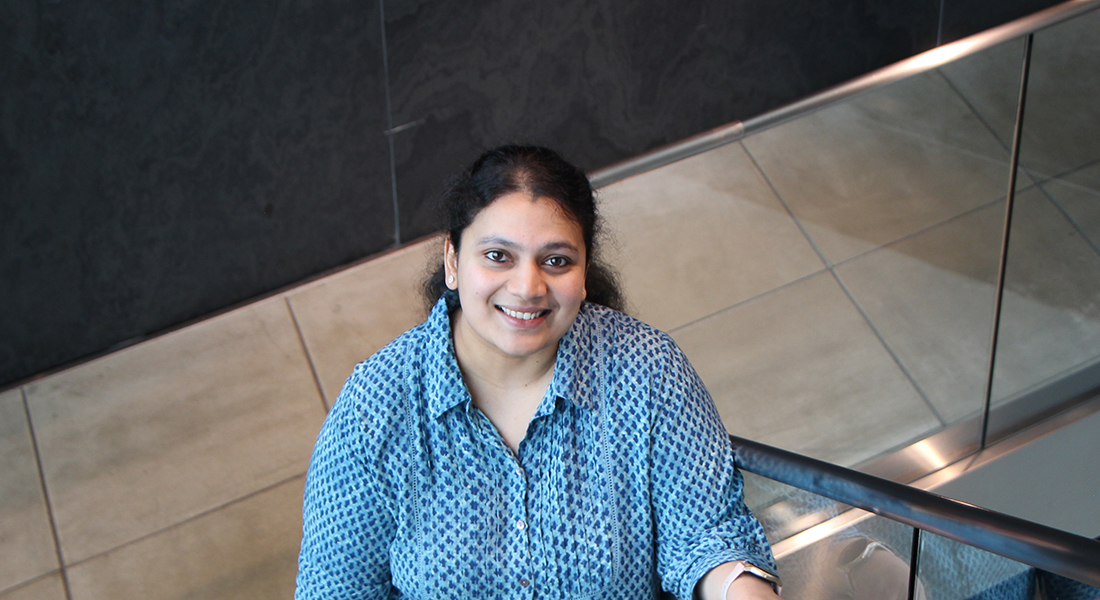

Surabhi Sreenivas, an MCB postdoctoral fellow in the lab of Maxim Prigozhin has been awarded a three-year American Diabetes Association Postdoctoral Fellowship to study how the liver regulates blood sugar through glucagon signaling.
Surabhi is investigating a critical but poorly understood aspect of type 2 diabetes: the role of glucagon in driving excessive glucose production by the liver. While diabetes is often viewed primarily as a disorder of insulin, blood glucose levels are actually controlled by an interplay between both insulin and glucagon.
“Insulin promotes glucose uptake and storage, while glucagon signals the liver to release glucose by breaking down glycogen,” Surabhi explained. “In type 2 diabetes, this glucagon-driven part of the pathway becomes overactive, causing the liver to produce glucose even though your body does not need it.”
Her research focuses on a recently identified protein that functions as a molecular traffic controller for the glucagon receptor, determining whether the receptor remains on the cell surface to receive signals or becomes internalized and recycled. “This regulation is very crucial or critical, because it directly influences how strongly your liver cells respond to glucagon, and how strongly your cells respond ultimately leads to how much glucose they release into the bloodstream,” she said.
The goal is to use this knowledge to develop molecular targets that could reset blood glucose homeostasis. “It’s like targeting the root cause rather than just managing symptoms, which is what people do when you have type two diabetes,” Surabhi noted.
Prigozhin praised his student’s achievement: “I am very happy that Surabhi was awarded the American Diabetes Association Postdoctoral Fellowship. “In the lab, Surabhi is very hard-working and determined—qualities that undoubtedly helped her in securing this prestigious fellowship. Her project–using high-resolution imaging to study a new mechanism that controls the receptor for glucagon–is highly relevant to human metabolic diseases. I wish Surabhi all the best towards success in her scientific endeavors, and I am very much looking forward to working with her during her fellowship years ahead.”
Advanced Imaging Expertise
Surabhi brings extensive expertise in advanced imaging techniques to her diabetes research. She earned her PhD from ESPCI (École Supérieure de Physique et de Chimie Industrielles) in France under a Marie Curie European Union Horizon 2020 fellowship, where she developed novel strategies for super-resolution imaging and fluorescence lifetime imaging.
During her doctoral work, she designed and built two original optical systems for multiplexing in single-molecule localization microscopy. “The idea was to exploit fundamental properties of fluorophores to be able to do multi-color imaging,” she explained. Her work combined optical design, hardware development, and custom modeling, creating a framework that improved existing super-resolution systems.
After completing her PhD in 2023 and receiving her degree in 2024, Surabhi joined the Prigozhin lab in early 2024. She was drawn to the lab’s cutting-edge techniques, particularly cathodoluminescence and cryovitrification. “The prospect of applying these cutting-edge approaches to capture precise temporal dynamics of biological pathways offered a uniquely powerful way to uncover signaling with high spatial and temporal resolution,” she said.
With Surabhi’s expertise in designing and developing advanced super-resolution and specialized FRET-based imaging systems, along with the group’s strong skills in cryo-vitrification and cathodoluminescence techniques, the team is uniquely equipped to define receptor trafficking and the spatial organization of proteins that control glucagon-driven glucose release.