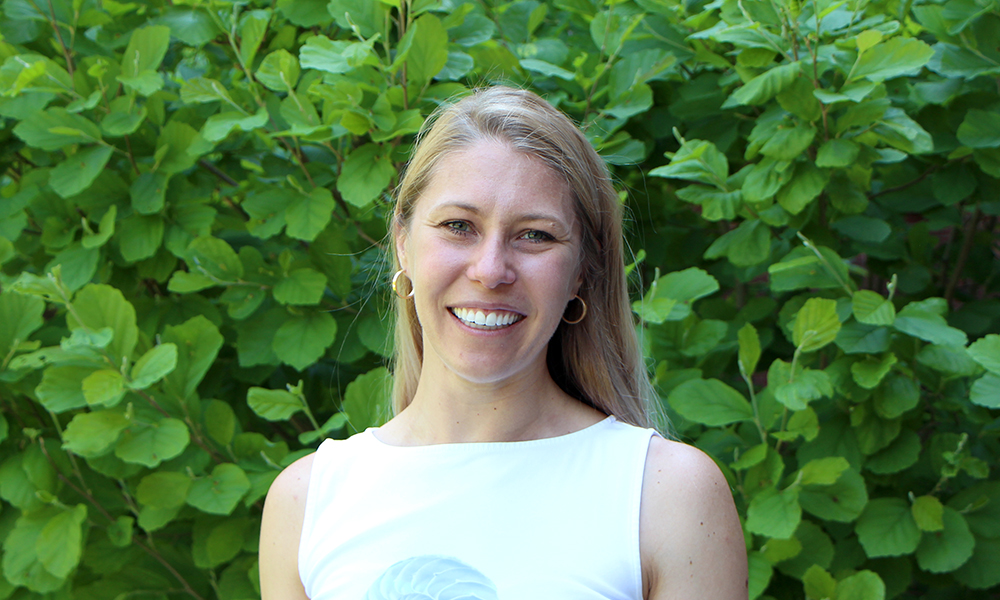

Rebecka Sepela, a postdoctoral fellow in the MCB lab of Nick Bellono, has won a 2026 Warren Alpert Distinguished Scholars Fellowship Award in Neuroscience from The Warren Alpert Foundation. The fellowship award is given annually to five postdoctoral researchers in the United States who demonstrate exceptional creativity in neuroscience, with the goal of facilitating their transition to faculty positions.
Sepela studies how microbes inform animal behavior. “The entirety of animal evolution occurred on a microbial stage, and more and more we are recognizing the profound implications microbes have on animal biology,” she said. “Yet, despite advances in characterizing animal-microbe associations, the interactions remain correlative and molecular mediators are often poorly understood.” To fill this gap in understanding, she aims to determine the molecules, receptors, and neural pathways through which microbes shape animal behavior.
Sepela is currently leveraging the octopus as a research model since it is particularly well-suited for exploring its external, microbe-coated underwater world. As described in previous research from the Bellono lab, octopuses detect and decipher their chemical world using an aquatic “taste by touch” sense mediated by chemotactile receptors (CRs) in the suction cups (suckers) along the arms. As described in her 2025 Cell paper, Sepela has previously found that octopuses use one CR to detect secreted molecules from prey- and egg-specific microbes to drive predatory and parental behaviors.
With support from The Warren Alpert Foundation, Sepela will extend these same ideas and methods to investigate a provocative idea: that the microbes living on octopus skin produce a chemical signature, helping these animals recognize members of their own species and make decisions about whom to mate with.
Octopuses rely almost entirely on their sucker-lined arms for social recognition. An octopus’s decision to stay near or retreat from another individual is made only after physical contact — a dependence that is especially striking in the context of mating. Following an investigatory touch, octopuses will either mate with the opposite sex or retreat from same-sexed animals and those of a different species. This behavior was recently demonstrated in work by Pablo Villar and colleagues, published in Science. This work sparked Sepela’s curiosity: “Both in the wild and in aquaria, we’ve noticed that octopus maintain species-specific and temperature-independent microbiomes on their skin,” she explained, “do microbes growing on octopus skin contribute to the chemical cues that inform this touch-based behavior?”
The fellowship will support two years of research during which Sepela will organize her efforts around a systematic workflow: culturing the microbes growing on octopus skin, identifying which species dominate each community, isolating the molecules those microbes produce, testing whether those molecules activate the octopus sensory system, and ultimately asking whether social behaviors can be tuned using specific microbial compounds. The work connects to a growing body of evidence that microbes influence the chemical bouquets animals use for social signaling — encoding information about age, mating status, and health. In most cases, however, the specific molecules, receptors, and pathways involved remain unknown. Sepela’s project aims to close that gap in at least one well-defined system, with broader implications for how microbes influence animal behavior, mating, speciation, and may have even shaped the evolution of the social brain.
Much of the preliminary data that makes this fellowship possible was collected by Abigail Weber, an undergraduate researcher in the lab who is graduating this year, a fact Sepela was quick to note.”I am grateful for the opportunity to test these ideas and learn more about how animals have evolved in a microbial world. I would like to express my profound appreciation to Jeff Lichtman, Jon Clardy, Nick Bellono, and The Warren Alpert Foundation for supporting my application.”