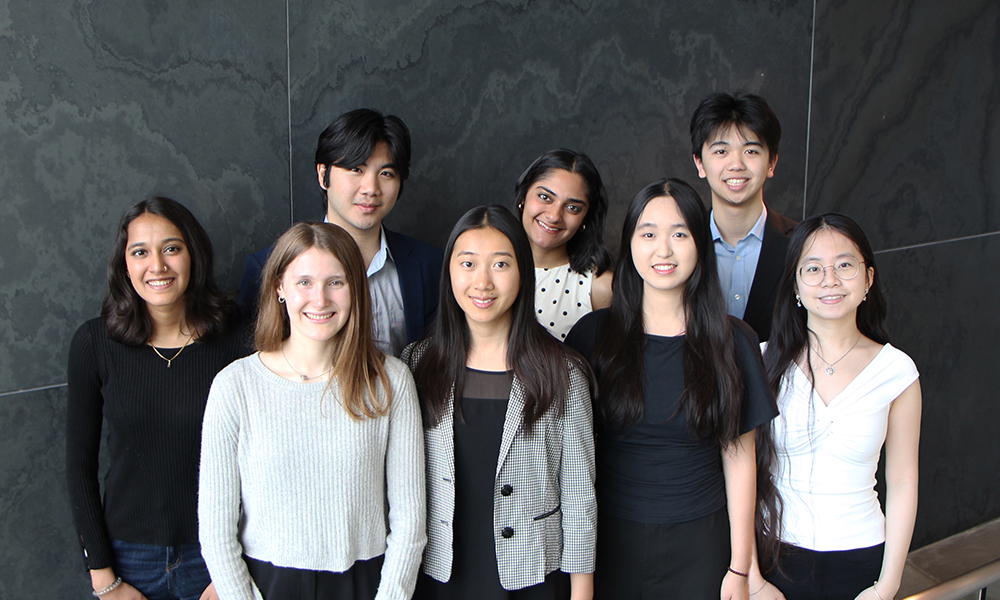

Eight graduating seniors in our MCB and Neuroscience concentrations have received the prestigious Thomas T. Hoopes Prize, Harvard College’s premier undergraduate prize recognizing outstanding scholarly work or research.
This year’s honorees include six MCB concentrators, two Neuroscience concentrators, and several students pursuing double concentrations. We are especially pleased to note that Sandhya Kumar has also been awarded the Lawrence J. Henderson Prize, a distinction recognizing exceptional undergraduate research and Mira Hu Jiang also received a Captain Jonathan Fay Prize, the annual award for the top theses of Harvard College’s graduating class.
MCB Concentrators
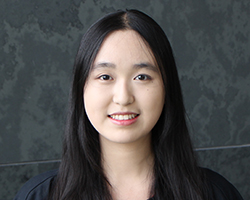
Yuchen Huang ‘26 (MCB) was recognized for her thesis, “Reductive Stress Vulnerabilities in Lung Cancer: An Investigation of the Mitochondrial Complex I Subunit NDUFB7,” supervised and nominated by Professor Liron Bar-Peled.
“In contrast to oxidative stress, reductive stress is comparatively understudied,” Huang explained. “Having the opportunity to work on projects that contribute to research that advances our understanding of cancer has been an especially rewarding and integral part of my college experience. I am deeply grateful to Professor Bar-Peled and Dr. Maolin Ge for their mentorship and for welcoming me to conduct research with them, as well as to the other members of the Bar-Peled Lab, and to my family and friends for their unwavering support.”
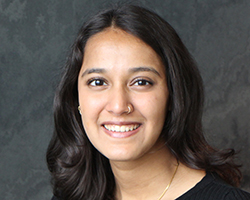
Sandhya Kumar ‘26 (MCB and Statistics) received the Hoopes and Henderson Prizes for her thesis, “Enteric Neurons Rapidly Prime Systemic Immunity in Response to Mucosal Infection,” supervised and nominated by Dr. Ruaidhri Jackson.
“In my research, I examined a novel role for the enteric nervous system, a “second brain” comprising millions of neurons that innervate the gastrointestinal tract, in regulating immunity beyond the gut,” said Kumar. Understanding this pathway may provide broader insight into how the nervous and immune systems interact throughout the body and how these interactions may contribute to inflammatory and systemic diseases.
“I want to sincerely thank the entire Jackson Lab, who have been a wonderfully collaborative group of scientists with whom I had the privilege of working,” Kumar added. “I especially want to thank my exemplary lab mentors, Dr. Ruaidhrí Jackson, Dr. Coco Duizer, and Dr. Ro Othman. I would also like to thank my friends and family for their unwavering encouragement throughout this process. Conducting this research was one of the most meaningful experiences of my college career and has reaffirmed both my passion for science and my desire to continue pursuing research. I am incredibly grateful for everyone who supported and guided me along the way!”
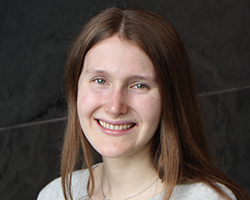
Sydney M. Levy ‘26 (MCB) was recognized for her thesis, “Revealing Macrophage-Derived Extracellular Vesicle-Mediated Signaling Mechanisms That Underlie Bioprosthetic Heart Valve Degeneration,” supervised and nominated by Professor Elena Aikawa.
“My thesis represents a culmination of years of curiosity, mentorship, and support from people who have shaped both my scientific path and personal growth,” Levy said. “I am grateful to everyone who has helped me on this journey, including my lab, Harvard College, and my family. I am honored to have been awarded the Hoopes Prize, and I look forward to continuing to make research a central part of my life as I pursue an MD-PhD.”
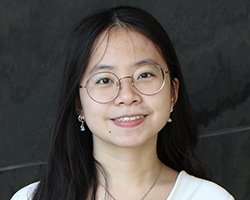
Anne Liang ‘26 (MCB) was recognized for her thesis, “Molecular and Functional Characterization of Lipid Droplets in Neuronal Development and Degeneration,” supervised and nominated by Professor Jeeyun Chung.
“My work demonstrates that in response to neuronal activity, lipid droplets form preferentially at neurites and undergo dynamic remodeling of their surface proteins, recruiting machinery involved in vesicle trafficking, energy metabolism, and calcium signaling,” Liang explained. “I further demonstrate that lipid droplet accumulation may be destabilizing synaptic structure and impairing neuronal communication, with broader implications for neurodegenerative diseases like Hereditary Spastic Paraplegia and Alzheimer’s. Lastly, I would like to thank all members of the Chung Lab, especially Dr. Chung herself and Eleni Katafygiotou for their incredible guidance and support throughout my thesis, as well as my friends and family.”
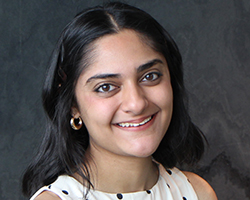
Ashini Modi ‘26 (MCB and Astrophysics) was recognized for her thesis, “Finding the Right Match Fast: Factors Influencing the Speed-Stringency-Stability Tradeoff in RecA-Mediated Homology Recognition During Double Strand Break Repair,” supervised and nominated by Professor Mara Prentiss.
“I’ve done research in the field of DNA damage repair since freshman year, but for my thesis I wanted to find a way to also weave in physics to reflect the many physics courses I’ve taken over my four years here, and Prof. Prentiss’s lab was the perfect place for this,” Modi said. “I am so grateful to the lab for giving me the opportunity to immerse myself in biophysics research and engage with such a rich learning environment over the past year and a half.”
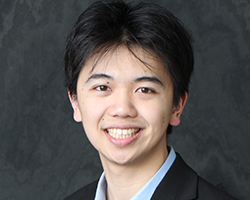
Aidan Jingwei Zhou ‘26 (MCB and Philosophy) was recognized for his thesis, “Characterizing SLC33A1 Subcellular Localization and Function and Investigating Cyclosporin A (CsA) Effect in KRAS-mutant NSCLC,” supervised and nominated by Professor Matthew Meyerson.
“I work in the Meyerson Lab at Dana-Farber Cancer Institute and was awarded for my project studying a redox-specific metabolic vulnerability in non-small cell lung cancer,” Zhou explained. His findings outlined a clear path for CsA combination therapies that could significantly improve clinical outcomes for patients with KRAS-driven lung cancers.”
“Conducting my thesis research has been a deeply rewarding process, and I’m incredibly grateful for the guidance and encouragement I’ve received from Professor Meyerson, my mentor Dr. Lior Golomb, and the rest of the Meyerson Lab, as well as the enduring support of my friends and family,” Zhou said.
Neuroscience Concentrators
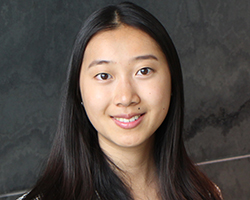
Mira Hu Jiang ‘26 (Neuroscience) project is “Disrupted Dialogues: Microbial and Hormonal Influences on Enteric Neurons in Disorders of Gut-Brain Interaction,” under the nomination of Professor Meenakshi Rao at Boston Children’s Hospital.
“My thesis was the culmination of my research on enteric neurons in the Rao Lab, where I have grown alongside incredible mentors who guided me since my first year,” Jiang said. “This Hoopes Prize speaks as much to their kindness and dedication to teaching as it does to the work itself.”
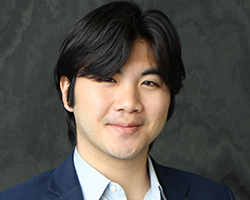
Sean Meng ‘26 (Neuroscience) project is “Rewired by Time: a Dopaminergic Account of Cognitive Flexibility Across the Mouse Lifespan,” under the supervision and nomination of Dr. Bernardo Sabatini nominator and mentor Dr. Kevin Mastro.
“I’m incredibly grateful to my mentors, Bernardo Sabatini and Kevin Mastro, for welcoming me to the lab my freshman year and continuously inspiring my curiosity,” Meng said. “They really have just been the most incredible support, and I feel extremely lucky to have learned from such excellent scientists. “
He adds, “I feel surprised, honored, and more motivated than ever after winning the Hoopes. It was a great learning experience putting this thesis together, and I grew a lot through the neuroscience department’s oral defense. I look forward to pursuing science further as I begin my PhD in Neurobiology at Caltech this coming Fall. A heartfelt thank you to the Hoopes committee for this honor and to all the mentors and instructors who have fostered my growth along the way.”
Please join us in congratulating all of this year’s Hoopes Prize recipients on this well-deserved recognition of their hard work, creativity, and scientific excellence.