
Sometimes, groundbreaking discoveries begin with what looks like a failed experiment.
Researchers in the lab of MCB Professor Nicholas Bellono have discovered that octopuses possess a unique structural adaptation in their ribosomes—the molecular machines responsible for building every protein in the body—that appears to improve the accuracy of protein synthesis and may have helped support the evolution of the animals’ famously complex nervous systems.
The study, published in Current Biology (PDF), challenges the long-held assumption that ribosomes function essentially the same way across all animals. Instead, it suggests that evolution can reshape even one of biology’s most ancient and highly conserved molecular machines, potentially giving rise to entirely new traits.
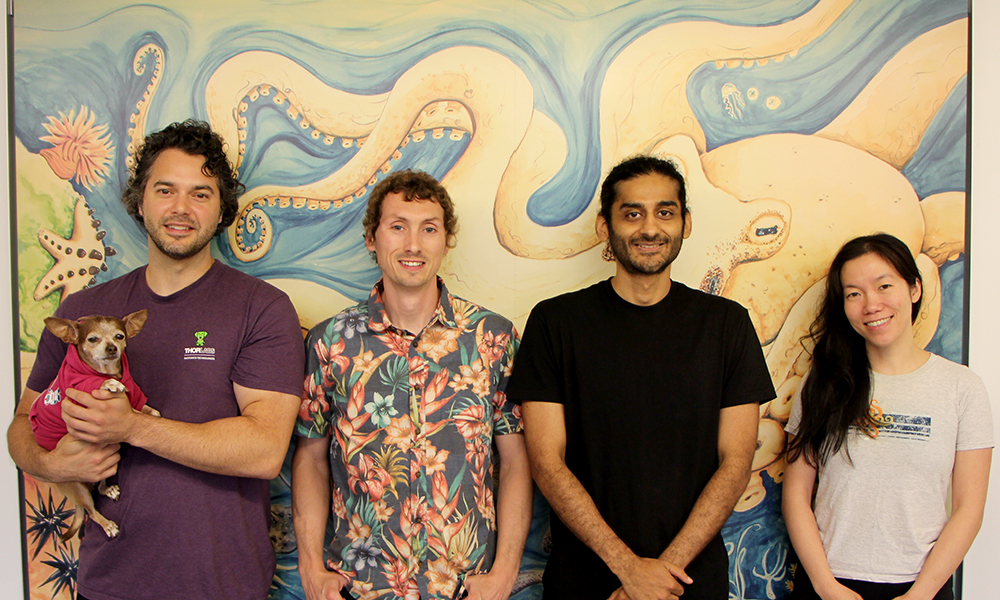
The work was led by MCB co-first authors Rishav Mitra and Trey Scott, both postdoctoral fellows in the Bellono lab, in collaboration with Amy Lee‘s laboratory at Dana-Farber Cancer Institute and Harvard Medical School. Richard Han, a former graduate student in the Lee lab, also shares first co-authorship.
The project began with an observation no one expected.
“We found that ribosomal RNA extracted from octopus consistently behaved differently on a simple gel than RNA from any other species,” Mitra said. “At first we assumed the RNA had degraded during handling, but it kept happening. That curiosity led us to investigate what was really going on.”
Bellono said the finding is a reminder that some of science’s biggest discoveries emerge from paying attention to surprises. “This was a totally unplanned project that started in an entirely different direction and changed course from a simple gel,” he said. “I think it’s a wonderful example of being open-minded and following the unexpected. Even something as simple as standard RNA quality checks can reveal something new, especially if one looks in a new place.”
Further investigation revealed that every octopus species the researchers examined shared an unusual break in one of the ribosome’s RNA molecules. Even more surprising, the break occurred within the catalytic core—the heart of the ribosome where proteins are assembled—a region that has remained remarkably unchanged throughout evolution.
Working with Lee’s laboratory, which specializes in ribosome biology, the team used cryo-electron microscopy to confirm that the break is a genuine structural feature of the octopus ribosome.
What does this unusual ribosome actually do? The answer surprised them again.
They found that octopus ribosomes produced proteins that were less likely to misfold or clump together than ribosomes from squid, other mollusks, or even humans. Protein misfolding can impair cellular function, making accurate protein synthesis especially important in long-lived, highly specialized cells such as neurons.
“The coolest part,” Mitra said, “was that we collaborated with Michael Jewett’s group at Northwestern that engineered this octopus-inspired ribosomal feature into E. coli bacteria. Those bacteria also made proteins that folded better and misfolded less.”
The experiment demonstrated that the underlying mechanism isn’t unique to octopuses. “Our findings show that not all ribosomes are the same,” Mitra said. “There are conserved principles in how ribosomes work at the molecular level that can transcend species.”
Although the work is fundamentally about how ribosomes have evolved, the discovery could eventually have broader biomedical relevance. “We think this work highlights the potential of targeting the ribosome, not just to kill bacterial infections as we have with antibiotics for nearly a century, but as a more tunable interface that could be used to improve translation fidelity and address protein-folding diseases like neurodegeneration or aging,” Lee explained.
Scott traced the evolutionary history of the adaptation by analyzing ribosomal RNA sequences from cephalopods across the octopus family tree.
Mining publicly available genomic data, he found that the structural break emerged roughly 100 million years ago in the lineage leading to modern shallow-water octopuses but was absent from squid and from all of the deep-sea cirrate octopuses examined.
To confirm that finding, the researchers analyzed tissue from a Grimpoteuthis, or Dumbo octopus, collected during a deep-sea expedition using an underwater robotic vehicle. As predicted, the Dumbo octopus lacked the distinctive ribosomal feature.
“The break is highly conserved across this lineage for about 100 million years,” Scott said. “When something is preserved for that long, it’s almost certainly important.”
The timing is particularly intriguing because the ribosomal adaptation appears to have arisen alongside the expansion of nervous systems in the lineage leading to modern shallow-water octopuses.
“One of the biggest differences between the deep-sea finned octopuses and the species that have this break is the amount of nervous tissue,” Scott said. “It’s an interesting correlation. It’s difficult to know exactly what role the ribosome played because these evolutionary changes happened so long ago, but it’s certainly something we’re interested in understanding.”
The team hopes future studies—including sequencing complete genomes from additional deep-sea finned octopuses—will help explain why this remarkable ribosomal innovation evolved and what role it may have played in the emergence of the octopus’s extraordinary biology.
 (PDF)
(PDF)