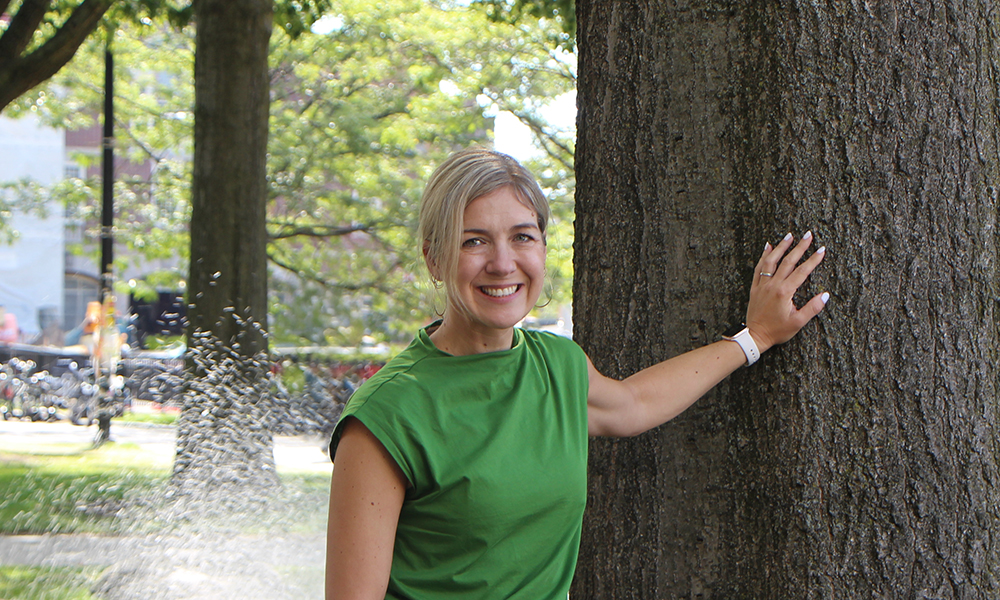

For many scientists, the path into research is straightforward: a keen interest in science as a child, a major in biology or chemistry, and years of graduate training. For Kathleen (Katie) Quast, Lecturer and Curriculum and Pedagogy Manager in MCB, the journey was anything but linear. What began in onion and cucumber fields in Wisconsin took a detour through fine arts and eventually led her to the forefront of neuroscience education at Harvard.
“I had a really nonlinear path to becoming a scientist,” Quast says with a laugh. “In high school, I always liked science. I actually worked at UW–Madison as an intern, doing genetic research on cucumbers and onions. I worked there throughout high school and into college. However, after four years of doing essentially the same thing, I thought it would become too boring. I always liked art, so I switched my major to fine art.”
That decision carried her through college, but by graduation, Quast realized she didn’t want to pursue art professionally. So she packed her bags and moved from Madison, Wisconsin to San Diego, CA looking for something new.
There, serendipity stepped in. With years of biology lab experience still on her résumé, she found a position in William Schafer’s lab at UC San Diego. The lab studied the tiny nematode C. elegans, focusing on behavior and synaptic physiology. “It just clicked,” she says. “This was the opposite of boring. It was fantastic for me, because I had genetics experience that I could bring into C. elegans. But then we had behavior, and for the first time, I could actually see neurons in action. Schafer’s lab was one of the very first doing in vivo calcium imaging, and I was hooked.”
That four-and-a-half-year experience convinced Quast that she wanted more. She took the GRE, applied to graduate schools, and found her way to Harvard. From 2008 to 2013, she trained in the lab of MCB Professor Takao Hensch, whose work on critical periods and inhibitory neurons has shaped the field of developmental neuroscience. Her graduate research became the first half of a body of work recently published with Hensch. “My paper was the first half of that research,” Quast notes.
After earning her PhD, Quast moved with her family to Texas, where she joined Benjamin Arenkiel’s lab at Baylor College of Medicine. There, she continued her work on inhibitory circuits and neural development, publishing several papers. But along the way, she also discovered her love for teaching. “At Baylor, I had gotten a teaching fellowship and was also an adjunct professor while doing my postdoc,” she explains. “That’s when I realized how much I enjoyed teaching.”
When her family returned to the Boston area, Quast first worked at MIT as a research scientist and project manager. “But I figured out that I didn’t like writing grants all that much,” she admits. “When Harvard posted a preceptor position for the introductory neuroscience course, MCB 80, I knew it was the right fit. That’s when I made the switch to teaching full-time.”
Since joining Harvard in 2017, Quast has become a central figure in undergraduate neuroscience education. She began teaching MCB 80 alongside Professors Jeff Lichtman and Venkatesh Murthy..
“Katie has been an amazing teacher and advisor to neuroscience students over the years,” says Murthy. “She has organized and taught the required introductory course for the largest life sciences concentration, a course that is routinely populated by over 200 students. It is as important as it sounds – and Katie has done it impressively over the years.”
When Murthy assumed the role of Director of the Center for Brain Science in 2020 and Lichtman became Dean of Science in 2024, Quast assumed leadership of the course. This fall, she is joined by MCB Professor Naoshige Uchida in guiding more than 250 students.
Her colleagues emphasize not only Quast’s teaching excellence but also her adaptability and leadership. “Katie is truly a treasure for our department and for undergraduate education at Harvard,” says Polina Kehayova, MCB Scientific. “She does it all and is always ready to rise to any challenge—from handling almost twice as many students as expected in MCB 80 a few years ago to jumping in as the main course instructor last fall when Jeff Lichtman became Dean of Science. On top of all that, Katie always looks for ways to contribute to the department as a whole, and she’s been a valued member of both the MCB Community Task Force and the Curriculum Committee.”
MCB Professor and Chair Rachelle Gaudet agrees. “Katie has been an indispensable member of the MCB 80 teaching team for years. She knows exactly what will help students thrive and is a strong advocate for both students and teaching staff,” she says. “Katie brings exceptional initiative, and I’m excited to see her two newest contributions to the curriculum take shape—one giving first-year undergraduates a taste of research and another equipping first-year graduate students with pedagogy skills to prepare them for teaching.”
In addition to teaching MCB 80, Quast has co-taught an undergraduate electrophysiology lab with Ryan Draft and is now preparing to lead a freshman seminar in Spring 2026 with Murthy. She is also set to take on a graduate-level pedagogy course with colleague Sien Verschave, continuing Harvard’s tradition of training the next generation of teacher-scholars. “I’m entirely teaching-focused now,” she says. “That’s where I put my energy.”
Even with her teaching load, Quast hasn’t lost her love of neuroscience research. “I still really enjoy electrophysiology,” she says. “It would always be wonderful to have some connection to it, but at the moment, my cup is quite full.”
Outside the classroom, Quast is a dedicated long-distance runner. “I picked it up shortly before I turned 40,” she says. “Running has become an important part of my life.” She has completed two marathons and is training for her third this January. Somewhat unexpectedly, she runs them at Disney World. “It feels weird, but it’s a very fun time. You literally run from park to park,” she says. “My brother got me into it. He stopped at the half-marathon, but my son teased me, saying, ‘Half-marathon isn’t a real marathon.’ So I went ahead and did the full.”
Between her teaching, running, and raising two children, Quast has little spare time, but she is excited about new opportunities to enrich the Harvard undergraduate experience. She is working with colleagues to expand first-year research opportunities, possibly through poster sessions where students can present their work. “We’re hoping to give undergrads more ways to showcase their research,” she says. “It’s a chance to build community and highlight their creativity.”
Looking back at her winding path—from art major to neuroscientist, from cucumbers to calcium imaging—Quast embraces the twists and turns. “I think it’s important for students to know that the path doesn’t have to be straight,” she reflects. “Sometimes the detours end up being the most valuable parts of the journey.”