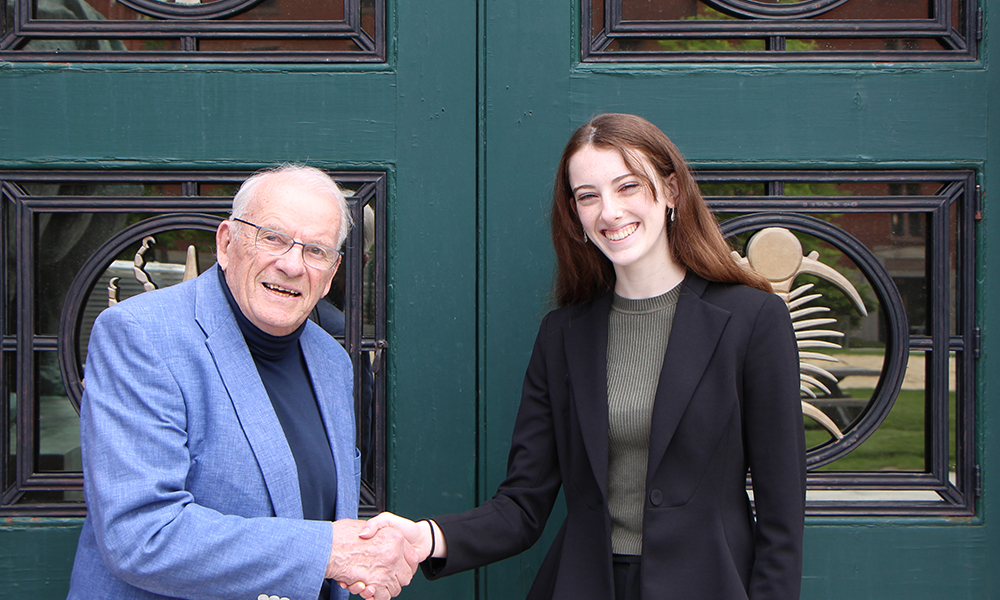

The Harvard Department of Molecular and Cellular Biology (MCB) is thrilled to announce that senior neuroscience concentrator Kathryn (Katy) Nairn has been awarded the prestigious John Dowling Prize. The annual award recognizes an outstanding undergraduate senior thesis in the field of neuroscience in honor of MCB’s John E. Dowling, Gordon and Llura Gund Professor of Neurosciences, Emeritus.
Nairn’s ambitious project investigates whether specific, rationally selected molecular manipulation might enable the regeneration of critical neuronal axons following spinal cord injury. Working in the laboratory of Jeffrey Macklis, her thesis reports an extremely creative and rigorous experimental and molecular design to effect targeted manipulations in corticospinal neurons, revealing modest yet robust regenerative effects after injury.
A “Magnificent” and Graduate-Level Contribution
The thesis made an immediate impression on the award committee and the prize’s namesake, Professor Emeritus John Dowling.
“Katy’s thesis is magnificent!” said Dowling. “I felt like I was reading a thesis from a PhD candidate, and not from an undergraduate. About 100 pages long, it was beautifully written—detailed, clear, and compelling. It addresses an important topic and points the way impressively as to the next steps to be undertaken.”
Her advisors and faculty reviewers echoed this high praise, noting that Nairn operated with an uncommon degree of maturity and precision during her oral defense.
“Both of Kathryn’s faculty reviewers commented that speaking with her about the work during her oral defense felt like speaking to a talented, late-stage graduate student,” notes Kristina Penikis, Concentration Advisor and Lecturer in Neuroscience.
Rejuvenating Cells to Regrow Axons
Nairn’s research explores a major challenge in neurobiology: the central nervous system typically fails to regenerate after injury. Her project focused on testing a potential model where reactivating embryonic developmental mechanisms might promote regeneration.
By overexpressing three embryonic developmental genes—Oct4, Sox2, and Klf4 (known as the “Yamanaka factors,” which earned Shinya Yamanaka the Nobel Prize in 2012)—Nairn sought to achieve partial cellular reprogramming. Rather than turning the cells into stem cells, the goal was to safely “rejuvenate” the neurons’ cellular age so they would enter a more youthful, developmental state and become capable of growing again.
Nairn designed and tested a strategy to overexpress these three factors in neurons in the mouse brain that connect the cerebral cortex to the spinal cord. After performing experimental spinal cord injuries in mice, she closely studied the modified cells during recovery. Six weeks post-injury, she found that the experimentally modified cells were growing back closer to the original injury site, approximating their original connections.
A Passion for Basic Research
Nairn, who is originally from Chicago, arrived at Harvard with a strong interest in neuroscience but no prior lab experience. She joined the Macklis lab in January 2023 and spent over three years developing the project.
“I fell in love with wet lab, basic research, and I’m really still passionate and interested in spinal cord injury research,” Nairn said. “I took on almost every aspect of the experiments myself, with guidance and input, of course, but it was incredibly exciting because it’s a really important first step in validating this model as a new way of studying spinal cord injury.”
Her advisor, Professor Jeffrey Macklis, emphasized how seamlessly Nairn integrated into the lab ecosystem while taking full ownership of her work.
“Katy is both a superb student and a dream student,” said Macklis. “She pursues complex research at the level of creativity and independence of a top-level, mid-stage Ph.D. student, while she approaches every question and every obstacle as a learning opportunity to be approached positively, collegially, and with enthusiasm. It has been great having her in our lab over the past three+ years! Katy took on almost every aspect of the experiments herself, with guidance and input, of course, but in a remarkably self-directed, internally motivated, and maturely dedicated manner. Her thesis itself is beautifully written, scholarly, and deeply thoughtful.”
Deepening a Scientific Legacy
For Macklis, seeing Nairn win this particular prize carries a profound personal and historical significance.
“Katy being awarded the John Dowling Prize is especially meaningful to me—and now to Katy after I explained John’s scientific and educational legacy—because John was an early mentor to me regarding undergraduate research education and thesis advising when I started my lab, then at Children’s Hospital,” Macklis explained.
Nairn was completely surprised when her name was announced during the department’s celebratory Neuro Thesis Night, an event where seniors share creative, lighthearted presentations of their research.
“Hearing my name called at the neuro thesis night was just incredible,” Nairn recalled. “It’s such an honor. I was so surprised. It’s truly such an honor to be given this award. I’m incredibly proud, and it’s really an honor that Professor Dowling has even read my work. Honestly, that’s a reward in itself.”
Nairn is quick to credit her success to the rich network of support she found at Harvard, particularly her immediate mentor, MD-PhD student Mariale Vicent Allende. “She’s just been fantastic and so supportive,” Nairn says. “I couldn’t have done it without all of them.”
Looking Ahead
Nairn’s findings lay the groundwork for future research to identify the specific RNA and protein changes occurring in the “growth cones” (the growing tips of axons) during this OSK-induced growth response, bringing science closer to regeneration-based therapeutics for human spinal cord injuries.
While her time at Harvard is drawing to a close, Nairn’s scientific journey is just getting started. Following graduation, she will return to her hometown to join the University of Chicago Post-Bac Scholars Research Program in Cell, Developmental and Molecular Biology (CDMB), working as a technologist in the Noah Mitchell lab.
“I’m taking two years to build up more skills, expose myself to new things, and then my plan is to apply for MD-PhD programs to matriculate in 2028,” Nairn says. “I eventually would love to do my PhD in a neuroscience-related field. I am still very interested in the field of neuro regeneration—that’s something I would love to come back to.”
The MCB community congratulates Katy on this remarkable achievement and wishes her the absolute best in her future research endeavors!
The John E. Dowling Thesis Prize was established in 2012