

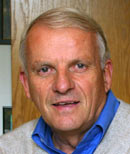
A mesmerizing professor, a chance conversation, fishing in a Cape Cod pond, and a series of questions that refused to go away. These have all shaped the six-decade career of MCB’s John Dowling, Gordon and Llura Gund Research Professor of Neurosciences, Emeritus.
Dowling’s remarkable career in neuroscience was shaped as much by curiosity and unexpected opportunities as by careful planning. Over more than six decades, he transformed understanding of the retina and visual system, helped establish neuroscience as a major discipline at Harvard College, trained over 150 scientists, and inspired generations of students through his teaching.
Along the way, he made foundational discoveries about vitamin A and vision, retinal circuitry, neuromodulation, and retinal disease while helping launch influential neuroscience and zebrafish training programs that continue today.
“There was a lot of luck,” Dowling said of his scientific journey. “But it was also curiosity.” That curiosity carried him from Nobel Prize winner George Wald‘s laboratory to some of the most important questions in visual neuroscience.
Captivated by Discovery
Dowling’s path began as a Harvard undergraduate and continued to earning his PhD at the university and teaching in the Biology Department, first as an instructor and then as an assistant professor.
As an undergraduate, he had little research experience and no clear plan to become a scientist. That changed when he enrolled in an undergraduate biochemistry course taught by Wald. “He was a fantastic lecturer,” Dowling recalled.
Wald transformed subjects that many students considered dry and technical into stories about their discoveries. One lecture in particular left a lasting impression. Wald described the work of Nobel laureate Albert Szent-Györgyi, whose studies at the Marine Biological Laboratory in Woods Hole revealed the fundamental role of ATP in muscle contraction. Szent-Györgyi showed that after a piece of muscle from a frog or rabbit was soaked in glycerol, which removed small molecules, adding ATP caused it to contract.
“That seemed to me phenomenal,” Dowling said. “Really getting at the essence of life.” Inspired, he approached Wald and asked to work in his laboratory. During the summer between his junior and senior years, he began studying the effects of vitamin A deficiency on rat vision, a project that launched a lifelong fascination with the retina.
Working primarily with Wald’s longtime laboratory assistant Paul Brown, Dowling learned how to dissect retinas, extract visual pigments, and measure the effects of vitamin A depletion. “I really enjoyed working with my hands,” he said. That instinct stretched back to childhood. In a small room in his family’s basement, he built model airplanes and boats, assembled electric trains, practiced the violin, and spent hours tinkering and experimenting.“Those years of spending time in that little room in the basement of our house and doing what I wanted to do were a precursor to discovering laboratory research,” he said.
One Question Leads to Another
Wald had proposed that Dowling map out the consequences of vitamin A deficiency on the rat visual system, and that is what he did mainly as an undergraduate. Because vitamin A is stored in the liver, deficiency develops gradually as those stores are depleted, followed by a loss of the visual pigment rhodopsin and then the visual protein opsin, which causes the photoreceptors to degenerate.
Rather than focusing solely on the biochemistry of vitamin A deficiency, Dowling wanted to know what it was doing to vision itself. An interaction with then-graduate student Donald Kennedy, who eventually became president of Stanford University, provided the answer. Kennedy was studying the electroretinogram, an electrical signal generated by the retina in response to light.
“I said to Don one day, “‘Wouldn’t it be interesting to see what is happening to the vision of the animals I have on a deficient diet?’” They tried the experiment, it worked, and Dowling soon began recording retinal responses himself. Those studies led to one of his earliest discoveries, revealing an unexpected log-linear relationship between visual pigment levels and light sensitivity of the retina.
Further investigations, mainly as a graduate student, showed that vitamin A acid was the active metabolite of vitamin A, and could reverse all the effects of vitamin A deficiency except for vision, which requires vitamin A aldehyde. Thus, he could isolate the deficiency to the retina.
But each answer generated new questions. “How are cones different from rods?” he wondered. That question led to a collaboration with neuroanatomist Brian Boycott, who was a visitor to the Biology Department for a semester, and eventually to joint pioneering studies of retinal circuitry. Examining and identifying retinal synapses by electron microscopy, Dowling recognized that cells thought to be support glial cells were actually neurons, making synapses and participating in information processing. “I said, these can’t be glial cells. If they’re getting synaptic input from the photoreceptors, they must be neurons,” he recalled. The discovery launched decades of work investigating how retinal circuits process visual information.
Building Neurobiology at Harvard
After joining the faculty at Johns Hopkins University in 1964, Dowling built a research program that combined biochemistry, anatomy, and electrophysiology. His work gained increasing recognition, and in 1970, Harvard invited him back as a full professor. The opportunity offered something he had missed while teaching primarily medical students at Hopkins – undergraduates. “I was very interested in teaching undergraduates again,” he said.
At the time, neurobiology barely existed as an organized discipline within Harvard’s Faculty of Arts and Sciences. Dowling helped build the field from the ground up, developing courses that introduced generations of students to neuroscience. He started an introductory Behavioral Neurobiology course for freshmen and sophomores that still exists today. His enthusiasm for teaching stemmed in part from his dissatisfaction with the introductory biology courses he encountered as a freshman.
Over the years, hundreds of students passed through his classrooms. Among his favorite experiences was teaching a Freshman Seminar that challenged students to think critically about topics ranging from addiction to consciousness. “I think that was the most fun teaching that I ever did,” he said.
Teaching was only one part of Dowling’s influence on young scientists. By his estimate, well over 150 undergraduates, graduate students, postdoctoral fellows, and visiting scientists trained in his laboratory. “What I’ve always enjoyed about all the people who’ve been in the laboratory is that I think virtually all left as friends,” he said. Many went on to become leaders in neuroscience, ophthalmology, and related fields, creating a scientific lineage that now spans multiple generations.
Woods Hole and the Rise of Zebrafish
Another defining chapter of Dowling’s career unfolded at the Marine Biological Laboratory in Woods Hole. In 1970, he co-founded the MBL Neurobiology Course, which would become one of the world’s premier training programs in neuroscience. Decades later, he co-founded the MBL Zebrafish Development and Genetics Course with Nancy Hopkins, which he still teaches for one day each summer. He also became involved in MBL administration, serving as a Trustee and then as President of the MBL Corporation for 10 years.
Also while doing research at the MBL, his interest in zebrafish emerged through another unlikely chain of events. While studying fish retinas that he obtained from the pond behind his house in Woods Hole, Dowling became convinced that biology needed genetically defined model organisms. The realization was reinforced through work on white perch—the fish behind his Cape Cod home. Soon afterward, he began building one of Harvard’s first zebrafish research programs.“That’s the way we need to go in biology,” he recalled. “Rather than working on animals from the wild, we need to work on animals whose genetics, age and background are known.”
Continuing a Tradition of Undergraduate Research
Although Dowling no longer teaches regularly, he remains closely connected to undergraduate education through the annual John E. Dowling Thesis Prize, initiated in 2011 by the Neuroscience Concentration, which recognizes outstanding senior thesis research in neuroscience. Awarded each year to a graduating neuroscience concentrator, the prize honors the kind of curiosity-driven scholarship that has defined Dowling’s own career. Recent recipients have gone on to careers in neuroscience, medicine, and biomedical research, carrying forward the tradition of rigorous undergraduate inquiry that Dowling helped establish at Harvard.
For Dowling, the award represents another opportunity to encourage young scientists at a pivotal moment in their careers. “The intention is to encourage clearly talented students to continue to do research as a career,” he said. That same commitment to nurturing future scientists continues through the thesis prize and the many students whose work it recognizes.
Administration at Harvard
Over the years, Dowling served in several administrative positions at Harvard – first as Department Chairman followed by election to the Faculty Council; he then spent 4 years as the first Associate Dean for Science. Later, when the Neuroscience concentration was established, he served as its Head Tutor for several years, and also as Chair of the Mind, Brain and Behavior Interdisciplinary Program.
His favorite administrative role at Harvard was as Co-Master with his wife, Judith, of Leverett House for 17 years, where he interacted closely with students and staff, resident and non-resident tutors, and faculty associated with the House. “Many of those we first met in the House remain good friends to this day,” he recalls
Still Asking Questions
In later years, Dowling’s research increasingly focused on neuromodulation and the roles of dopamine and other signaling molecules in retinal function. Even after closing his laboratory, he continued collaborating with former trainees and colleagues, including with Jeff Lichtman’s laboratory, on studies of Macular Telangiectasia, a rare retinal disease that revealed clues about mitochondrial dysfunction and retinal degeneration.
Today, Dowling remains engaged with the field through writing. Recent projects include reviews on vitamin A and retinal neuromodulation, as well as a paper, just published, examining some of the field’s most important unanswered questions.“The hope is that the next generation of vision researchers will read this and consider trying to deal with some of these problems,” he said.
For a scientist whose career began with a simple question about vitamin A and vision, it is a fitting goal. For more than six decades, Dowling has followed curiosity wherever it led—and, in doing so, has helped generations of scientists see the visual system and science itself in new ways.
07.20.2026_approvedby John Dowling