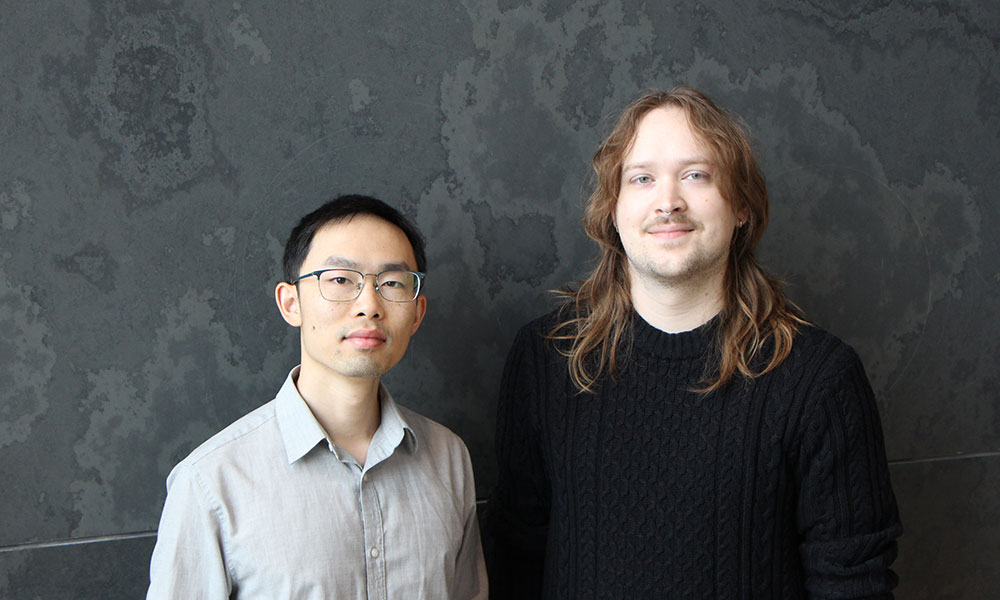

Two MCB postdoctoral researchers, Matthew Capek and Ruoyu (Roy) Chen, have been awarded prestigious fellowships from the Jane Coffin Childs Fund for Medical Research, one of the nation’s leading programs supporting outstanding early-career scientists pursuing innovative biomedical research.
The highly competitive fellowships provide three years of support for exceptional postdoctoral researchers whose work has the potential to advance fundamental understanding of biology and human health.
Although their research spans very different areas of biology, both scientists are pursuing ambitious questions that seek to uncover the mechanisms underlying complex biological systems.
Exploring the Neural Basis of Social Connection

Chen, who joined the laboratory of Catherine Dulac in July 2025, studies the neural mechanisms that regulate social behavior in mice.
His work focuses on a phenomenon known as social homeostasis—the idea that social interaction may be regulated in ways similar to hunger or sleep. Previous research from the Dulac lab found that mice housed alone for a period of time subsequently seek out increased social interaction when reunited with their former cage mates.
“When the mouse is singly housed, it will try to interact much more than it used to with its former cage mates,” Chen explained. “It feels like they are trying to catch up on their amount of social interaction.”
Through his Jane Coffin Childs Fellowship, Chen will continue investigating the neural circuits that drive this behavior. His research centers on a population of neurons in the hypothalamus that may help animals monitor and maintain appropriate levels of social engagement.
“What I’m doing now is to dig more into this group of neurons, trying to visualize their activity when the mice are being singly housed and also when they reunite with their friends,” Chen said. “Basically, we’re trying to understand the neural basis of this social homeostasis.”
Chen earned his PhD from New York University Grossman School of Medicine, where he studied germ cell development in fruit flies in the laboratory of Ruth Lehmann. His transition to neuroscience reflects a longstanding interest in understanding the brain and behavior. He was drawn to the Dulac lab after learning about its work on social behavior and the opportunity to investigate fundamental questions about how the brain regulates social needs.
Investigating Evolution Through Ancient Lineages

Capek, who joined the laboratory of Nicholas Bellono in October 2025, studies how organisms communicate with one another and how those interactions have shaped evolution.
His fellowship research focuses on springtails, small hexapods that diverged from insects approximately 400 million years ago, and mosses, which were among the first animals and plants to transition from aquatic to terrestrial ecosystems. Importantly, these first terrestrial organisms closely interacted through springtails facilitating moss fertilization and the resulting spread of life on land.
“I’m fascinated by interspecies interactions,” Capek said. Because springtails and mosses occupy a key position in evolutionary history, they offer a unique opportunity to investigate how sensory systems and communication mechanisms evolve.
“These lineages emerged right at the shift from aquatic life to terrestrial life,” Capek said. “Both are diverse and understudied, so there are a lot of new and interesting questions to ask, and particularly towards understanding that crucial transition in evolutionary history.”
Capek earned his PhD from Northwestern University, where he studied the evolution of behavior and neural circuits in fruit flies. His research showed how species adapted to different climates evolved distinct temperature preferences through changes in sensory receptors and neural circuitry.
The Bellono lab’s focus on sensory systems made it a natural fit for Capek’s interests. “That’s what drew me a lot to this laboratory,” he said. “With sensory systems and sensory receptors, we are able to explore detailed questions about how organisms interact with their surroundings, and also give us a molecular window back in time.”
Through the Jane Coffin Childs Fellowship, Capek will continue exploring how different species detect and communicate with one another at the molecular level and how these interactions led to the evolution of complex life.
“The general crux of my research is understanding how species communicate with each other at the molecular level,” Capek said. “How they sense each other, what signals they use, and ultimately how these processes helped drive the diversification of life on Earth.”