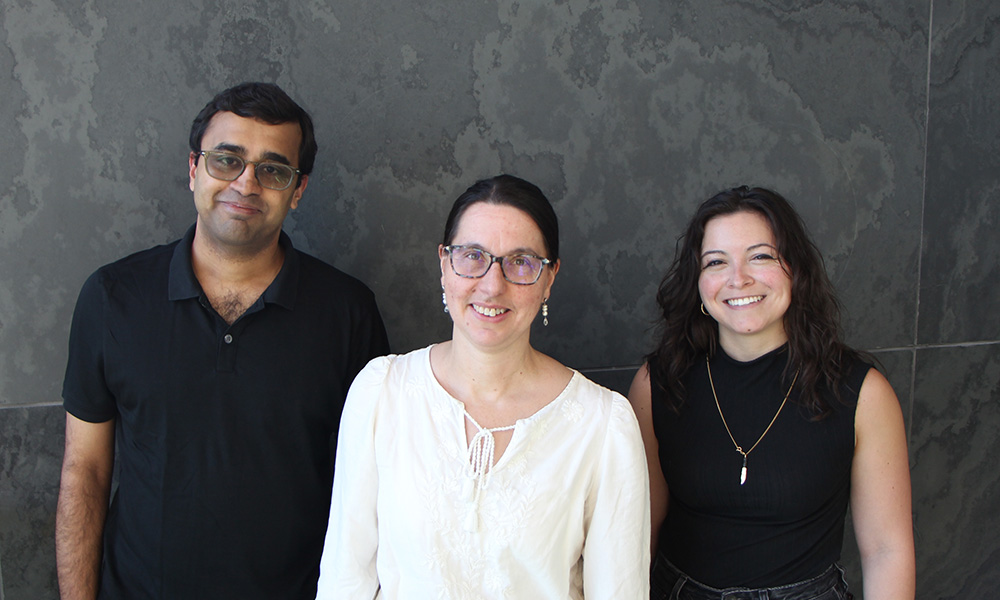

The Department of Molecular and Cellular Biology has named its 2026 Mentorship Award recipients, recognizing a group of scientists whose approaches to guidance, collaboration, and community-building span career stages—from postdoctoral fellows to department leadership. This year’s honorees—Siddharth Jayakumar, Gabrielle (Gaby) Paniccia, and Rachelle Gaudet—reflect a shared philosophy: that mentorship is less about hierarchy and more about creating environments where people can learn, contribute, and grow with confidence.
The awards were presented at MCB’s Community Forum on April 17, where faculty, students, postdocs, and staff gathered to celebrate the contributions of mentors across the department.
For Siddharth, a research associate in the lab of Venkatesh Murthy, the recognition came as a surprise. “I am a shocked soul, very honestly,” he said, downplaying his role even as colleagues consistently pointed to his influence across the lab.
Siddharth studies olfactory-guided navigation—how mice follow odor trails using a custom-built “paper-based treadmill” that allows researchers to precisely control scent patterns and study behavior in near-total darkness. But while his research sits at the intersection of systems neuroscience and engineering, his mentoring style is grounded in something simpler: accessibility. “I treat this as a process where… the goal is to fundamentally help people when you can, but also teach them how to think,” he said.
Colleagues describe him as someone who is consistently available—whether troubleshooting experimental setups, advising on surgical techniques, or helping interpret complex datasets. In a lab known for its interdisciplinary makeup, Siddharth works across boundaries, supporting undergraduates, graduate students, and fellow postdocs alike.
That openness has made him a central figure in the lab’s collaborative culture. While he resists singling out specific contributions, he points to one example: mentoring an undergraduate from their freshman year through a senior thesis, guiding them from inexperience to independence. Even then, he frames it modestly—“I can claim to have… molded [him] on some plane”—before returning to his broader belief that mentorship is a collective responsibility. “I honestly believe that… if we go together, we will go far,” he said.
A similarly community-driven ethos shapes the work of Paniccia, a postdoctoral fellow in the Carolyn Elya lab, where she leads efforts in molecular biology and microbiology within a highly interdisciplinary team. “I really like working with other people, and I do genuinely care about making sure that the people that work with me have a good time of it,” she said.
Paniccia’s mentorship philosophy was shaped in part by her own experiences in high-pressure research environments. Having seen how an intense focus on output can undermine learning, she emphasizes instead the importance of growth—especially in fields where failure is common.
“There’s always… a reason why something isn’t working that is beyond your control,” she said. “Learning to really separate output from productivity from growth… was very important.”
That perspective is especially relevant in her current work, which involves developing genetic tools for a little-studied fungal system. With few precedents to guide experiments, trial and error is unavoidable—and, in Paniccia’s view, essential.
Her mentorship extends across undergraduates and rotating graduate students, many of whom work closely with her on technically challenging projects. She encourages them to embrace uncertainty, creating a lab culture where questions—and mistakes—are part of the process.
Outside the lab, Paniccia draws inspiration from an unexpected source: capoeira, an Afro-Brazilian martial art that emphasizes community and iterative learning. The parallels to science are clear. “You just start out… it seems very daunting,” she said. “And so I’ve kind of used a lot of the same lessons… making spaces where it feels okay to learn.”
While Jayakumar and Paniccia exemplify mentorship at the bench level, Gaudet—chair of MCB—has been recognized for her sustained impact on junior faculty across the department. Notably, her nomination drew support from an unusually broad coalition, including all junior tenure-track faculty as well as undergraduates, graduate students, and postdoctoral fellows, underscoring the reach of her influence.
In their nomination, junior faculty described Gaudet’s mentorship as both “exceptional and sustained,” highlighting her central role in helping them navigate the complexities of academic life—from building independent research programs to managing teaching responsibilities and engaging in departmental leadership.
A hallmark of her approach is accessibility. Faculty pointed to her regular meetings—often around a “whiteboard-topped table… decorated with brainstorming evidence like pro/con lists, timelines, flowcharts, and course outlines”—as spaces where ideas take shape and challenges are worked through collaboratively.
Her monthly lunches with junior faculty have become a cornerstone of the department’s mentoring culture. These informal gatherings provide a trusted forum to discuss topics ranging from mentoring students and postdocs to interpreting faculty activity reports and understanding shifts in federal research funding.
Equally important is Gaudet’s emphasis on inclusion. During the federal funding crisis of 2025, she actively sought input from junior faculty, reinforcing the idea that “seniority alone should not determine who has a voice.” That encouragement, nominators noted, has had a lasting impact—transforming situations that once felt intimidating into opportunities for meaningful participation. Crucially, that guidance does not end when meetings conclude; Gaudet is known for following up with targeted advice, helping faculty refine their trajectories over time.
“I was surprised and humbled to receive an MCB mentorship award,” said Gaudet. “Mentoring is the most rewarding part of my work, both as chair and as a faculty member. I became chair because I believe in our junior faculty cohort and want to invest time supporting them, and I’m heartened that they appreciate our interactions. And similarly with my research group and student mentorship activities, I’m proud of the small parts I’ve played in supporting my mentees’ many successes, and of how they collaboratively create a supportive environment in which to develop as scientists as they do impactful science.”
Additional Announcements
At the Community Forum, Camila Ossa’s son, Samuel Calegar, was also recognized as the winner of the Golden Ticket to the MCB BioCamp for Middle Schoolers, which he will attend this summer. In addition, Dominic Mao received a 2026 Harvard Hero award.
Looking ahead, the department also announced a leadership transition: beginning July 1, Naoshige Uchida, Jeff C Tarr Professor of Molecular and Cellular Biology, will serve as MCB’s next Chair, succeeding Rachelle Gaudet following her impactful tenure.