John M. Nicoludis (l) and Rachelle Gaudet As the brain develops, neurons play a complicated game of Twister: they have to keep their neuronal processes from getting tangled…
100 years biochemical sciences tutorial


John M. Nicoludis (l) and Rachelle Gaudet As the brain develops, neurons play a complicated game of Twister: they have to keep their neuronal processes from getting tangled…
The holy grail for neuroscientists is to understand how the symphony of activity in our 100 billion neurons acts to control our thoughts and actions. The NIH BRAIN…


Imagine you are a child hoping to get a teddy bear from your parents as a birthday gift. What if they gave you a box of candies instead?…
(l to r) Nao Uchida, Sachie K Ogawa, William Menegas, Mitsuko Watabe-Uchida and Yoh Isogai Dopamine, originally referred to as a pleasure molecule, is now one of the…

Nao Uchida (l) and Neir Eshel Say you’re at a supermarket, staring at two cartons of ice cream: chocolate and caramel. Before making your choice, you try to…
The retina is not only a light sensor but also a sophisticated image processor. Photoreceptors (rods and cones) generate electrical signals when illuminated, much like pixels in a…
Joshua Sanes (l) and Dimitar Kostadinov The dendritic processes of neurons form elaborate branched arbors that are stereotyped among neurons of a specific type but differ markedly among…
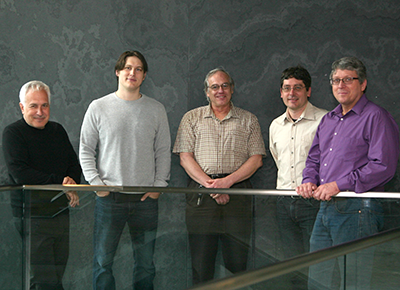
(l to r) Jeff Lichtman, Josh Morgan, Jose Conchello, Daniel Berger, and Richard Schalek This paper describes a suite of automated technologies designed to probe the structure of…
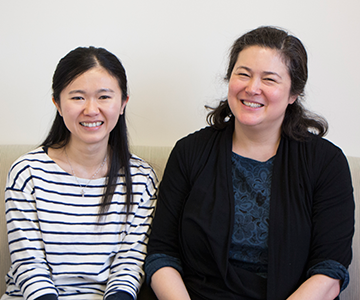
Hui-Ting Hsu (l) and Susan Mango Talk to any teenager and they will tell you the many ways they want to be independent from their parents. However, the…
Jeff Lichtman (l) and Doug Richardson The Harvard Center for Biological Imaging (HCBI) recently celebrated its five year anniversary. A central pillar in its mandate is to ensure…
