We have suggested that chromosomes should be viewed as macroscopic mechanical objects whose functions are governed by accumulation, release and redistribution of mechanical stress. We have proposed specifically…

100 years biochemical sciences tutorial


We have suggested that chromosomes should be viewed as macroscopic mechanical objects whose functions are governed by accumulation, release and redistribution of mechanical stress. We have proposed specifically…
(l to r) Shunxin Wang, Nancy Kleckner, Liangran Zhang, and Shen Yin Gamete formation for sexual reproduction involves the specialized cellular program of meiosis. As part of this…

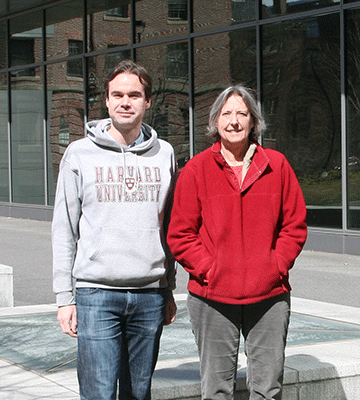
Chromosomal regions of identical or nearly identical DNA sequence can preferentially associate with one another in the apparent absence of DNA breakage and recombination. The genome-wide synapsis of…
(l to r) Guillaume Witz, Mara Prentiss, Nancy Kleckner, Beth Weiner, and Jay K. Fisher The E. coli chromosome is a single circular unit which, if stretched out,…


Meeting Time: M., W., 12:00 pm – 1:30 pmLocation: Northwest Building 169 (Harvard Square-distal end of first floor hallway)Prerequisites: Suitable for students in either the physical or biological…
Meiosis is a modified cellular program by which a single diploid cell gives rise to haploid gametes (e.g. sperm and egg). To this end, DNA replication is followed…
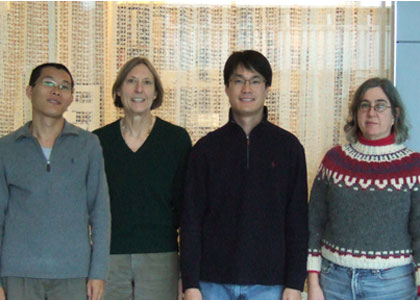

(L to R) Beth Weiner, Nancy Kleckner, Alison Grinthal, and Martin Karplus There is widespread current interest in the roles of mechanical forces for basic cellular process. Many…
The co-authors (left to right): M. Prentiss, R. Koszul, K.P. Kim, S. Kameoka, and N. Kleckner Movement plays important fundamental roles in basic chromosomal processes. Motion is most…


Several students associated with MCB faculty have been awarded 2007 Thomas T. Hoopes Prizes. The annual Prizes are awarded to undergraduates for exceptional scholarly efforts, usually senior theses.…
Figure 1: E. coli cell just prior to cell division with classic terminus-in / origin-out configuration. Origin (blue) and terminus (red) loci were visualized by FISH, and the…
